

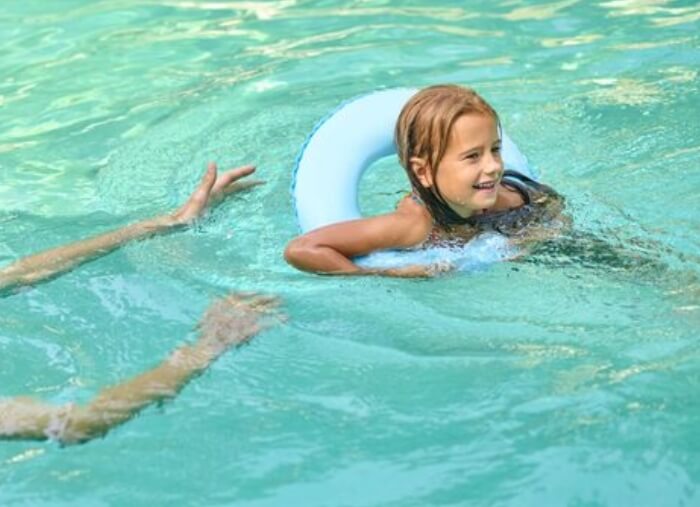
In nearly every mid-sized town, you can stand outside a community pool at 6:45 p.m. on any given Tuesday and watch a little drama play out. A minivan arrives. The door is slid open by a parent. A younger sibling is already half asleep in a car seat, clutching a half-eaten granola bar, while a child in a wet swimsuit and hoodie tumbles out clutching goggles. Inside, another group is lining up at the shallow end as teachers in red shirts finish up the 6:30 class. The entire process operates with the accuracy of a small airport.
This wasn’t always the case. Ten years ago, swimming lessons were mostly a summertime ritual. Families would fit them in between June and August, usually at a nearby pool where a teenager with a clipboard would teach the fundamentals. It seemed almost luxurious to enroll in a swim class in a heated indoor pool in February while snow was piling up outside. It’s the standard now. And it’s not because swimming pools have changed. Families did, which is why.
| Topic | Details |
|---|---|
| Subject | Adaptation of swimming lessons to modern family schedules |
| Primary Concern | Drowning is the leading cause of death for children ages 1–4 (CDC) |
| Recommended Start Age | As early as 1 year old (American Academy of Pediatrics) |
| Recommended Frequency | 2–3 sessions per week for best skill retention |
| Common Schedule Adaptations | Weekday evenings, weekend slots, parent-and-tot pairings, year-round sessions |
| Key Benefits Beyond Safety | Cardiovascular health, emotional regulation, confidence, social development |
Teachers believe that the contemporary family calendar has become nearly unmanageable. two parents who are employed. school pickups at different times. Mondays are for soccer, Wednesdays are for piano, and somewhere in between is a science fair. In the past, swimming used to compete with all of that and lose. Swim schools began bending instead of competing, which was a subtle but clever move. Weekend slots at 7 a.m. were added. Blocks were opened in the evenings on weekdays. Parent-and-tot programs are designed so that a parent’s only peaceful half-hour of the day coincides with a baby’s swim time.
It’s difficult to ignore how much the philosophy has changed as you watch this develop. Families would set up their lives around the pool, according to the previous model. The pool must fit between dinner and bedtime, according to the new model. These days, some swim schools use rolling enrollment, which allows you to start any week, skip a class without losing your spot, and switch days when a school project takes up a lot of time. It’s the type of flexibility that was previously only found in yoga studios and gyms, and it’s really helping.
The more significant structural change is the move to year-round instruction. Instructors will tell you sometimes with a hint of frustration that a three-month break can undo months of progress, and the American Academy of Pediatrics has long advised beginning swim instruction early and maintaining consistency. Young children in particular learn best through repetition. If they haven’t been in the water by November, a four-year-old who could float on their own in August frequently can’t. Sometimes parents are unaware of this until they return to the pool the next summer and witness their child once more struggle with the deep end.
The statistic that comes up in almost every discussion about water safety is that drowning is still the most common cause of death for children in the United States between the ages of one and four. It’s the kind of information that clarifies why year-round programs are a safety argument disguised as a scheduling option rather than merely a convenience play. Retained skills are those that can be used in an emergency. Beneath all the jovial conversation about kickboards and bubble blowing on the pool deck, there’s something subtly serious going on.
Swimming has begun to do some of the emotional heavy lifting for children that other activities can’t quite handle, which is another development that goes unnoticed. Both pediatric researchers and educators note how water seems to calm kids the rhythm, breathing, and concentration needed. After a 30-minute lesson, a child who was overstimulated during the school day is noticeably calmer. Swim lessons are now viewed by some parents more as a weekly reset button than as just another item on the list. It’s still up for debate whether the structured movement or the water itself is responsible for that effect, but the pattern appears too frequently to ignore.
Additionally, swim schools have improved their communication skills. Nowadays, a lot of parents use apps that allow them to message instructors directly, reschedule with just two taps, and monitor skill development. It may seem insignificant, but it eliminates the obstacle that initially prevented swimming from being scheduled. It is not necessary for a parent to remember which Saturday session their child is enrolled in or to call during business hours. At the very least, the friction has decreased.
As expenses rise and instructor shortages continue, which they do in almost every region, it is still unclear if this flexibility will endure. It’s more difficult to find qualified swim instructors now than it was five years ago, and the compensation scales haven’t kept up. The general direction is evident for the time being. Families no longer have to fit swimming lessons in. Families now build around them, despite the fact that the structure is untidy, improvised, and covered in granola bar crumbs in the back seat.
Perhaps that is the true adaptation. Not the pools or the schedules, but the realization that swimming has subtly evolved from a seasonal luxury to something more akin to a non-negotiable for many families. Finally, the industry is meeting them where they are.
i) https://ymcasouthflorida.org/blog/importance-of-swim-lessons/
ii) https://www.sunsationalswimschool.com/blog/should-parents-watch-their-childs-swim-lessons-from-a-distance
iii) https://www.swimmingsafari.com/smart-moves-how-swim-lessons-boost-baby-development
iv) https://goldfishswimschool.com/blog/the-golden-benefits-of-year-round-swim-lessons/
v) https://instaswimusa.com/9-best-ways-to-incorporate-swim-lessons-into-your-familys-busy-schedule/