

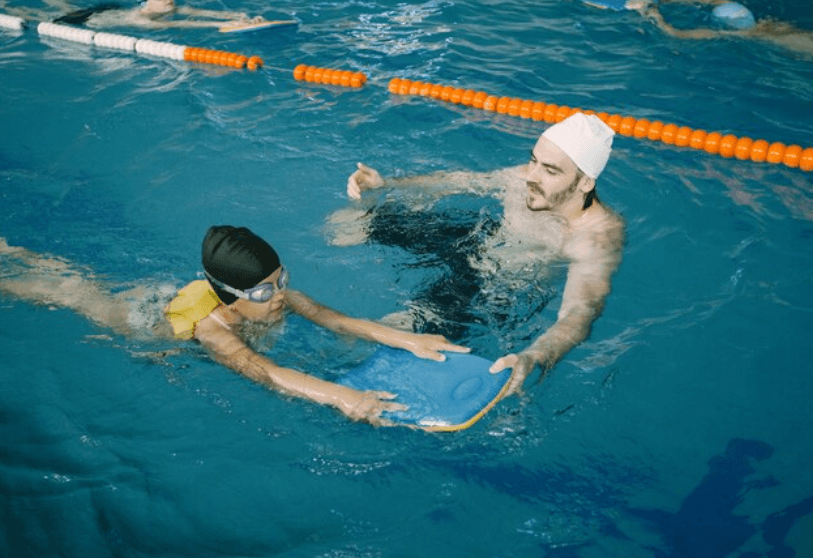
Anyone who has seen a child learn to swim will be able to identify a specific moment. A fleeting moment of serenity, a sort of settling, appears on their face in between the terrified splashing and the first genuine, self-assured stroke. The water ceases to be a threat.
The child begins to move and ceases to fight. It may not seem like much, but it sticks with you. It turns out that moment is more important than it appears. A young nervous system learning to coordinate itself under pressure. Two hemispheres of the brain firing simultaneously. And a body discovering what it can do when it stops being afraid are all part of what appears to be a child simply learning not to drown.
It is now difficult to ignore the evidence that researchers and swim instructors have been pointing to for years. One of the few physical activities that requires what neuroscientists refer to as bilateral stimulation the simultaneous, coordinated engagement of both sides of the body and, consequently, both hemispheres of the brain is swimming. The brain engages in a sort of synchronized dialogue with itself with each freestyle stroke, flutter kick, and left-to-right breath.
| Category | Details |
|---|---|
| Topic | Children’s Swimming & Mind-Body Development |
| Focus Area | Cognitive, physical, and emotional development through aquatic activity |
| Recommended Age to Begin | As early as 6 months (with supervision); formal lessons from age 3–4 |
| Primary Benefits | Neural development, coordination, stress reduction, confidence, memory |
| Key Concept | Bilateral stimulation — engaging both brain hemispheres simultaneously |
| Scientific Backing | Neurogenesis (hippocampus), cortisol reduction, bilateral motor coordination |
| Recommended Frequency | 2–3 sessions per week for measurable developmental gains |
| Reference | SwimJim |
It is truly challenging to replicate that type of neural cross-talk on land, the kind that fortifies the brain’s communication channels. Perhaps no other popular children’s sport accomplishes this to the same extent. If you spend enough time observing a group of children at a swim lesson, you begin to notice things.
In the water, the child who had trouble staying still during story time is totally focused, counting strokes, timing breaths, and adjusting body angle. The pool doesn’t have a magical disciplinary effect. It’s more that swimming provides a genuinely complex task for an overactive brain.
In contrast to a basketball court or a soccer field, the cognitive strain of coordinating limbs, controlling breath, and navigating three-dimensional space appears to absorb restless energy. Research is just now starting to explain why parents of children who struggle with attention have noticed this for years. The advantages to the brain extend beyond concentration and focus.
The aerobic nature of swimming encourages neurogenesis, or the creation of new brain cells, particularly in the hippocampus, which is the area most closely linked to memory and learning. It’s not theoretical. Regular aerobic exercise has been consistently linked to better memory retention in children, and swimming is at the top of that list due to its full-body cardiovascular demand.
Although it’s still unclear how much of this is due to the exercise itself versus the more general structure and discipline that swim lessons tend to instill. Children who regularly swim tend to show improvements in problem-solving skills and academic performance. Stress is another issue.
When a fussy toddler is dropped into a warm pool and becomes quiet, parents quickly realize that water has a truly calming effect on the nervous system. Swimming is repetitive and rhythmic, which is similar to the breathing patterns used in meditation. The body’s main stress hormone, cortisol, significantly decreases following swimming sessions.
That kind of physiological reset is more important than it may seem for kids navigating the low-grade but real anxieties of school, social dynamics, and overscheduled lives. Equally striking is the physical aspect of the mind-body equation. Because swimming eliminates the typical feedback loops, it improves coordination in a way that dry-land sports find difficult to duplicate.
A child can rely on gravity and friction to help them stay upright on solid ground, but in the water, they must actively use their core muscles and adjust their balance with each movement. Better gross motor skills, better posture, and a sort of proprioceptive awareness a sense of where the body is in space that permeates everything else they do are the results of this over time. It’s difficult to ignore how much confidence children acquire along with the skill.
Since humans aren’t naturally optimistic thinkers, there’s something about mastering a skill that exists partially in defiance of instinct that fosters a certain kind of self-belief. A child has experienced a series of minor, tangible successes when they learn to float, kick, and finish a full lap. These successes add up to something that resembles resilience.
Young swimmers who struggle the most at first typically develop the strongest mental toughness because they have to work for it, according to coaches who work with young swimmers. Even though it’s occasionally the last thing parents consider when enrolling a child in lessons, the social aspect shouldn’t be disregarded either. Whether they are recreational or competitive, swim lessons foster a sense of community that transcends many typical barriers.
Children with varying sizes, personalities, and skill levels are working on the same fundamental problems in the same water. Learning to swim has an inherent humility that levels the playing field in a way that team sports occasionally don’t. All of this does not imply that swimming is a panacea or that every child should be preparing for the Olympics.
Regular, moderate use of water leads to the advantages mentioned here, including improved coordination, reduced stress, and neural development. Most kids can see noticeable improvements over time with just two or three sessions per week. A child’s life doesn’t have to revolve around the pool; it just needs to be a regular feature.
More than anything else, swimming provides an environment where the body and mind are compelled to engage in real-time negotiation. The kind of compartmentalized thinking that contemporary life promotes has no place. In the water, breathing, movement, and attention are all part of one system rather than distinct ones.
That kind of whole system engagement might be just what kids need as they continue to develop the neural architecture that will determine their thoughts and emotions for the rest of their lives.
i) https://wallenswim.com/how-swimming-helps-raise-healthy-smart-kids/
ii) https://kidscanswimcanada.ca/how-swimming-helps-children-think-smarter-focus-better-and-learn-faster/
iii) https://www.ocaquatics.com/benefits-of-swimming-for-children-brain-development
iv) https://pedalheads.com/en/blog/swimming-benefits-for-kids