

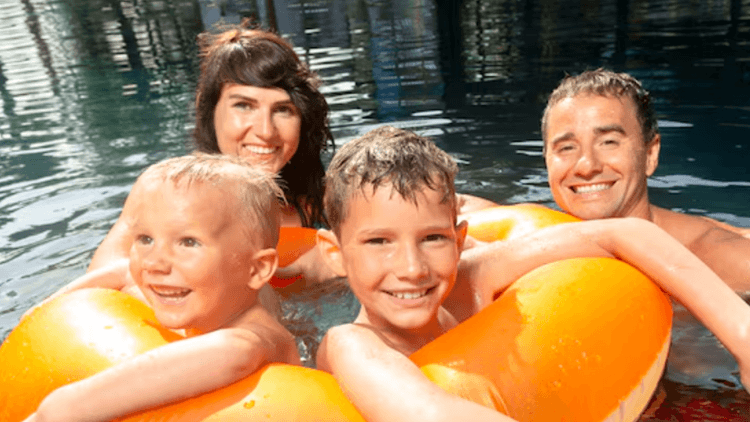
Around the end of August, a certain type of parental guilt begins to manifest. Many families quietly decide that swimming can wait until next summer when they receive emails from the swim school reminding them to register for fall classes. This decision is made in the midst of back-to-school shopping lists and soccer practice schedules. It seems reasonable. The outdoor swimming pools are closing. The weather is changing.
Life becomes hectic. However, observing what happens to kids who take those extended seasonal breaks makes it difficult to ignore what swim instructors have been saying for years: stopping is rarely as safe as it first appears. The reasons why more families are defying that seasonal cycle go far beyond simply keeping kids occupied in the winter.
| Category | Details |
|---|---|
| Topic | Year-Round Swimming Lessons for Children |
| Focus Area | Child Water Safety, Skill Development & Cognitive Growth |
| Key Advocacy Organization | Step Into Swim (drowning prevention & swim access) |
| Notable Research | Griffith Institute for Educational Research, Australia — swim lessons linked to improved cognitive development |
| Recommended Weekly Activity | 2.5 hours of aerobic activity (CDC guideline) |
| Pool Temperature (Indoor) | Typically 88–90°F for teaching environments |
| Primary Safety Concern | Drowning remains one of the leading causes of accidental death in children |
| Reference | https://www.stepintoswim.org |
The trend toward year-round swimming instruction is indicative of a more comprehensive reconsideration of what water safety truly entails and what it really takes to develop a skill that endures when it counts most. Similar to learning a second language or playing the violin, swimming is a sensory-motor skill. The analogy is more than poetic.
It suggests that there is a truth to the way the brain codes movement. It takes more than a few weeks of summer lessons to develop the kind of muscle memory that causes a child to automatically roll onto their back after an unexpected fall into the water. It grows through months of repetition and reinforcement until the body knows what to do on its own.
A child’s memory fades more quickly than most parents anticipate if they miss five or six months of school. Teachers frequently have to start almost from scratch by the next summer, rebuilding rather than improving skills. Many families are still unsure of the extent of that regression.
While some kids pick things up quickly, others need half a season to just catch up. The forward momentum is lost in either case. Additionally, prolonged breaks can reintroduce fear and anxiety that have already been carefully worked through for younger swimmers, particularly toddlers and preschoolers.
By January, a child who fell in love with the water in June might be clinging to the pool wall once more. That is a significant setback. It’s a true reversal of development.
Perhaps the simplest justification for year-round instruction is safety. Risks of drowning do not follow the academic calendar. They can be found in bathtubs, backyard water features, hotel pools during the winter holidays, and any time of year when families travel to warmer climates.
According to statistics, the American child who drowns is not the one who fell into a summer lake. Compared to that, the threat is more subtle and persistent. Survival skills are kept sharp and automatic through ongoing swim instruction; they are instinctive rather than recalled.
In an emergency, that is the distinction that might truly matter. More surprisingly, the research on cognition is also attracting families to year-round programs. According to a comprehensive study conducted by the Griffith Institute for Educational Research in Australia. Children who regularly took swim lessons outperformed peers of similar age and background who did not take lessons in areas like mathematical reasoning. Comprehending instructions. And general cognitive development.
It’s possible that the breath control, spatial awareness, and physical coordination needed to navigate water are all creating neural pathways that can be applied in academic settings. Although this finding does not establish causation. It does pose an interesting question. What if a child’s academic performance is improved more by year-round swimming than by the additional hour of tutoring parents pay for on Tuesday afternoons?
Routine is another issue. Younger children especially benefit from consistent structure. They no longer have to mentally prepare for or fear returning to swimming after a long absence because it becomes a part of the week and the rhythm.
That consistency can subtly foster a kind of confidence that is difficult to create elsewhere for children who have trouble adjusting to new circumstances or who are anxious. Teachers who work with young children all year round frequently report a different level of comfort in those kids: less reluctance, greater willingness to try new things in the water, and increasingly beyond it. Additionally, the case for physical health persists throughout the winter.
Many families find it extremely difficult to engage in outdoor activities during cold weather, but indoor pools with controlled temperatures completely remove that obstacle. Swimming provides a low-impact, full-body workout that satisfies the CDC’s own recommendations for weekly aerobic activity and carries none of the injury risk associated with most youth sports. Compared to a child who participates in a seasonal sport and then spends the colder months mostly sedentary, a child who swims year-round is more consistently active.
According to some research, swimming on a regular basis may even strengthen the immune system. This suggests that parents’ long-held worries about winter pools causing illness are not only unfounded, but may even be reversed. All of this does not imply that families who take seasonal vacations are acting irresponsibly.
Swim lessons are a financial and practical commitment that not every family can maintain without interruption due to conflicting demands in life. However. It seems worthwhile to consider whether the seasonal model. Which is so ingrained in the majority of people’s conceptions of swimming. Is genuinely beneficial to kids’ growth or if it’s just a cultural practice influenced by summer vacations and outdoor pools.
It seems that the families opting for year-round instruction asked that question and came to a fairly obvious conclusion. Instructors often report that their kids are more than just safer swimmers. They also have greater self-assurance.
i) https://goldfishswimschool.com/blog/the-golden-benefits-of-year-round-swim-lessons/
ii) https://www.seaotterswim.com/the-benefits-of-staying-in-lessons-year-round
iii) https://www.sunsationalswimschool.com/blog/5-Reasons-to-Continue-Swim-Lessons-YearRound
iv) https://www.phdswimschool.com/why-year-round-swimming-lessons-are-important/