

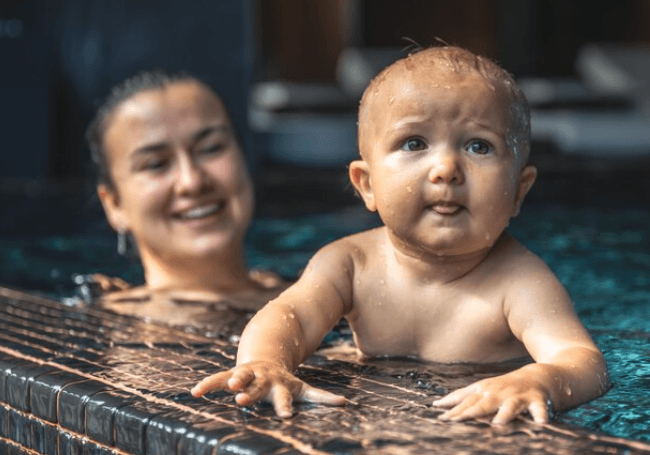
When only six families are in the pool on a Saturday morning, a certain silence descends upon the area. A toddler’s laugh is audible in the instructor’s voice. Instead of twelve, you can hear the splash of one tiny foot kicking. More than any marketing pamphlet, that statement captures the current state of the swim school industry. Learn-to-swim providers all over the UK are discreetly placing their bets on smaller classes.
A portion of the story is revealed by the numbers. More than half of parents are now requesting smaller groups for preschoolers between the ages of three and five. And the demand is even higher for infants and toddlers. According to the Swimming Teachers’ Association’s 2025 Baby and Preschool Swimming Survey. Over the past year, nearly half of swim schools have increased the number of lessons packed into a single pool session in an effort to reduce group sizes without turning away families. It’s possible that, ten years ago, this shift wouldn’t have happened. In the past, parents generally accepted class sizes of eight or ten.
| Field | Detail |
|---|---|
| Industry Body Cited | Swimming Teachers’ Association (STA) |
| Type | Registered charity & professional body |
| Company Number | 01272519 (England) |
| Charity Numbers | 1051631 (England & Wales), SC041988 (Scotland) |
| Registered Office | Anchor House, Birch Street, Walsall, WS2 8HZ, UK |
| Core Objective | Preservation of human life through swimming, lifesaving and survival teaching |
| Key Survey Referenced | STA 2025 Baby & Preschool Swimming Survey |
| Survey Scope | 238 learn-to-swim providers, 45,000 children aged 0–5 weekly |
| Typical Recommended Class Size | Up to 6 participants (incl. adult-and-baby pairs) |
| Recommended Pool Temp (Baby) | 30°C – 32°C |
But something has changed, and it’s more than just safety. Parents who witnessed their toddlers learn to socialize through screens and Perspex barriers during the pandemic seem to want something more intentional and intimate when they hand their child over at the poolside. Twelve students in a class feel like a line, while six feel like attention.
No one pretends that the economics are not uncomfortable. In the past few years, eighty percent of the swim schools surveyed by the STA have increased the cost of lessons. A 20-minute baby lesson now costs between £5 and £10 in the public sector.
Two-thirds of private schools charge £11 or more for the same period of time. Smaller classes result in fewer paying patrons per pool slot, which raises prices and necessitates awkward discussions with parents who are already struggling financially. The odd thing is that nearly half of providers who increased their prices claim they did not lose clients.
Parents grumbled then made the payment. Observing this from the outside, it’s difficult to ignore the similarities with the larger discussion about childcare and early education. Anything that appears to be batch processing has caused parents to become skeptical.
They want people to see, name, and remember their two-year-old. Swim instructors occupy a unique emotional space because they are frequently the first non-family adults a child trusts in deep water. A stranger holding your infant in a swimming pool while staring at five other infants is not something you want.
You want the stranger to know your baby’s name, how they like to be lifted out at the end, and that they are afraid of the back float. The industry discusses the fraying supply side more in private than in public. According to the 2025 survey, the lack of certified swimming instructors was the main issue, not cost or pool space.
Smaller classes need more teachers per pool, and there simply aren’t enough of them. The second concern, and a legitimate one, is pool space. According to 75% of providers. Parents are now inquiring about the water’s temperature. And when local council pools fall to 28 or 29 degrees much below the recommended range of 30 to 32 degrees for infants families push back.
Imagine managing a company where clients politely but firmly ask if you can raise the temperature of a public pool by two degrees. Every week, a lot of swim school owners have that discussion. Some people no longer wait for someone else to figure it out.
Of the private swim schools surveyed, 15% have constructed their own pools, typically on an industrial estate or occasionally at the owner’s house, and 42% are thinking about doing so. In addition to expanding into Hampshire. Dorset. Wiltshire. And Oxfordshire. World of Swimming. A southern England company that recently unified its Wessex. Totton. And Radley brands under one name. Plans to open a London branch in 2026.
The reasoning behind branding is clear. More intriguing is the strategic reasoning: manage your own pools, water temperature, and class size. The local recreation center doesn’t always share your priorities, so don’t rely on it.
Speaking with people in this sector of the economy gives me the impression that something is being both scaled and protected. Baby swimming has always been a somewhat casual world, a warm, charitable, and occasionally chaotic aspect of grassroots athletics. Making it more professional without making it feel like a factory is the current pressure.
In addition to being a business decision, smaller classes serve as a subtle assurance to parents that the water is still warm. It’s still unclear whether the math works in the long run, whether parents continue to pay, whether enough teachers can be trained, and whether councils will stop chilling or closing pools. For the time being, the wager is that six is the correct number. Not because it’s stated in a spreadsheet. Because what people remember is a quiet pool with a child laughing in it.
i) https://www.sta.co.uk/news/2025/02/14/for-the-love-of-teaching-shaping-the-future-of-baby-and-pre-school-swimming/
ii) https://www.worldofswimming.co.uk/latest-news/a-year-of-growth-change-and-new-opportunities-at-world-of-swimming
iii) https://www.sta.co.uk/news/2023/11/15/an-evolving-era-for-baby-pre-school-swimming/