

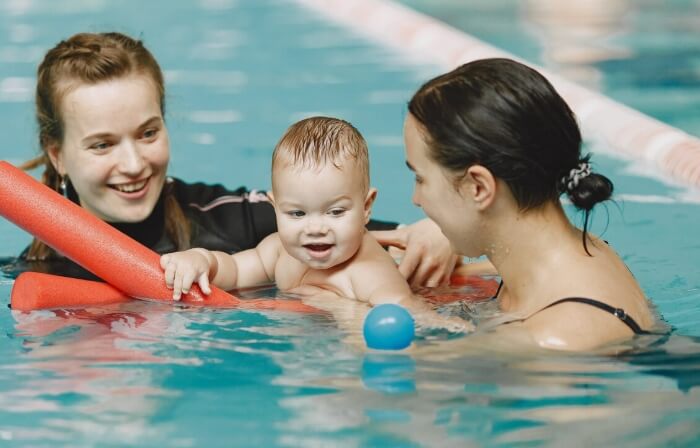
At practically every public pool during the summer, there’s a moment that subtly reveals everything. Watching their child wade farther than they probably should, a parent stands at the shallow end with a towel in hand. The child splashes, giggles, and slips a bit. The parent chuckles as well, then stops. The calculation is visible on their face. How far is too far? How quickly could I enter? It’s a minor issue that occurs thousands of times every day throughout the nation, and Swim England has been working to address it for almost ten years.
Don’t put it off until you’re packing your suitcase. Make your lesson reservation now. It may seem apparent, but consider how many parents actually treat swimming as a vacation accessory that needs to be reviewed before takeoff, much like sunscreen or a passport check. The campaign appears to be primarily designed to undermine that mindset.
| Campaign / Authority | Details |
|---|---|
| Campaign Name | #LoveSwimming (Wave 17) |
| Run By | Swim England |
| Campaign Year | Ninth year, launched Thursday 7 May 2026 |
| Public Face | Michael Gunning, international swimmer & broadcaster |
| Key Voice | Helen Marney, Director of Community Participation and Health, Swim England |
| Partners | 10 leisure operators across England |
| Recommended Starting Age | No minimum — babies through school-age welcome |
| Cited Safety Authority | Royal Life Saving Society UK (RLSS UK) |
Because Gunning doesn’t rely on statistics, his own interpretation of it is intriguing. He talks about how his parents gave him confidence, happiness, and the sensation of water at a young age. Listening to him gives me the impression that those who are most adept at the water are also the least valuable when it comes to elucidating its significance. He states unequivocally that a child who can swim is not the same as a child who is genuinely water safe. The first can travel in a tiled rectangle from point A to point B. The second is able to read open water with an instinct that can only be developed through repetition, float when the current changes, and remain composed when the cold strikes.
The under-ten argument truly makes sense in light of that distinction. Physical skills learned before the age of ten tend to stick like a first language, and children’s brains develop new neural pathways more quickly than they will ever again. Ask any adult who picked up swimming skills at the age of thirty. They are capable of it. They are able to withstand a deep end. Before the body moves, there is nearly always a pause, a half-beat of thought. Kids can’t compete with that. They pick up and maintain the rhythm.
It’s difficult to ignore how much more is smuggled in by swimming. First, patience. coordination. The tiny daily perseverance of showing up to a teacher who wants one more length and a pool that is a little too cold. It takes patience to swim. To be effective in the water, you must pay attention to your strokes, consider your breathing, and keep proper form. In an attempt to keep their kids safe, parents frequently enroll their kids, but the result is a child who can also remain motionless during a math problem. Teachers who work in pools on a daily basis will tell you that children who stick with lessons past the early stages are noticeably different afterwards, in ways that aren’t always easy to name. The transfer isn’t magical, but it is real.
The campaign subtly raises another issue that merits greater attention than it receives. It’s evident from Swim England’s own instructors, who are represented in the most recent wave, that parents are most likely to drop lessons in their later stages. The family leaves after the child swims a distance, the badges are gathered, and the schedule is full. It makes sense. The teachers contend that this is also the worst time to stop. Mechanics is taught in the earlier phases. The calm is built by the later ones.
Swim England’s head of community participation and health, Helen Marney, used language that is more difficult to understand than most public health messaging. Families go to the water together every summer, and tragedies that could have been avoided happen every summer. She doesn’t make it look nice. She is not required to. For years, the Royal Life Saving Society UK has made it clear that drowning is still one of the most common causes of unintentional death in children. This fact contrasts with how casually most of us use water as a backdrop for vacation photos.
Here, too, there is a gradual but genuine cultural change taking place. Swimming lessons were viewed as something you eventually had to do, somewhere between braces and the piano, a generation ago. Alongside the fundamentals, they are now beginning to fall closer to the bottom of the parenting hierarchy. Raising awareness is one aspect of that. The fact that more families travel, own homes close to swimming pools, and spend weekends near reservoirs and rivers that appear gentler than they actually are are all contributing factors.
It’s still unclear if the campaign has any discernible impact. Seldom do these things appear in large quantities quickly. Its argument is more difficult to refute than most. Early swimming instruction is carried by children in a similar manner to handwriting. It becomes a part of how they navigate the world. Parents who put it off frequently find that confidence in the water is not something you can purchase at the airport, usually at the worst possible time. The swimming pools are open. The lessons are running suitcase can wait.
i) https://www.virginactive.co.uk/blogs/articles/2025/11/05/9-reasons-swimming-is-an-important-life-skill-for-your-child
ii) https://www.ripplekids.co.uk/post/learning-to-swim-vital-skill
iii) https://swim-tank.co.uk/why-swimming-is-a-must-for-kids-the-benefits-of-early-lessons/
iv) https://www.lleisure.co.uk/blog/why-learning-to-swim-is-an-essential-skill/