

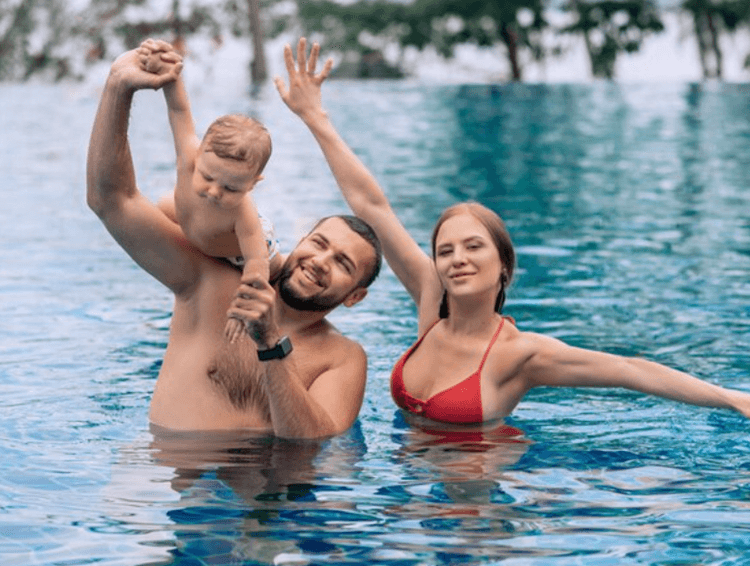
On a Saturday morning, a certain silence descends upon a swimming pool. The sound of a toddler’s arms windmilling as she launches herself off the edge. Nearby, a father was treading water, half-laughing, half-braced. With her phone face down on the towel, a mother observes from the shallows. In a world where analog has become charming, it’s the kind of scene that feels almost purposefully analog. However, it appears that more families are returning to it.
In recent years, there has been a significant shift in the discourse surrounding family time. Parents discuss the guilt associated with excessive screen time, the challenge of maintaining a child’s focus, and the unsettling feeling that everyone is in the same room but isn’t truly there. A few families experiment with board games. Some people attempt hiking. However, swimming unglamorous, chlorine-scented, logistically challenging swimming continues to be mentioned as the effective method.
| Activity | Family swimming |
| Category | Family wellness & bonding activity |
| Suitable for | All ages — infants to seniors |
| Primary benefits | Physical fitness, mental health, family bonding, stress reduction |
| Research body | Swim England (commissioned study on parent-toddler swimming) |
| Key finding | 96% of pre-school parents say swimming makes their child happy; 80% report improved sleep |
| Health savings (UK) | Swimming saves the UK health system over £357 million annually |
| Exercise type | Low-impact, full-body, cardiovascular |
| Reference | Swim England |
Perhaps the very lack of alternatives is what makes it work. You can’t check a notification or stray toward a screen once you’re in the water. Your body is required by the water. When a parent takes their six-year-old into the pool, they are not multitasking. They simply exist, which is less common than it should be.
Swimming was the best indoor activity for fostering bonding moments between parents and toddlers, according to research commissioned by Swim England. The figures are startling but not shocking. Four out of five parents of preschoolers said swimming helped their kids sleep better, and about 96% of parents said swimming made their kids happy. It’s the kind of information that validates what parents have long secretly suspected: the living room isn’t doing what the pool is.
The best 25 minutes of the week, according to Charlotte Power-Mcleod, a mother who balances a full-time job with raising a young son, is her weekly swimming session. It was just the two of them, phone silent, the world on hold, rather than any specific accomplishment or skill her son had mastered. It’s important to be specific. More hours are not always necessary for parents. They occasionally require better ones.
Additionally, there is something noteworthy about its physicality. In a way that is more difficult to create on a couch, skin-to-skin contact in the water parents holding babies, catching toddlers, guiding young arms through their first freestyle stroke builds trust. Some swim schools actively encourage parents to stay in the water with kids under four, not only for safety reasons but also because being physically present and helping a child learn to kick simultaneously develops both neuromuscular and emotional patterns. The body recalls being restrained.
The dynamics change for older children, but the advantages compound. Swimming is not a sport that benefits those who are self-assured. It matters more than most people realize that a child who struggles in math or finds the classroom oppressive can actually be good in the water. Early body confidence building tends to spread to social skills, willingness to try new things, and the kind of quiet self-assurance that is hard to teach directly.
According to research, young children who regularly swim exhibit superior motor coordination, memory, and literacy than those who do not. Although it’s still unclear how much of that is due to swimming in particular as opposed to the more general effects of physical activity, the correlation is strong enough to warrant attention.
Then there’s the stress issue, which is the main reason why so many families are initially choosing water. Family life in the modern era is truly draining. A household with two working parents and two school-age children frequently has a schedule that resembles a logistics operation. That is not resolved by swimming.
Compared to other activities, spending time in the water seems to provide a different kind of decompression. It reduces cortisol in ways that can be measured, such as the feeling of weightlessness, breathing rhythm, and the low thrum of background noise. When adults return from a family swim, they have not only worked out but also gotten the necessary amount of rest.
Anecdotally at least, it appears that swimming is turning into a container for the kind of family experience that people used to find more naturally. Families used to spend pockets of time doing physical activities together because there wasn’t much else available before schedules became this hectic and gadgets filled every void. That texture is replicated in swimming. Participating only partially is difficult. Being distracted is hard. Additionally, it scales: two-year-olds and fourteen-year-olds can be in the same pool, actively participating, and benefiting from it. It’s not as common as it seems.
All of this does not imply that swimming can alleviate the structural stresses of contemporary family life. The cost of living, the conflicting demands on time, and the commutes don’t go away by poolside. However, it’s difficult to ignore the fact that something real had just occurred when you watch a family come out of a Saturday session, towel-wrapped and a little pink-cheeked, arguing merrily about who went fastest. Something that didn’t need much preparation, a screen, or a subscription. Just showing up and drinking water.
i) http://www.littlefinsswimschool.com/blog/swim-family-connection
ii) https://www.mother.ly/health-wellness/childrens-health/mental-health-benefits-of-swimming/
iii) https://www.nuffieldhealth.com/article/the-a-z-of-why-swimming-is-great-for-kids
iv) https://woombie.com/blog/post/why-swimming-is-a-great-family-bonding-activity