

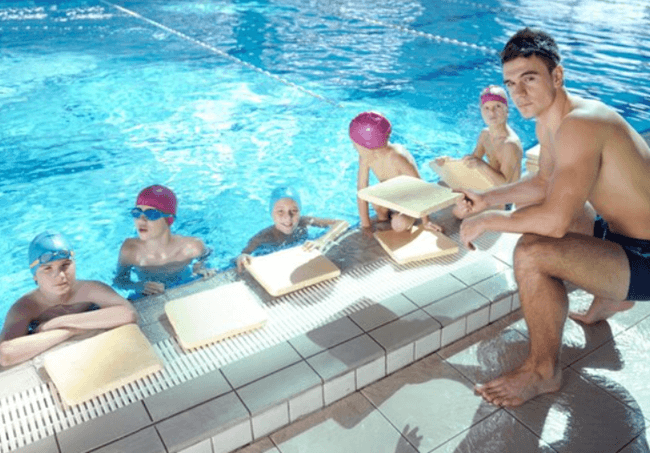
Suburban areas in Singapore, Sydney, and suburban Texas are currently experiencing a certain type of Saturday morning scene. A father holding a thermos and two towels while wearing flip-flops. Goggles are being negotiated by a mother to fit a fidgety four-year-old. Pretending not to be cold, an older sibling was already in the water. This was a drop-off custom ten years ago. After waving, the parent got in the car and spent forty minutes scrolling through emails before heading home. Nowadays, the parent is almost always in the water as well.
Families attitudes toward swimming are changing, and this is something to be aware of. The outdated paradigm children learn strokes, parents observe from a plastic chair, and everyone leaves for home feels more and more out of step with the current discourse on wellness. In the cultural imagination, swimming seems to have been subtly elevated from a summertime survival skill to something more akin to family therapy with chlorine. It’s another matter entirely whether that reframing is justified. However, the demand is evidently present.
| Snapshot | Details |
|---|---|
| Topic | Holistic Family Swimming Programmes |
| Sector | Health, Wellness, Aquatic Education |
| Featured Voice | Wayne Goldsmith — swimming educator, coach, sports scientist (25+ years in the sport) |
| Notable Schools Mentioned | JustSwim Singapore (founded 2020); Marlins Swim School Mackay, Australia |
| Programme Focus | Motor skills, cognitive development, stress reduction, family bonding, water safety |
| Recommended Frequency | 2–3 sessions per week for measurable mental health benefit |
| Age Range Served | Toddlers through retirees |
| Reference Source | World Health Organization — Physical Activity Guidelines |
This concept has been central to the identity of schools like Singapore’s JustSwim, which was established in 2020. Their team, which includes lifesavers, competitive swimmers, and triathletes, offers small-group and private lessons as a way to engage the community in addition to improving technique. The coaches are said to stay in the pool until a stroke is perfect. Similar approaches are taken by Marlins Swim School in Mackay, Australia, which bases its curriculum on motor development, cognitive engagement, and what they refer to as comprehensive growth. The vocabulary has changed. Coaches who previously discussed breath control and kick boards now discuss neuroplasticity and emotional regulation, sometimes in the same sentence.
Of course, marketing plays a part in this. These days, it’s difficult to read the homepage of a swim school without coming across at least one reference to holistic development or mindfulness. However, when the language is removed, the underlying observation appears to be sound. Swimming does engage the body and brain in a unique way, including full-body coordination, rhythmic breathing that resembles meditation, and the peculiar sensory calm of being underwater. Regular swimming has been associated by researchers with reduced cortisol levels, better sleep, and enhanced cognitive function in older adults. It’s possible that the parents enrolling in family lessons are reacting to a genuine issue rather than merely following a fad.
Wayne Goldsmith, who has worked in elite coaching circles for more than 25 years, has written extensively about the risks of treating young swimmers too narrowly. For example, defining a child by the stroke they happen to be best at could lock a ten-year-old into being “the backstroker.” Here, we should heed his advice. Ironically, the holistic family program runs the risk of falling into the same trap from the opposite direction, transforming what ought to be enjoyable weekly water time into yet another optimization project. It’s not really swimming when parents show up at the pool with a list of developmental outcomes. They are conducting an audit.
They are treated differently by the families who appear to benefit the most from these programs. They arrive exhausted. Sometimes they forget the goggles. Not every lap is captured on camera. A few months ago, I saw a mother at a nearby pool who just floated next to her son for the entire forty-minute session, talking about nothing in particular, like whether his teacher was nice or what he wanted for lunch. That summer, he took up swimming. Though she would probably find it difficult to identify it, she appeared to learn something as well.
The rise in family-focused swimming programs also reflects broader parental attitudes regarding screen time, anxiety, and the peculiar loneliness of contemporary childhood. Despite all of its commercial features, a pool is one of the few locations where a phone is truly useless. Underwater scrolling is not possible. Mid-lap notifications are absent. The family spends an hour together in a peaceful, distraction-free blue room. That might explain a lot on its own.
It’s still unclear if the holistic framing will survive the wellness boom that gave rise to it or if the next reframing will subtly take its place in a few years. Despite being backed by an increasing amount of research, the claims about mental health are occasionally exaggerated in promotional materials. Depression cannot be cured by swimming. It cannot be used in place of therapy. More simply put, it’s a regular weekly hour of breathing, movement, and physical presence, which is more than many families are currently receiving elsewhere.
It’s difficult to avoid feeling quietly optimistic about this as it has developed over the past few years. The tendency might quickly turn into yet another obsession with performance-coded parenting. For the time being, however, it appears that families are finding a way to spend time together in the water. That seems like a sensible place to begin.
i) https://www.justswim.com.sg/swimming-mental-health/
ii) https://marlins.com.au/the-science-of-swimming-how-the-body-and-brain-work-together-in-the-water/
iii) https://wgaquatics.com/2018/02/21/teenage-swimmers/
iv) https://goldfishswimschool.com/washington-park/area/washington-park-co/kids-swimming-classes/
v) https://www.bestonlinerated.com/best-private-swimming-lessons-singapore/