

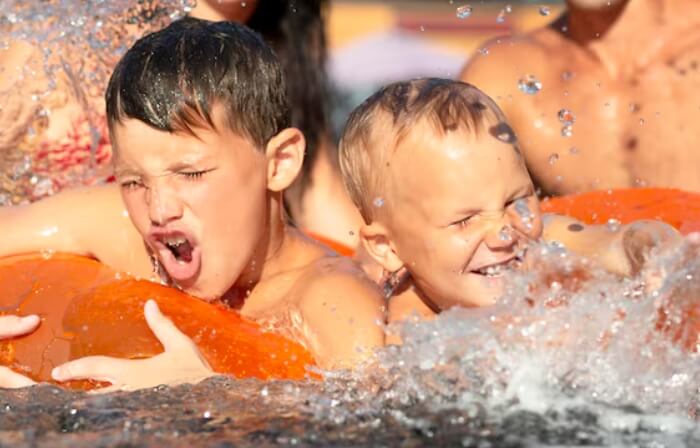
You’ll notice something that hasn’t really changed in forty years if you stroll past a neighborhood recreation center on a Saturday morning. Hair plastered with moisture. A line of tiny bodies covered in big towels. As their child hoops from foot to foot on the chilly tile in the changing room, a parent fumbles with goggles. The way kids learn to swim is almost unavoidably outdated, but the industry surrounding it has completely changed. With apps, branded products, and eye-catching onboarding videos, large chain swim schools have developed into opulent businesses. Even so, a surprising number of parents are discreetly opting for the smaller location further down the street.
The question of why is worthwhile. The information is not nuanced. Despite swimming being a part of the national curriculum, only 2.8% of children in the UK are currently learning through school-based programs, according to a recent STA survey of parents with children under the age of twelve. Private swim schools of all sizes are increasingly filling that gap. Families are more likely to discuss smaller, locally owned businesses than larger national brands when discussing who they trust. There’s more going on here than just marketing.
| Topic | Details |
|---|---|
| Subject | Local Swim Schools vs. Big Chain Swim Schools |
| Industry | Children’s Aquatic Education & Water Safety |
| Primary Concern | Drowning prevention, water confidence, accessibility |
| Key Stat | Nearly 1 in 3 UK children leave primary school unable to swim 25 metres |
| Parent Priority | 99% agree swimming is a vital life skill; only 18% want competitive pathways |
| Biggest Barrier | Cost of lessons (61%) and pool access (58%) |
| Notable Local School Cited | Swim Generation (London & Surrey), est. 2012 |
| Industry Body | Swim England, STA, Royal Life Saving Society |
The obvious thing is part of it. reduced class sizes. A coach who doesn’t need to consult a clipboard to recall your child’s name and is aware of their fear of submerging their face in water. Swim Generation is a London-based school that has been in operation since 2012. Teen group sizes are limited to six, and lessons are typically taught one-on-one or one-to-three. At a nearby school, that ratio is not a luxury. By default, it is. The economics favor larger groups at many of the larger chains, and parents notice the difference in about three lessons.
The more awkward aspect of the discussion is the cost. The largest obstacle to swimming, according to 61% of respondents in a different Better survey of 2,000 people, is the expense of lessons, with another 58% citing pool access fees. Big chains frequently set their prices at the top of the market because of their corporate overheads and expansion goals. Parents perceive the value calculation differently, even though local swim schools occasionally match or undercut those prices. Paying a premium to a neighbor who operates three swimming pools in your neighborhood is not the same as paying a premium to a company with its headquarters located three counties away. Perhaps parents are just more understanding when it comes to local money.
Additionally, there is the safety dimension, which parents discuss last but are likely to be the most important. According to the Royal Life Saving Society, accidental drowning claimed the lives of 35 children in a recent year, a 46% increase over the previous five years. Priorities are rearranged by that kind of number. In the STA survey, 99% of parents agreed that swimming is an essential life skill. Just 18% of parents wanted their kids to be competitive swimmers. The desire for basic safety and water confidence was overwhelming. Big chains frequently market themselves in terms of progression pathways and stage badges, which is all well and good, but for a parent whose main concern is that their seven-year-old won’t panic in deep water, it may seem a little off.
More than most people realize, the physical surroundings are important. Private pools or off-peak times at boutique health clubs are often reserved by local swim schools, resulting in warmer water, fewer strangers, and no shared lane chaos. Public pools typically have a temperature of about 27°C, which is acceptable for adults doing lengths but may make a nervous child shiver and tense. Swim Generation and other schools maintain water temperatures between 29 and 31. Until you see a novice attempting to ease their shoulders in a chilly pool, that may seem like a minor detail. Chains optimize this kind of thing in an effort to increase throughput.
Trust builds up in little ways. Instead of calling instructions from the side, a parent observing from the gallery discovers that the coach is actually in the pool with the children. They observe that the same coach is present every week rather than being rotated according to a staffing schedule. Another parent tells them that in just two years, their daughter went from being a nervous beginner to a member of the club squad. People remember these moments when they are asked for recommendations at the school gate, even though none of them are included in a marketing brochure. In this industry, word-of-mouth still does the majority of the heavy lifting, and it nearly always favors the local.
There is also a cultural undertone that is worth mentioning. Parents now bear a generational responsibility due to the decline in school swimming, with primary teachers reportedly providing less than ten lessons per student in many cases. They want to know who is doing a job that the state used to do. Large chains may have the feel of being outsourced to a logo. Local swim schools are similar to outsourcing to an individual. The family-run model is currently gaining some quiet momentum, but it’s still unclear if the chains will adjust or just keep expanding on a different parent demographic.
It’s difficult not to feel that something authentic is being preserved as you watch this unfold across suburban pool decks and London recreation centers. It’s not a nostalgic trip to the local swim school. It’s a workable solution to an issue that parents are now more concerned about. The large chains are not going away. They are no longer the clear default, and that change no matter how slight says something about what families genuinely desire when it comes to the safety of their children.
i) https://www.sta.co.uk/news/2025/05/16/sta-survey-reveals-parents-priorities-and-concerns-around-learning-to-swim/
ii) https://www.lep.co.uk/education/swimming-third-most-important-subject-after-maths-english-parent-survey-lessons-less-accessible-4875747
iii) https://www.swimgeneration.co.uk/blog/why-parents-trust-swim-generation-for-teen-swimming-lessons/
iv) https://www.pattisswimschool.com/blogs/blog/1300520-how-swimming-improves-overall-fitness-and-health