

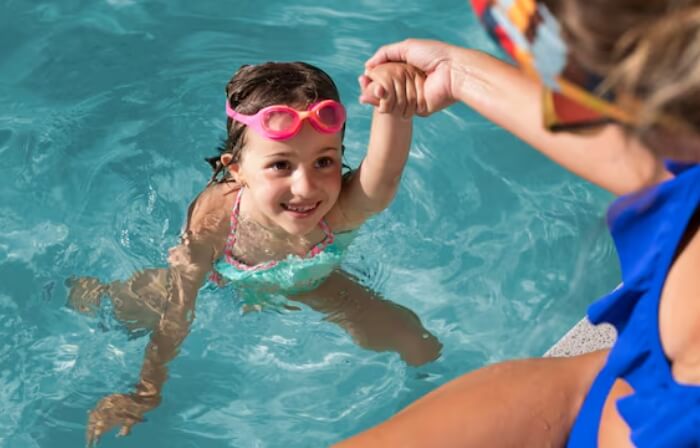
Anyone who grew up in Britain will instantly recognize the distinct smell of public pools. Damp tile, chlorine, and the subtle, corny smell of rubber changing mats. For a generation of kids, that stench was associated with Tuesday mornings when a class of shivering eight-year-olds lined up in goggles that were too tight for their heads, waiting for a tracksuit-clad teacher to blow a whistle. Quietly, it’s becoming less common than most people realize.
Nowadays, about one in three kids in England can’t swim 25 meters when they graduate from primary school. Swim England continues to publish that figure year after year, and it hasn’t changed much. It’s the kind of statistic that seems abstract until you watch parents counting heads on a sweltering July afternoon while standing at the edge of a reservoir. Then it sounds completely different.
| Information | Detail |
|---|---|
| Topic | Children’s Swimming Education in the UK |
| National Curriculum Requirement | Swim 25 metres unaided by end of primary school |
| Children Meeting Requirement | Approximately 52% |
| Children Leaving Primary School Unable to Swim | Roughly 1 in 3 |
| Gap Between Wealthiest and Poorest Areas | 76% vs 45% can swim 25m |
| Risk Statistic | Drowning is among the leading causes of accidental child death in the UK |
| Governing Body | Swim England |
Safety has always been the primary justification for teaching swimming to all British children, and the safety argument is difficult to refute. In the UK, a nation encircled by coastline and dotted with rivers, canals, flooded quarries, and decorative ponds, drowning persistently ranks near the top of the list of unintentional causes of death for children. Speaking with anyone who works in water rescue gives me the impression that people still don’t realize how quickly cold water can shut down a body. In the sea off Cornwall in May, a child who can confidently swim a certain distance in a heated pool is not necessarily safe. A child who is completely incapable of swimming is far more vulnerable.
The evidence is truly impressive when it comes to the unromantic question of fitness, which goes beyond survival. Swimming protects joints from the impact of running or rugby while working nearly every muscle group. The pool can be the only place where movement feels welcome rather than punishing for a child with asthma or a child whose weight makes the football field unbearable. While it’s true that swimming enhances cardiovascular health, posture, and endurance, coaches sometimes overlook the calmer benefit of how rhythmic breathing and the muffled quiet of underwater seem to calm restless minds. Anyone who has seen a hyperactive seven-year-old come out of a swim lesson with noticeably softer shoulders will understand what that looks like.
The Olympic gold medallist Tom Dean has been outspoken about expanding access, and it makes sense that he is frustrated. He developed a system that was effective for him. It doesn’t for many kids, especially in lower-class postcodes. It is unsettling to observe the disparity: less than half of children in the most impoverished areas can swim the necessary distance by the age of eleven, compared to approximately 75% in the wealthiest regions. It’s difficult not to interpret that as a story about parents working shifts that prevent Saturday-morning lessons at the recreation center, school budgets, and pool closures.
The structural issue is practically awkward. The majority of state elementary schools lack a swimming pool. A hired lane at the neighborhood baths, coaches, transportation, changing times, and a curriculum already burdened by SATs and phonics are all part of lessons. Head teachers perform their math and, more often than they would like to acknowledge, swimming loses. Some have begun experimenting with pop-up pools built on school property. This kind of solution seems a little ridiculous until you see one in use and realize the kids are spending more time in the pool in two weeks than they used to in a year.
Ignoring all of this has a more subtle cost as well. One of the few sports where a child who is not naturally athletic can make significant progress through patient repetition is swimming. This kind of measurable, undramatic, earned progress boosts confidence in a way that team sports rarely do. Although those terms have been used so frequently in education circles that they have begun to lose meaning, new research from Swim England indicates that the lessons develop resilience and focus in addition to the physical skill. You can understand the researchers’ point of view by seeing a nervous child go from clinging to the rail to letting go and floating on their back. Something changes.
It’s important to note that British perceptions of swimming have evolved in ways that go beyond pools and financial constraints. There has been an odd resurgence of open-water swimming, with adults finding lidos and chilly lakes in quantities that would have confused their parents. The children who stand to gain the most from that culture those who live along the coast, in river towns, or in areas where summer means cooling off in water that isn’t always safe are frequently the ones who haven’t had a structured lesson.
It’s unclear what will happen next. For many years, school swimming funding has been precarious, and pool closures continue to push the numbers in the wrong direction. There are excellent programs available, with charities filling in the gaps and schools handling the challenging administrative tasks. It remains to be seen if any of it constitutes a true national solution. For the time being, the safest assumption is that children who learn to swim will primarily be those whose families can afford to pay for it privately. This is an odd situation for a nation that is so surrounded by water. There has always been a recommendation. What keeps failing is the follow-through.
i) https://www.schoolofplay.org.uk/the-importance-of-swimming-education-in-englands-primary-schools/
ii) https://www.freedom-leisure.co.uk/blog/why-every-child-should-learn-to-swim/
iii) https://www.bbc.co.uk/news/articles/c2le7lggd8xo
iv) https://www.swimming.org/learntoswim/why-your-child-should-learn-to-swim/
v) https://children-ne.org.uk/is-swimming-accessible-for-everyone/
vi) https://www.wiltshire.gov.uk/article/14822/New-research-highlights-the-powerful-benefits-of-swimming-for-children-s-wellbeing
vii) https://www.swimdesignspace.com/blog/uk-children-swimming-skills-decline
viii) https://southwarkleisure.co.uk/learn-to-swim/