

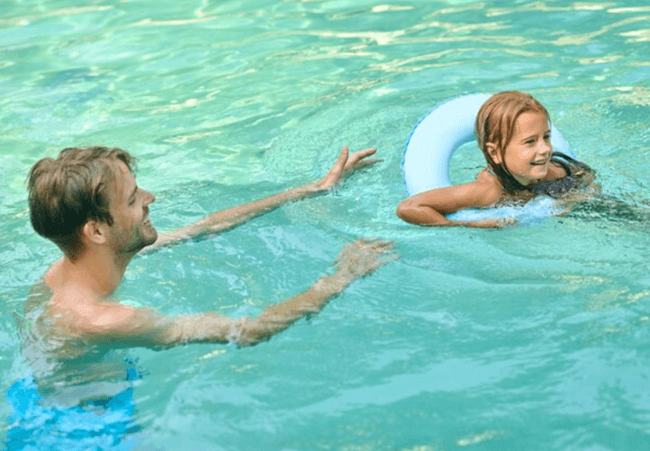
On weekday evenings, a small ritual takes place at leisure centers all over Britain, and most people pass it by without noticing. Watching a five-year-old in an overly tight swim cap attempt to blow bubbles, a parent is kneeling at the pool’s edge with a towel draped over one shoulder. The child emerges and parent gives a clap.
There’s a shift in the parent’s shoulders, the kind of drop you only notice if you’ve been keeping an eye out for it. As parents have begun to refer to it, mindful swimming is not actually a movement. Both a manifesto and an influencer-led brand are absent. It’s more of a subdued adjustment, a response to the cacophonous, regimented, screen-driven rhythm of contemporary family life. And because it doesn’t really require anything from you, it’s expanding more quickly than most parenting trends.
| Information | Details |
|---|---|
| Topic | Mindful Swimming for Stress Free Parenting |
| Featured Voice | Leon Taylor — Olympic Silver Medallist (Athens 2004), Diving |
| Supporting Body | Swim England — #LoveSwimming Campaign |
| Reported Stat | 84% of parents say their child’s mood improves after a swimming lesson |
| Adult Mental Health Stat (UK) | 1.4 million adults report swimming significantly reduced their anxiety or depression |
| Featured Programme | Aqualetes Swimming Lessons (Wiltshire Council Leisure Centres) |
| Concept Origin | “Blue Mind” — coined by marine biologist Wallace J. Nichols |
You simply head to the swimming pool. This is being pushed along by numbers that are not subtle. According to a recent study by Swim England called #LoveSwimming, 84% of parents report that their child’s mood improves after a lesson, and nearly 80% say that their children are able to focus better.
A journalist would squint at those figures because they seem almost too neat. If you spend ten minutes at a pool gallery on a Tuesday night. You’ll witness the non-scientific version of it. Parents finally exhaling for what appears to be the first time all day. And children leaving louder but somehow lighter.
One of the more vocal voices on this is Leon Taylor, who won silver in synchronized diving at the Olympics in Athens. Like any parent, he talks about his five-year-old, Ziggy, with a mix of amazement and fatigue. He claims that when they go swimming together, the boy feels at ease for the remainder of the week.
The fact that Taylor isn’t selling anything contributes to the soft observation’s impact. He’s just discovered something that functions. Swimming is different from the typical parental wellness remedies because it simultaneously induces the same state in both the parent and the child. In the living room, a yoga mat is a compromise. There is a pool. The water does the majority of the work once you’re in.
The physical weight is lifted by the buoyancy, the nervous system is calmed by the regular breathing, and outside noise is muffled. Being in charge is almost like a little vacation, according to parents. Swimmers’ long-held belief that aquatic exercise significantly lowers anxiety and depressive symptoms was confirmed by a 2022 systematic review of eighteen trials.
According to preliminary research, swimming may even promote the development of new brain cells in areas of the brain that are typically damaged by long-term stress. It provides some framework for what families have been explaining in simpler terms for years, but it’s still early science and should be regarded with caution. Another issue is what swimming isn’t. It’s not a screen. There isn’t a clipboard in this class. Optimizing is no different.
That absence is appealing to parents who are engulfed in a culture of productivity. One of the few hours left that no one can truly interfere with is watching your child attempt to avoid swallowing chlorine while sitting in a humid viewing gallery with a flask of something lukewarm. Emails are not properly answered at Poolside. The phone is placed inside the bag. The social layer is also subtly significant. Week after week, the same parents attend the same classes.
In the slightly damp, slightly shouted conversations about school nights and packed lunches that take place in changing rooms, friendships are formed. It functions as a community even though it isn’t organized in any way. And loneliness is a stress in and of itself. As anyone who has raised a toddler through a long winter will attest.
Some parents have gone so far as to try cold-water swimming on the weekends or attend adult lane sessions after dropping the kids off. There are proponents of wild swimming, and some of their accounts are truly remarkable. One well-known BMJ case describes a young woman whose cold-water routine enabled her to stop taking anxiety medication while under her doctor’s supervision. The majority of parents won’t go that far. They are not required to. On a Wednesday, a heated municipal pool is sufficient.
Observing all of this makes it tempting to exaggerate. A challenging marriage, a demanding job, or a child going through a difficult time won’t be resolved by swimming. It shouldn’t take the place of therapy because it isn’t. What it provides is a more compact and stable hour where everyone is held in place by the water. Where a parent can act as a parent without actually carrying out the role.
And where a child discovers that calmness is something you can truly feel in your body. It’s difficult to ignore how out of style this trend is as it spreads. No subscription, no app, and no style. Goggles, chlorine, and a lesson at 5:30 p.m. Perhaps that’s precisely why it’s functioning. Parents are fed up with being offered fixes. They desired something that only required them to be present, without requiring them to improve. It turns out that the pool had been waiting the entire time.
i) https://www.wiltshire.gov.uk/article/14822/New-research-highlights-the-powerful-benefits-of-swimming-for-children-s-wellbeing
ii) https://www.swimdesignspace.com/blog/swimming-for-anxiety-stress-mental-health
iii) https://www.swimexpert.co.uk/about-us/news/managing-anxiety-in-the-water-the-gentle-approach-of-1-to-1-lessons-for-children