

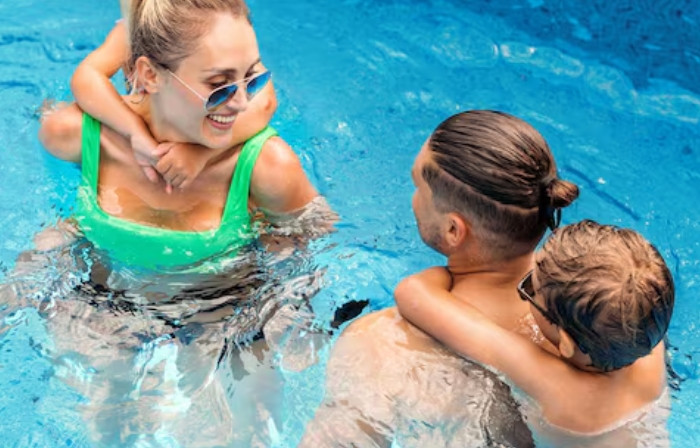
You’ll notice something that wasn’t quite there five years ago if you stroll past any respectable municipal pool on a Saturday morning. By nine, the parking lot is full. The viewing gallery is crowded with younger siblings and parents juggling coffee cups. Inside, a teacher in a red polo shirt is coaxing a four-year-old to put her face in the water for the first time, and the kid is laughing instead of crying. Something has changed.
Of all things, swimming lessons are subtly surpassing almost all other kid-focused activities. Dance studios continue to be busy, gymnastics has a devoted fan base, and football teams continue to draw large crowds. The swim school waitlist phenomenon is relatively new and is becoming more widespread. Waiting lists can last anywhere from six months to a year, according to pools in the UK, Australia, and North America. Parents feel that this is more than just an extracurricular activity. They no longer feel comfortable leaving this fundamental skill up to chance.
The pandemic contributes to the explanation. A whole generation of small children missed the splash-around years, the toddler classes, the holiday hotel pools. When lockdowns ended and parents realized their five-year-olds had a real fear of the water, panic and guilt drove them directly to the reservation page. According to swim instructors I’ve spoken to, the rush was unlike anything they had ever experienced in their entire careers. There used to be openings in her Tuesday night intermediate class, according to a Manchester instructor. She is currently using her own phone to manage a private waiting list.
| Important Information | Details |
|---|---|
| Topic | Growth of Swimming Lessons as a Childhood Activity |
| Governing Framework | Swim England Learn to Swim Framework (Stages 1–7) |
| Target Age Group | Toddlers, Primary School Children, Adults |
| Recommended Completion | Up to Stage 7 (Swim England guideline) |
| Instructor Standard | Level 2 Qualified Swimming Teacher |
| Core Skills Taught | Four strokes, water safety, confidence, breath control |
| Life Skill Status | Classified alongside reading and writing |
| Linked Sports | Swimming, Water Polo, Diving, Synchronised Swimming |
Beneath this, a more subdued cultural change is also taking place. Swimming is now viewed as a life skill, more akin to literacy than football, rather than a sport. The language used by Swim England, which compares learning to swim to learning to read, has gradually permeated how parents discuss it. Swim England itself advises children to advance through Learn to Swim Stage 7 before taking a step back. Such a comparison is difficult to refute. You don’t stop teaching your kids to read halfway through.
Here, specifics are important. The framework is structured around seven stages, each with clear targets, badges that children genuinely care about, and a games-led approach that keeps the dread out of it. Because the setting is already familiar to them, children who began in adult-and-baby sessions typically advance through the first two stages swiftly. Others take longer and somehow end up stronger swimmers in the end, which is one of those small ironies the teachers seem to enjoy pointing out.
The research, for what it’s worth, has been working in swimming’s favour. Griffith University in Australia found that children who swam regularly hit developmental milestones earlier than peers who didn’t. When parents skim the headlines or read these studies, something clicks. There’s an argument forming in the back of their minds: this one activity gives my child physical coordination, mental discipline, water safety, and an early developmental edge, all in a single weekly session. The pitch isn’t exactly the same in football. Kumon doesn’t either.
The explosion of private lessons speaks for itself. Eight students share the teacher’s attention in a group setting. The teacher observes one during a private lesson. Progress is faster, which is exactly what time-poor parents want to hear, even if it costs more. The market has responded the way markets always do, and you can now find swim coaches offering one-to-one packages, intensive crash courses, and even private pool hire blocks. Another question is whether this is long-term beneficial for the sport. There’s something to be said for the chaos of a group class, for learning to wait your turn at the wall.
What you notice, watching this unfold, is that swimming has gained a kind of moral weight that other activities don’t carry. A parent who skips piano lessons feels a little guilty. A parent who skips swimming lessons feels something closer to fear. Drowning is one of the leading causes of accidental death for children under five in most developed countries, and that statistic hangs in the air whenever the conversation starts. No one wants to be the family whose child couldn’t swim when it mattered.
In a year or two, this surge might reach a plateau. That’s what trends do. It’s also possible that swimming has crossed a quiet threshold, similar to what cycling did decades ago, and the pool will just continue to be a necessary component of the modern childhood checklist. It’s difficult not to feel that this one won’t end when you see the Saturday morning lines, the badges being distributed, and the slightly drenched parents making their way home.
i) https://www.swimexpert.co.uk/about-us/news/do-private-swim-lessons-work-faster-than-group-classes
ii) https://www.swimdesignspace.com/blog/why-swimming-lessons-are-a-life-skill-not-just-a-sport
iii) https://swim-tank.co.uk/why-swimming-is-a-must-for-kids-the-benefits-of-early-lessons/
iv) https://bewellwigan.org/latest/6-days-swimming-lessons-help-your-child-thrive/