

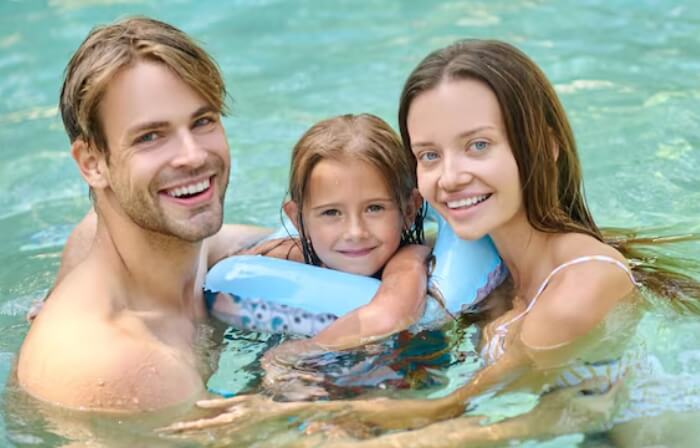
On a weekday evening, there’s a certain silence around a community pool. The muffled splash, a weary teacher’s whistle, and parents leaning on the railings with a phone in one hand and a towel in the other are examples of softer sounds than the loud ones that hit you in the chest like at a stadium. A five-year-old is seen gripping the wall, kicking once, kicking twice, and then pushing off into water that seems deeper than it actually is. In that brief instant, something occurs. It appears to be play not totally.
Swimming is often viewed by families as a weekend activity, a monthly fee, and a skill that may or may not stick, much like piano lessons or football practice. The more you examine the figures and the individuals, the more swimming begins to act more like a benefit than an activity. According to recent research by Swim England, the sport generates about £2.4 billion in social value annually throughout the UK. This is a strange way of saying that something quiet and chlorinated keeps showing up in budgets that people don’t typically associate with leisure, like the NHS, GP offices, and mental health services.
| Important Information | Details |
|---|---|
| Topic | Swimming as a long-term family investment |
| Primary Source Referenced | Swim England — national governing body for swimming in England |
| Key Finding Cited | Regular swimming linked to a 28% lower risk of early death |
| Reported Social Value | £2.4 billion generated per year (Swim England, Value of Swimming report) |
| Public Health Savings | 78,500 cases of ill health prevented in 2022 alone |
| Largest Health Savings | Dementia (£105.2m) and diabetes (£94.9m) |
| Pool Closures Since 2010 | Over 1,000 publicly accessible pools closed in the UK |
| Notable Voices | Jane Nickerson MBE (CEO), Rebecca Adlington OBE, Mark Foster |
Researchers believe that water has an effect that the gym does not. Perhaps it’s the buoyancy, the rhythm, or simply the forty minutes without screens. According to a significant study conducted by Swim England, older swimmers typically maintain their mental and physical acuity for longer, and they have a 28% lower risk of dying young. Even a small portion of that benefit, compounded over a lifetime, is the kind of return that most parents wouldn’t scoff at if it came from a financial product. Health research rarely provides clear answers.
The framing of investments is intentional. The way accountants discuss pensions is similar to how swim instructors discuss lessons. You make an early payment, the value appears later, and the expense of missing it is concealed until it becomes apparent. A child who can confidently tread water at age seven is, statistically speaking, a different person at a beach vacation than one who cannot, as drowning continues to be one of the leading causes of accidental death in children worldwide. Seldom do parents say this aloud. It is behind every Saturday morning drop-off.
Smaller details are more difficult to record in spreadsheets. For the remainder of the week, a child who completes a length without stopping is carrying that. Classrooms cannot provide the same level of confidence that pool floors do. According to Robert, a swimmer featured in Swim England’s wellbeing report, swimming helped him escape a place that felt closed off. Robert has bipolar disorder and Korsakoff syndrome. “It’s just a simple swim” , he replied, “but it has changed my life.” The entire policy paper is hidden in that sentence.
Quietly, the economics also add up. According to data from Swim England, regular swimming can save over £105 million for dementia and nearly £95 million for diabetes. Anyone tempted to write off recreation centers as a nice-to-have will find the picture unsettling when they consider the approximately £36 million saved through fewer GP and psychotherapy visits among regular swimmers. Since 2010, the UK has seen the closure of over a thousand public pools. Many of the survivors are over forty, struggling to pay their winter heating bills while being supported by councils unsure of what to cut next. In essence, the “Don’t Put a Cap on Swimming” campaign is a courteous protest against that math.
It’s difficult to ignore the generational thread as this develops. Three life stages in one tiled room: parents working out before work, grandparents doing aqua-aerobics in the slow lane, and children learning the front crawl in the shallow end. There aren’t many activities that span that range. Running thins the knees, football disappears, and cycling is dependent on the weather and road conditions. Swimming never stops. Olympic medallist Rebecca Adlington has expressed this idea in more straightforward terms, but nothing compares to the experience of standing on the edge of a pool.
All of this raises a question about the future. What happens when the pools disappear if a nation can covertly save tens of millions on diabetes and dementia by keeping families in the water? It’s still unclear. The government is starting to talk about investing in more modern, environmentally friendly pools, but the pace of closures seems to be outpacing the pace of progress. Some councils will do this correctly. Most likely, others won’t.
The math is not as difficult as it might seem for a family deciding how much money and time to spend. A lifelong skill that reduces health risks, boosts self-esteem, and provides you with something to do together when nothing else works that isn’t a hobby. It’s a hedge.
i) https://www.sportengland.org/news/study-reveals-huge-health-benefits-of-swimming-regularly
ii) https://everybody.org.uk/blog/why-learning-to-swim-is-a-lifelong-skill-benefits-for-kids-and-adults/
iii) https://www.beaconsfieldswimming.org/beaconsfield-swimming-blog/why-learning-to-swim-is-a-long-term-commitment-and-how-we-benefit-from-it
iv) https://www.activeblackpool.co.uk/the-benefits-of-swimming-lessons-for-kids/