

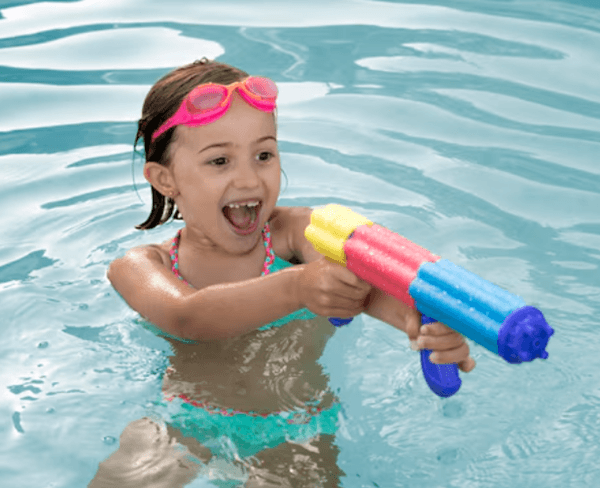
After spending enough afternoons by a community pool, you begin to recognize a certain type of child. They want to know things and climb out of the water dripping, forgetting their towel. Why does chlorine cause eye irritation? When their lungs are full, why do they float more easily? Why does the sound of someone pressing a pillow against the surface come from the underwater world? Parents who are standing close typically nod and say something courteous. Week after week, lesson after lesson, the questions never stop. There’s a chance that the pool itself is appealing.
Families were sold swimming as a safety skill for many years. The fundamentals of drowning prevention and water confidence. Then it evolved into a fitness pitch that was full-body, low-impact, and beneficial for posture. The discussion has only lately begun to veer toward something more unusual and fascinating. Researchers are now confirming what swim instructors in places like Brisbane and Toronto have been quietly noticing: children who regularly swim seem to develop a hunger for *how things work*. Not only in the water. in every aspect.
| Topic | Swimming and Cognitive Curiosity in Children |
|---|---|
| Field of Study | Pediatric Cognitive Development & Aquatic Education |
| Key Research Source | Griffith Institute for Educational Research (2019 Early Years Study) |
| Notable Mechanism | Bilateral cross-patterning, corpus callosum development |
| Age Range Studied | 3 months – 12 years |
| Linked Cognitive Gains | Memory, focus, language, problem-solving, emotional regulation |
| Reference Authority | Griffith University – Early Years Swimming Research |
| Article Type | Feature, observational journalism |
The early signs are impressive, but the science behind it is still up for debate. According to a 2019 Griffith Institute for Educational Research study, children who learned to swim at a young age achieved language, fine motor coordination, and memory milestones more quickly than their peers who did not swim. Bilateral cross-patterning, which sounds boring until you see a four-year-old trying freestyle for the first time, is the mechanism that researchers keep coming back to. Their right leg kicks and their left arm tugs. At precisely the wrong time, their head turns to breathe. The brain then gradually begins to connect it. Speaking from both hemispheres. Most land sports don’t provide the same level of exercise to the corpus callosum, the thick band of nerve fibers that connects the two sides of the brain.
The similarities to the way science requires thinking are difficult to ignore. In miniature, a child figuring out why their body sinks when they exhale is doing what physicists do. observing. Changing. Testing once more. You can see it if you walk into a swim school on a Tuesday night. A boy asks his coach why his goggles only fogged up on one side after stopping in the middle of the lane and treading water. With a shrug, the coach remarks about temperature variations. The boy scowls, puts it away, and tries something different the next time. It’s not an athletic instinct. That’s the wet version of the scientific method.
Teachers feel that this isn’t a coincidence. You are resisted by the medium of water. A child notices that water pushes back when you wave your hand through it, but air does not. All of a sudden, drag, buoyancy, and the way a kickboard tilts under uneven pressure are real. These are not abstract ideas from a textbook written ten years ago. They are occurring against the skin at this very moment. After all, lectures are not typically the source of curiosity. Friction with the physical world is how it gets there.
Although it receives less attention, the emotional piece is equally important. Children tend to sleep better after swimming because it releases endorphins and the rhythmic breathing serves as a sort of unintentional mindfulness practice. A child who is calm and well-rested is inquisitive. One who is overstimulated and worn out is not. This is already evident to anyone who has attempted to explain a science museum exhibit to a weary seven-year-old. The mental space that questions require to land is somehow cleared by the pool.
I’ve talked to swim instructors, and they mention something else that’s more difficult to quantify. Regular training helps kids become more at ease with their ignorance. They swallow water, miss a flip turn, and try again. Swimming may be the most underappreciated cognitive gift because it provides low-stakes practice with making mistakes. Failure in the pool isn’t disastrous; it’s just wet. Real science is powered by the same energy. The majority of experiments fail. The majority of theories are partially incorrect. Years later, a child who learned to laugh after a poor dive might be the same child who ignores a negative lab result and repeats the experiment with a different variable.
This is not to say that all young swimmers go on to become chemists. Many talented scientists never learned how to perform a proper backstroke, and the research is suggestive rather than deterministic. There is a pattern to it. With no screen separating them from the experience, the pool is one of the few places where kids can simultaneously experience raw physics, social patience, and personal boundaries. As you watch this develop over several seasons, it begins to feel more like a quiet apprenticeship than a coincidence. Scientists might not be made by swimming. It appears to preserve a child’s desire to become one.
i) https://www.orcamultiaquatics.com/post/why-swimming-boosts-brain-power-and-academic-performance-in-kids
ii) https://davinasswimhouse.com/how-swimming-shapes-the-brain-the-learning-benefits-no-one-talks-about/
iii) https://kidscanswimcanada.ca/how-swimming-helps-children-think-smarter-focus-better-and-learn-faster/
iv) https://www.aquachamps.com/2020/01/26/the-sooner-you-swim-the-smarter-you-will-be/
v) https://swimstars.co/en/blog/advice-en/swimming-would-make-you-smarter/