

The custom is familiar to anyone who learned to swim prior to the late 1990s. For the remainder of the afternoon, the cold pressure of an overly tight elastic strap left a ring across the temple, causing red eyes and a chlorine sting. Back then, wearing goggles was practically a punishment. The majority of students removed them in the middle of class and squinted to avoid the burn. Seeing a four-year-old put on her own goggles without assistance no fuss, no tears, the strap clicking neatly behind her ears with a quick-release button while passing a Saturday morning swim class is strange these days. People don’t realize how much work that little click is doing.
The children’s swimming goggles that were available in supermarket aisles a generation ago are not the same as the ones you find on the rack today. For years, companies such as Splash About, Speedo, Zoggs, Aqua Sphere, and Zone3 have been rethinking the shape of a child’s face, which is, as it turns out, very different from that of a small adult. silicone seals that are softer. wider nose bridges that are occasionally interchangeable. Kids who want to race can use lower-profile lenses, while those who would rather pretend to be snorkeling in a coral reef can use mask-style frames. It seems like the industry has finally addressed the issues that parents have been quietly grumbling about for years.
The British company Splash About, which has been in business since the mid-1990s, clearly divides its goggles into two categories: a junior line with brands like Piranha, Koi, and Snapper for those aged six to fourteen, and an infant line called Guppy and Minnow for those aged two to six. You can infer some information about the target audience from the color schemes alone Pistachios, Croc Blue, lavender and Lime. The fact that these are not the subdued black-and-grey goggles of the past is more significant than it first appears. A child who enjoys the appearance of her goggles will continue to wear them.
| Information | Details |
|---|---|
| Brand Spotlight | Splash About |
| Founded | 1995, United Kingdom |
| Product Category | Kids Swimming Goggles & Swimwear |
| Age Ranges Covered | Infant (2–6 years), Junior (6–14 years) |
| Notable Features | Anti-fog lenses, UV protection, quick-release strap, soft silicone seals |
| Popular Lines | Infant Guppy, Junior Piranha, Junior Koi, Snapper Mask |
| Headquarters | United Kingdom (global shipping) |
| Reference | splashabout.com |
It’s possible that technical rather than artistic changes have been the most significant. Once considered a luxury feature, anti-fog coatings wore off after three swims. Even on entry-level pairs, it is now the norm. For families who spend half of the summer at outdoor pools or on vacation near the coast, the lenses’ built-in UV protection makes a huge difference. You can see why this kind of subtle engineering advancement is valued long before it is noticed when you watch a parent attempt to wrestle sunscreen onto a fidgety toddler by the pool.
The market’s competitive segment has taken its own course. For children who have progressed from splash-and-play to real club swimming, Speedo’s Junior Vengeance, the TYR Black Hawk, and comparable low-profile racing goggles remove bulk to reduce drag. The fact that parents of nine-year-olds are suddenly familiar with the term “FINA approval” indicates how seriously some families are taking the sport. And there’s a reason for that. Following the Tokyo Olympics, club registrations increased noticeably, according to British Swimming, and the impact on junior gear has been consistent.
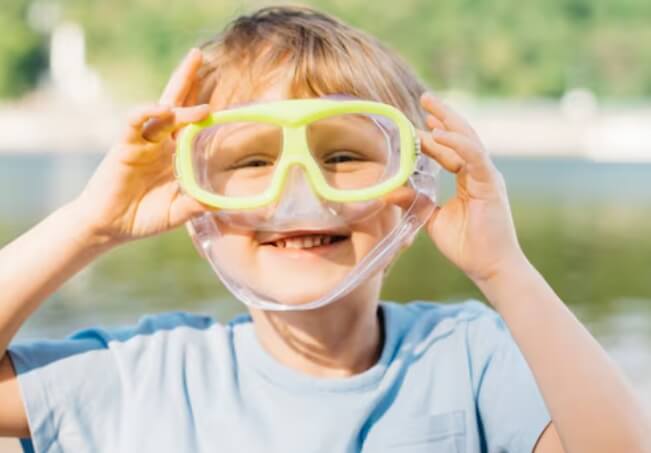
Then there’s the mask category, which has subtly emerged as the most well-liked option for younger children. A mask-style goggle prevents painful suction marks, a panicked moment when water seeps in mid-lap, and a broader seal across the brow and cheekbones. Splash About’s Snapper, Aqua Sphere Seal Kid, and Zoggs Phantom all play in essentially the same area. Small hands can pull on them more easily without assistance, which may seem insignificant until you witness a six-year-old crying because she was unable to untangle her goggles.
Additionally, the price hasn’t increased as you might anticipate. A good pair still weighs between eight and twenty pounds, with more expensive mirrored or sport-specific models costing up to twenty-five pounds. Compared to purchasing, say, a new bicycle helmet, that is a lesser commitment for parents considering whether a restless four-year-old will actually use them.
The extent to which this evolution went unnoticed is difficult to ignore. Goggles are not a high-end item. There isn’t a glamorous launch party or a well-known celebrity spokesperson. A little bit of childhood was subtly improved somewhere between the silicone seals and the rainbow strap colors. Children spend more time swimming and less time fussing. Less time is spent by parents searching beneath the pile of towels for the lost pair.
It’s still unclear if smart lenses or completely customizable fits will follow the upgrade. As of right now, what’s on the shelves works remarkably well. If the young child came up for a breath long enough to mention it, she would most likely tell you that she was able to put on her own Guppy goggles without assistance.
i) https://www.splashabout.com/collections/goggles-accessories-goggles-kids-goggles
ii) https://www.simplyswim.com/collections/childrens-goggles
iii) https://www.zoggs.com/en_GB/shop-goggles/kids-up-to-6-yrs
iv) https://cindysswimschool.co.uk/what-are-the-best-swimming-goggles-for-children/