

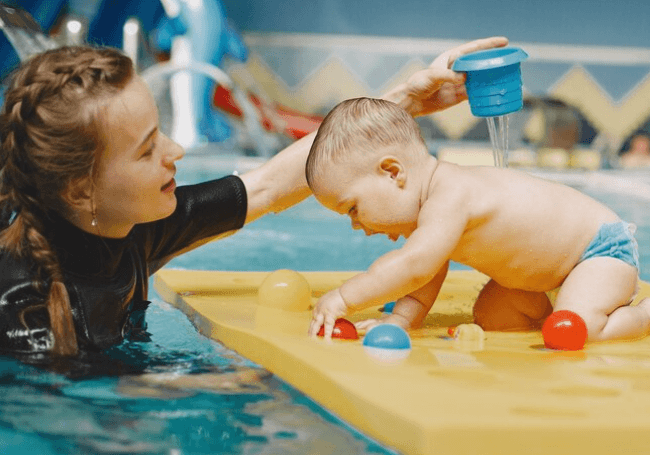
On a Saturday morning, the deck of a toddler swim class is filled with a certain sound. A teacher counting down before a controlled little submersion. A steady murmur of parents humming along to nursery rhymes. Or the soft slap of small hands on water are examples of softer sounds than the shrieking you might anticipate.
You begin to suspect something is going on here that the brochures don’t fully convey as you spend more time around it. It’s an unhurried kind of chaos. Drowning is the only concern that most parents have when enrolling their young children in swimming lessons.
| Topic Snapshot | Details |
|---|---|
| Subject | Early swimming lessons for toddlers (ages 6 months – 4 years) |
| Recommended Start Age | 6 months (parent-assisted); 1–4 years for formal lessons |
| Endorsed By | American Academy of Pediatrics, Swim Australia, Red Cross, Royal Lifesaving Society UK |
| Ideal Pool Temperature | 31–32°C (87–89°F) |
| Class Size Best Practice | 4 children per session for maximum attention |
| Core Skill Areas Developed | Water safety reflexes, motor coordination, cardiovascular health, social confidence, cognitive growth |
| Critical Stat | Around 90% of brain neurons form and connect before age five |
| Drowning Risk Data (UK) | Child drownings in England doubled from 20 (2019–20) to 41 (2022–23) |
| Reference | American Academy of Pediatrics – Swim Lessons Guidance |
Alright. According to the Royal Lifesaving Society UK, the number of child drowning deaths in England increased from 20 in 2019–20 to 41 in 2022–2023. Over the course of four years, 125 children lost their lives due to accidental drowning.
The question of whether early lessons are worthwhile is usually resolved by numbers like that. Survival is merely the tip of the iceberg and may not even be the most fascinating aspect of it. When you watch a six-month-old in a warm pool. Where the water is kept at a constant temperature of about 31 or 32 degrees. Which is almost amniotic. You’ll see that they move differently than they do on land.
They can push, kick, and twist before they can crawl. They get their first taste of independent movement in the pool, and it’s evident in their expressions. Something seems to be unlocking sooner than it normally would.
For years, pediatric experts have noted that by the time a child is five years old, about 90% of the brain’s neurons have formed and connected. This means that the years when most parents worry about screen time and snack choices are also the years when sensory-rich experiences leave the most lasting impression. Formal education should start between the ages of one and four, depending on the child, according to the American Academy of Pediatrics.
The number of programs that accept infants as early as six months in parent-assisted sessions is increasing, and their guiding principles are more about emotional preparation than athletic aspirations. The instruction is play-led and gentle. Babies naturally enjoy small movements like singing, floating, and splashing.
There’s no pressure to reach milestones within a specific week. Part of the point is that parents remain in the water the entire time. It may seem unimportant, but that parent-in-the-pool detail is crucial.
In contemporary parenting, bonding moments are often fragmented, such as a half-eaten meal while responding to emails or a bedtime story interrupted by a phone buzz. To be honest, it’s rare to spend twenty minutes in chest-deep water with nothing to do but hold your child and sing poorly. According to a number of swim instructors I’ve spoken to, parents frequently appear the most changed by the end of a term.
The infants quickly adjust. Adults have a harder time recalling how to be present. The body itself, working silently beneath the surface, comes next. Reaching for a floating duck or chasing a foam stick are examples of cross-lateral swimming motions that enhance hand-eye coordination, and the smaller grips and grasps improve wrist and finger fine motor skills.
The vestibular system, the unsung hero of balance and spatial awareness, is stimulated by the bouncing and splashing. Early swimmers frequently exhibit greater balance and coordination in unfamiliar physical circumstances. It is not magical.
A developing brain receives thousands of tiny inputs at the precise moment when it is most prepared to process them. The confidence piece is easier to identify but more difficult to quantify. When a toddler learns to trust water, they bring something new into the world.
They can relax in it, turn back toward the edge, and listen for the instructor’s voice. It’s a form of quiet self-possession, according to educators. The two-year-old who can flip onto their back and float for ten seconds develops into a four-year-old who attempts the climbing frame without assistance and. Eventually. A school-age child who raises a hand without hesitation. Some of this might have occurred in any case. Kids mature. It’s difficult to ignore the pattern.
Social skills accompany the journey. In group classes, toddlers learn how to wait their turn on the pool steps, applaud another child’s float, and obey basic directions in an environment other than home or daycare. On the pool deck, parents also create their own little communities.
Every Tuesday, they see the same faces, share towels, and joke about whose toddler always cries during the song. It may seem insignificant, but parenting can be lonely, and a voluntary weekly social ritual is more valuable than most people realize. There are restrictions.
Not all pools are designed with this in mind. A baby can become overwhelmed in roughly 90 seconds by crowded, chlorine-filled public pools with cold water and reverberating acoustics. The best option are purpose-built baby pools that are kept quiet and warm, but they’re not always affordable or readily available.
The instructor’s caliber is very important. Furthermore, it’s still unclear if more thorough research will support the cognitive gains some studies have suggested, such as boys outperforming girls on advanced language milestones and visual-motor tasks. Here, skepticism is beneficial. After observing enough classes and hearing from enough parents. It is evident that early swimming lessons provide a low-stakes. Sensory-rich. Fully present hour that benefits both parent and child simultaneously. Something that most contemporary toddler activities do not.
Water safety skills are real, and they might be important in the future in ways that no one wants to think about. Parents are more likely to recall the subtler advantages years later, such as the serenity, coordination, and small, self-assured expression on a toddler’s face when they kick across to the wall on their own. They’ll remember how it felt to be there with their child long after they’ve forgotten which week they first submerged their face in the water.
i) https://www.everyoneactive.com/content-hub/swimminglessons/under-5s-swimming-lessons/
ii) https://get-set-go.com/benefits-of-learning-to-swim-early-from-babies-to-toddlers/
iii) https://www.rlss.org.uk/blog/the-importance-of-baby-and-toddler-swimming
iv) https://swim4lifeschools.com.au/benefits-of-early-swimming-lessons/
v) https://www.waterbabies.co.uk/blog/become-swimvincible/