

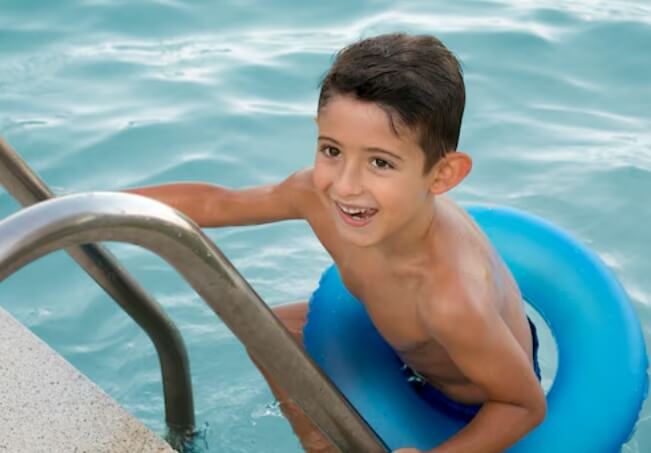
In a British backyard, there’s a certain sound that heralds summer and it’s not birdsong. It’s the slow groan of vinyl swelling with air, followed by the wheeze of a foot pump. Right now, a child is hopping impatiently close to a parent who is kneeling on the grass, red in the face, shaping the sides of a paddling pool. Every June, it takes place. Tomorrow, it will occur once more.
Companies like Bestway have built an entire catalog around the inflatable pool, which has become a quiet fixture of family life. It includes play centers, family-sized versions, traditional paddling pools, and the hassle-free Fill ‘N Fun pools that do not require a pump. Some come with firm, elevated sides and UV sunshades, which are minor features meant to protect toddlers rather than just amuse them. With all that plastic, it’s simple to become pessimistic. It’s difficult to miss the significance when you see a two-year-old laughing at the realization that water splashes back for the first time.
| Key Information | Details |
|---|---|
| Topic | Kids swimming pools — home and public |
| Common Types | Inflatable paddling pools, play centres, learner pools, heated lidos, Olympic-size pools |
| Suitable Ages | Babies and toddlers (learner pools) through to teenagers |
| Main Benefits | Low-impact full-body exercise, water confidence, mental wellbeing, lifelong safety skill |
| Notable UK Providers | Bestway (home pools); Better / GLL (140+ public pools and lidos) |
| Featured Venue | London Aquatics Centre — 2012 Olympic swimming venue |
| Accessibility | Poolpod lifts and submergible wheelchairs at many public sites |
| Reference Website | londonaquaticscentre.org/swimming |
On the hottest days, these pools deserve their spot. No one talks about them again until the next warm spell because they are simple to inflate, drain, and fold away when September arrives. The first proper afternoon of the year, the garden hose, towels drying on the fence, and a parent pretending not to notice they’ve been soaked all give the impression that a children’s swimming pool in the garden is more about ritual than swimming.
The capabilities of an inflatable are limited. Children eventually outgrow splashing and require real water, which is deeper, colder, and more demanding. That’s where public pools in Britain subtly take over. Most people are unaware of how big the network is. Better, the trading name of the nonprofit organization GLL, operates ten outdoor lidos and lakes in addition to over 140 indoor pools. These facilities range from the well-known Manchester Aquatic Centre to tiny community pools hidden behind busy streets. They claim to be the largest swimming lesson provider in the nation, instructing thousands of infants, kids, and anxious adults annually.
Of course, London has some of the most memorable choices. The 36-meter outdoor lido at Hampton Pool, which is located inside Bushy Park, is heated to 28 degrees all year round. It has a grassy area for idle football and picnics, as well as a shallow learner pool for infants. Locals stubbornly refer to Brockwell Lido as Brixton’s Beach, and it is located inside a 125-year-old park behind an art deco frontage. It is unheated and gloriously simple. The fifty-meter London Fields Lido in Hackney is open year-round and is divided between families looking to cool off and serious lane swimmers.
The London Aquatics Centre, where people can still swim in the same water as the 2012 Olympians, is the centerpiece. There are three pools, one with Olympic-sized lanes and another reserved for families and recreational swimmers. The Aqua Splash sessions, which are inflatable obstacle courses that transform the pool into something more akin to a moist, soft battlefield, take over on weekends. Youngsters over five take on the shorter wipe-out course, while older kids attempt the longer, more brutal versions. Not many of them succeeded on their first attempt. Charlton Lido, on the other hand, maintains temperatures of 25 degrees throughout the bitterly cold winter months, demonstrating how seriously this nation takes outdoor swimming.
Why should I bother with any of this? Swimming improves strength and cardiovascular health while being gentle on developing bodies because it works nearly every muscle without straining joints. The physical case is not the whole story. According to one Better member, the pool is the only location where she can’t be reached by phone or email; the water serves as a sort of haven. Two seasoned lido swimmers, referred to as the Lido Ladies in the area, discuss a community that is more concerned with getting in than with fashion, size, or shape. That might be the true advantage concealed beneath the lengths.
It’s also worth mentioning that it’s fair. These days, many of these pools have submergible wheelchairs and poolpod lifts that allow people with limited mobility to enter the water on their own. It’s a small piece of engineering that does a lot of quiet good.
Whether a generation that grew up with screens will continue to use them as adults is still up for debate. Lessons fill up, attendance fluctuates, summer arrives, and the pumps start up again. The pattern seems less like a trend and more like something ingrained in the culture when you watch it develop year after year. In thirty years, a child laughing in a paddling pool in their backyard might be performing slow lengths at a heated lido. or not. In any case, putting them in the water seems like a good place to start.