

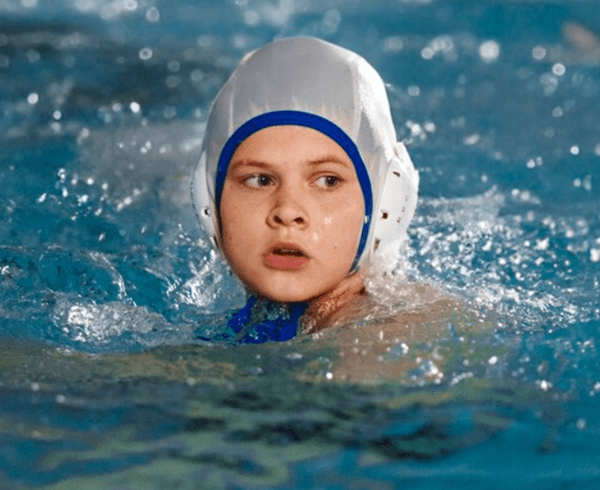
No matter which country they are in or which pool they are standing next to, there is a moment that people who work with children describe in nearly identical terms. A child enters the gate with a tense expression on their face, shoulders raised, jaw clenched, and all the traits of an eight-year-old’s day. That same child is a completely different person thirty minutes later, dripping and laughing. Until you’ve seen it happen enough times that it ceases to surprise you, it sounds like an exaggeration.
The way that parents, pediatricians, and researchers view children’s mental health is changing, and the discussion is moving closer to the water. Previously categorized as a “nice extracurricular” or “essential safety skill,” swimming is now being researched and discussed as one of the more effective mental health tools available to children. Not an additive. Not much of a bonus. a real intervention that has quantifiable effects on mood, anxiety, sleep, and cognitive function. It is now more difficult to dismiss that case in 2026.
| Topic | Swimming as a Mental Health Intervention for Children |
| Year of Growing Significance | 2026 (accelerated post-2025 World Aquatics Championships) |
| Key Hormones Involved | Endorphins, Serotonin, Dopamine, Cortisol (reduced) |
| Recommended Frequency | 2–3 sessions per week, 30 minutes minimum |
| Core Mental Benefits | Reduced anxiety & depression, improved focus, better sleep, boosted self-esteem |
| Age Range | All ages; particularly impactful for children aged 3–16 |
| Leading Research Bodies | University of Portsmouth, University of Texas at Austin, Swim England, International Journal of Environmental Research and Public Health |
| Notable Concept | “Blue Mind” theory — Dr. Wallace J. Nichols, marine biologist |
| U.S. Swimming Participation | 300+ million recreational swimming visits annually (CDC) — 4th most popular recreational activity |
| Reference | Swimming World Magazine — swimmingworldmagazine.com ↗ |
For a long time, the science has been developing. The brain’s reactions during swimming are remarkably similar to those that occur during meditation. Cortisol, the body’s main stress hormone, is reduced by the steady breathing, the rhythmic motion of the strokes, and the muffled underwater silence that muffles the background noise of homework, school, and social pressure. Dopamine, serotonin, and endorphins are released simultaneously with the aerobic effort. Few other childhood activities can replicate this chemical combination as thoroughly or consistently as this one. According to research from the University of Portsmouth and supporting studies that were published in the International Journal of Environmental Research and Public Health, children’s anxiety and depression symptoms can be considerably reduced by swimming.
Dr. Wallace J. Nichols, a marine biologist, introduced a concept that is worth understanding: “Blue Mind.” According to the theory, humans have a neurological reaction to water; being in, around, or even hearing it causes the brain to become calmer and more focused. Nichols contends that this is biology rather than poetry or preference. Brain regions linked to comfort and safety are activated when one sees water. Children may be particularly vulnerable to this effect, in the best way possible, because their nervous systems are still developing and they are virtually constantly exposed to digital overstimulation. Of all places, a swimming pool might be the closest thing that many children can get to a real mental break.
Interestingly, the advantages extend beyond mood. Measurable increases in cerebral circulation have been found in studies monitoring blood flow to the brain during submersion in water, which translates into sharper cognitive function, better attention, and improved memory. Children who regularly swim are more likely to concentrate better in class, deal with frustration more patiently, and sleep better, according to reports from parents and teachers. Anecdotally speaking, these are not anomalies; rather, the trends are so consistent that researchers are now endorsing swimming as a valid means of promoting children’s academic and emotional growth in addition to serving as an exercise. This represents a significant change in the classification of the activity.
What swimming does to a child’s sense of self is another issue. Swimming is a truly difficult skill to learn. The water requires real effort, real repetition, and real patience, regardless of your intelligence or popularity. Something difficult to replicate artificially occurs when a child who was terrified of the deep end eventually crosses the pool on their own. In a way that is transferable, that moment of mastery the body performing an action it was previously unable to perform builds confidence. It appears to be present in social settings, classrooms, and difficult times. Regular swimmers seem to develop a quiet confidence in their own abilities that is more valuable than any number of organized confidence-building activities.
The social factor is also important. There’s an odd egalitarianism about swimming pools. Children from different schools, neighborhoods, or family circumstances are not differentiated by the water. Swim clubs and group classes foster communities where friendships are built on mutual effort and advancement. Parents frequently describe the pool setting as surprisingly welcoming for kids who have social difficulties and find group environments overwhelming or exclusive. For years, coaches have been aware of this. There is a genuine and noticeable relief on some children’s faces when they understand that no one is judging their stroke.
Since access to pools is still uneven and there are practical obstacles, it is still unclear whether swimming will be formally incorporated into school mental health strategies at scale. However, the research’s trajectory and the increasing weight of firsthand observation are pointing in a particular direction. The pool is presenting itself as something worth taking seriously at a time when anxiety in children is on the rise and parents are looking for solutions that don’t involve a screen or a prescription. Not because it fixes every problem. But more and more, it appears to be beneficial in ways that are difficult to dispute and simple to accept once you’ve seen them.
i) https://cindysswimschool.co.uk/why-swimming-is-great-for-your-mental-health/
ii) https://american-pools.com/swimming-brain-boost-back-to-school-2025/