

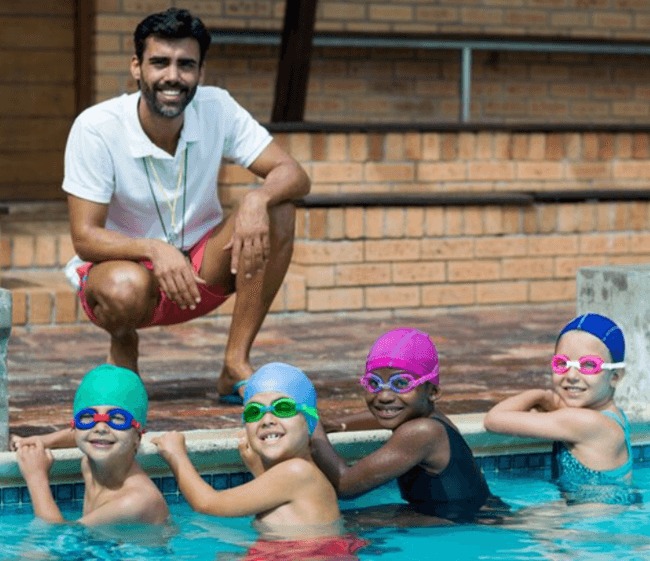
Anyone who has seen a child advance through swim lessons will recognize the moment when something changes. Abruptly, the child who was clinging to the edge of the pool two weeks ago pushes off and glides.
Nobody instructs them to appear proud. They simply do and something far more profound than muscle growth or water safety is taking place in that little, unremarkable stretch of shallow pool. This is the start of a routine. One that could endure for decades if the research is correct.
Swimming may not receive the recognition it merits. Without fully understanding what the pool is subtly teaching their child every week, parents frequently view it as a survival skill something to cross off the list before summer vacation by a lake self-control. control of breathing. self-confidence. the readiness to attempt uncomfortable things until they become second nature. These values are not ethereal. They are repetitive habits that have a tendency to travel.
| Topic | Swimming as a child development and lifelong health tool |
| Recommended starting age | As early as infancy (parent-child programs); structured lessons from age 3–4 |
| Primary benefits | Physical fitness, cognitive development, water safety, emotional resilience, social skills |
| Key safety statistic | Drowning is a leading cause of accidental death in children aged 1–14; early lessons significantly reduce risk |
| Exercise type | Low-impact, full-body; combines endurance, strength, and flexibility |
| Mental health link | Shown to help manage anxiety, hyperactivity, and ADHD through rhythmic, calming movement |
| Academic impact | Regular swimmers show improved memory, focus, and developmental milestone achievement |
At this point, the physical case for early swimming is almost too solid to be contested. Water is especially beneficial for developing bodies because it provides natural resistance without the joint stress associated with land-based exercise.
Young swimmers gain coordination, core strength, and cardiovascular endurance in ways that transfer to other sports and, more significantly, to daily movement. Regular swimmers tend to have better posture, more stable balance, and a certain ease in their bodies that you can’t quite put your finger on. It’s difficult to determine whether the pool is a cause or an effect of that physical confidence. Most likely both.
The effects of swimming on the brain are less widely discussed. According to studies, kids who swim frequently reach developmental milestones in language, spatial awareness, and early academic readiness earlier than their peers who don’t swim.
Swimming’s rhythmic quality and the need for simultaneous arm, leg, and breath coordination appear to foster the kind of cross-brain communication that promotes focus and memory. It resembles a play-based cognitive exercise. This is less shocking than it might seem to parents who see their children return home from a swim session more composed and at ease.
Additionally, the emotional aspect is often disregarded in favor of the more quantifiable physical advantages. Swimming exposes kids to an environment that is truly unfamiliar: one in which breathing must be actively controlled rather than merely permitted, where the ground isn’t solid, and where standard movement rules don’t apply.
The predictable format of a swim lesson the same lane, the same instructor, the same movement sequence can be incredibly calming for kids who are struggling with anxiety or hyperactivity. The world seems contained in the pool. Developed in the water, that feeling of serenity and control has a way of transferring to dry land.
Then there is what swim lessons in a group setting offer. Compared to a classroom or playground, shy kids frequently find it easier to open up in the pool because there is less social pressure, less scrutiny, and the common goal of not drowning tends to level the playing field.
Waiting turns, supporting peers during relay drills, and accepting guidance from someone other than a parent are all examples of how cooperation is ingrained in the system. Week after week, these little social rehearsals accumulate. Youngsters who are taught early on how to work in a group and appreciate others’ accomplishments without devaluing their own are more likely to carry that ease with them.
Although the exact reason why early swimming habits persist into adulthood is still unknown, a consistent pattern emerges. Simply put, swimming is one of the few types of exercise that doesn’t gradually harm the body.
Almost always, joints that are incapable of running at sixty can still swim. Since it’s an activity that develops with you, kids who associate it with enjoyment and self-assurance in their early years are less likely to give it up when life becomes challenging. It just needs a pool; it doesn’t need to be reinvented.
As you watch this happen, lesson by lesson, child by child, you get the impression that the pool is accomplishing something that is difficult to duplicate elsewhere. It teaches children to move despite discomfort. to breathe when it’s difficult. When they sink, try again. There are lessons that are worse for a child to learn.
According to the research and the pool deck, parents who are unsure about when to begin should start sooner rather than later. There won’t be a swimmer from the first lesson. However, it might plant something that doesn’t fully bloom for thirty years.
i) https://fitnesschamps.com.sg/how-swimming-supports-kids-growth-and-development/
ii) https://aquaticpros.org/swimming_into_success_early_swim_lessons/
iii) https://www.kjaquatics.com/why-learning-to-swim-is-an-essential-life-skill-for-all-ages/
iv) https://www.swimjim.com/blog/diving-into-development-how-kids-benefit-from-swimming