

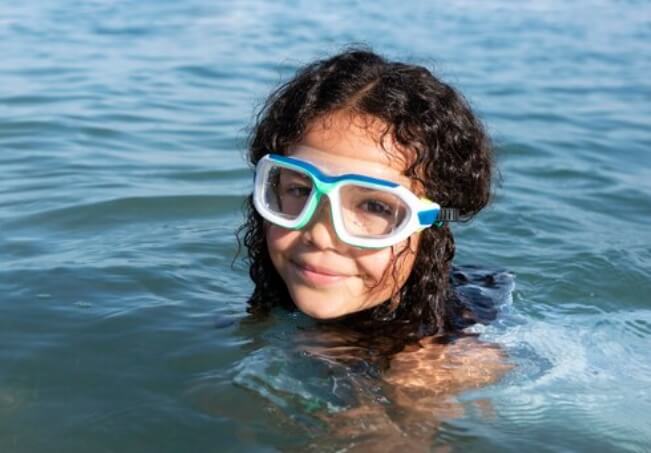
On a Saturday morning, you can see them if you stroll by any community pool. Bright pink and electric blue rubber forms that occasionally have a tiny cord looping behind the head. Ten years ago, a parent might have reached into the medicine cabinet for a pair of foam earplugs and called it a day. There’s a reason why that doesn’t actually occur anymore.
The ears of children are not miniature versions of those of adults. They tend to retain water much longer than most parents realize, have a different shape, and drain less effectively. This helps explain why children are far more likely than their parents to experience swimmer’s ear, a painful inflammation of the outer canal. It’s not a dramatic solution. Typically, it’s a soft silicone plug that sits at the ear canal’s entrance and effectively and silently performs one task.
Families’ perceptions of these plugs have gradually changed. Speaking with swim instructors and the parents who were waiting on the bleachers seemed to shift the topic from “do we really need this?” to “which kind actually stays in?” Anyone who has witnessed a six-year-old repeatedly shake water from her head before declaring that her ear hurts can see why. Because parents kept asking, companies like Alpine, which received a Red Dot Design Award for its adult SwimSafe line, eventually created a children’s version called Pluggies Kids. Because the market would not stop asking, the market responded.
| Quick Reference | Details |
|---|---|
| Topic | Swimming Ear Plugs for Children |
| Recommended Age Range | 3 to 12 years |
| Most Common Material | Soft medical-grade silicone |
| Top Concerns Addressed | Swimmer’s ear, middle ear infection, ear tubes |
| Typical Lifespan (Custom) | 4 to 5 years |
| Featured Brands in Industry | Alpine Pluggies Kids, Bollsen Kidz+, SwimSafe Custom 4D, Speedo, Zoggs |
| Often Paired With | Swim headbands, ear drops, drying solutions |
| Reference Source | American Academy of Otolaryngology – ENT Health |
The traditional swimming aid, foam, has largely lost popularity. Instead of obstructing water, which is what you want, it absorbs it. It has been replaced by silicone, particularly the soft pre-molded variety. It is gentle, reusable, and produces the crucial watertight seal. Companies that have pushed in that direction include Speedo, Zoggs, and Bollsen Kidz+. Although there is ongoing discussion about whether moldable wax plugs are a cost-effective choice, the majority of audiologists appear to be against them for very young swimmers. Parents are sometimes unable to determine whether the seal is correct, and children lack the patience to properly shape them.
Then there’s the issue of kids who have ear tubes, which are tiny grommets that are surgically inserted to help drain middle ear fluid. Swimming used to come with a long list of cautions for these children. As long as some kind of water protection is in place, the majority of ENT specialists are now more laid back about swimming. Since the fit must be exact, custom-fit plugs are typically the recommended option in this situation. Although it’s still debatable whether complete protection is necessary for casual splashing, the general consensus is strongly in favor of it for diving and submersion.
The subtle luxury of this entire category is custom molds. A few weeks after the audiologist takes an impression of the child’s ear, a pair of plugs that are specifically designed for that child are delivered. Until your eight-year-old drops one in the shallow end, it may seem insignificant that they float. They last four or five years, which is more time than most children spend in a single shoe size. Among other clinics, Audiology Island in Staten Island has established a small business producing them, and parents appear willing to pay because the alternative is to replace drugstore plugs every few months and still end up at the pediatrician with a red, sore ear.
Smaller observations are also important. The child will wear a plug if it is available in the color they have chosen. Because plugs left at the bottom of a damp swim bag grow things you don’t want in an ear canal, storage cases are important. Cleaning schedules that the child participates in are more likely to be followed than rules that are imposed from above. None of this is novel parenting guidance. It’s simply the gradual accumulation of lived-in knowledge around a weekly activity that families engage in.
It’s difficult to ignore how unglamorous the entire situation is as you watch this segment of the market develop. Children’s earplugs don’t have any viral marketing campaigns. No endorsements from famous people. Just a quiet, steady improvement in the products that are offered and the guidance that families are given. It is still up to the individual to decide whether or not each child truly needs them, frequently after speaking with an ENT or pediatrician. The question has evolved. Earplugs used to be a question of whether they were worth the hassle. These days, it’s mostly about the type and color.
i) https://bollsen-hearingprotection.com/blog/child-ear-plugs-for-swimming/
ii) https://audiologyisland.com/blog/the-best-swim-ear-plugs-for-kids
iii) https://www.independent.co.uk/extras/indybest/outdoor-activity/swimming/best-earplugs-swimming-adults-a9694346.html