

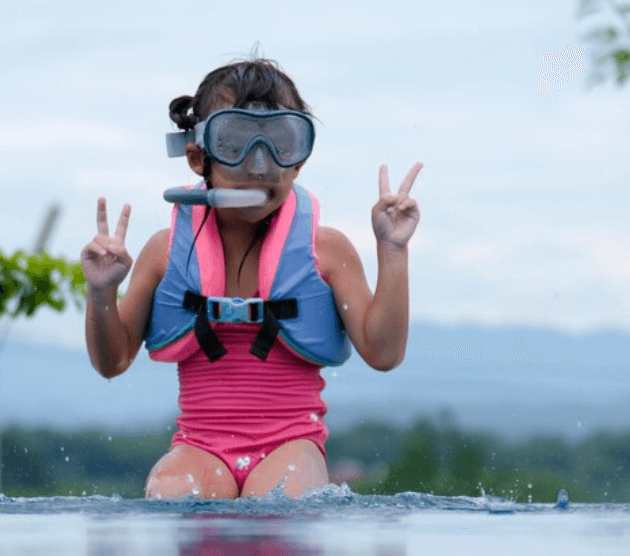
If you’ve watched enough kids’ swimming lessons, you’ve undoubtedly witnessed a certain moment that occurs in practically every one. A child approaches the pool’s edge, looks up at the instructor with a somewhat weary resolve, and attempts the same stroke for what may be the fifteenth time that session. They still haven’t figured it out. They won’t become proficient in it today. Additionally, something subtly significant that has nothing to do with swimming is taking place somewhere during that repeated attempt.
Patience is the key and perhaps the most difficult skill a child can be expected to acquire in 2026 is patience. Our world has become incredibly adept at eliminating waiting from daily existence. Food is either free or arrives in thirty minutes. Before you can find the remote, a movie starts to stream. Before questions are completely typed, answers are displayed.
| Topic | Swimming for Children’s Development |
|---|---|
| Focus Area | Patience, Mental Discipline & Cognitive Growth Through Swimming |
| Key Benefit | Builds patience, focus, resilience, and delayed gratification in children |
| Recommended Age to Start | As early as 6 months (water familiarization); structured lessons from age 3+ |
| Supporting Research | Griffith University 4-year study (7,000+ children across USA, Australia & New Zealand) |
| Key Statistic | 84% of parents report mood improvement after swimming lessons (Swim England, 2025) |
| Cognitive Advantage | Children who swim are up to 15 months ahead in social/emotional development |
| Governing Body / Reference | Swim England – #LoveSwimming Research |
| Physical Benefit | Full-body workout, joint-friendly, builds coordination and cardiovascular health |
| Mental Benefit | Reduces stress, builds emotional regulation, encourages delayed gratification |
| Notable Expert | Leon Taylor, Olympic silver medalist (Athens 2004), swim advocate and parent |
The experience of wanting something and just not having it yet has become truly uncommon for kids growing up in this setting. For years, pediatric researchers and educators have been discreetly bringing up this issue, but the solutions that are being proposed such as screen limits, mindfulness training, and regimented schedules tend to be theoretical. The fact that physical activity, especially swimming, may be doing some of the hardest lifting when it comes to developing this capacity in kids is something that is not often discussed.
Swimming takes time. That’s the idea. A child cannot learn to swim while watching a tutorial. They are unable to click a button to unlock a new level or buy a shortcut. No matter how intelligent they are, how much their parents have invested, or how irritated they are, the water doesn’t care. When the body learns to trust the water, it can float. This trust is developed gradually, session after session, incorporating setbacks and corrections along the way. The pool is a truly foreign environment for kids who are used to quick feedback loops, and that foreignness proves to be very beneficial.
Over the course of four years, research from Griffith University in Australia tracked the development of over 7,000 children under the age of five in the US, Australia, and New Zealand. Regular swimmers were not only physically superior. In terms of social and emotional development, they were about 15 months ahead of their peers. It’s a startling number. Self-control, the capacity to tolerate frustration, and the ability to persevere toward a goal are examples of social and emotional development. Put differently, the architecture of patience itself.
Here, structural factors contribute to the effectiveness of swimming. Every lesson builds upon the one before it. A child learning to swim must go through several phases, such as breathing rhythm before speed, basic comfort before actual technique, and floating before stroking. It is impossible to build something functional without starting with the foundation.
This is aptly explained by Danny Yeo, a former competitive swimmer who is now a coach in Singapore: skill mastery at every level guarantees that swimmers can advance smoothly and confidently. He points out that hurrying causes gaps in technique, confidence, and the internal conviction that effort truly yields results. Parents might not always see this clearly, particularly if other students in the class appear to be progressing more quickly. However, children learn that progress is earned rather than given when they respect the pace of the pool.
It is challenging to duplicate the mental discipline that is developed in the water. A young swimmer has to control their breathing, arm timing, body position, and whatever instruction the coach called across the pool at the same time. That’s a lot of information to process at once. Children learn what psychologists refer to as working memory over the course of weeks and months of practice, which is the capacity to act on several ideas at once. According to a 2025 study by Swim England, almost eight out of ten parents said that regular swimming lessons improved their child’s focus and attention span. These are not insignificant advancements. These are the kinds of classroom improvements that educators observe.
Additionally, children seem to be calmed down by the physical surroundings of water. Swimming’s rhythmic qualities the steady stroke, the repetition of laps, and the water’s predictable resistance have a truly relaxing effect on the nervous system. Parents often observe that swimming lowers cortisol levels and releases endorphins without having to read the research. When a child enters a pool session tense and overstimulated, they frequently emerge calmer, more relaxed, and easier to talk to. The conditions for patience to truly develop are created by that physiological reset. Observing a group of six-year-olds come out of the pool after 45 minutes makes it difficult to ignore the fact that something has changed within them.
Perhaps more than any other kid-friendly activity, swimming teaches kids about delayed gratification. It could take three weeks to learn a new stroke. It could take three months to swim the entire distance without stopping. Children remember the genuine and earned satisfaction when it occurs. They have it with them. The coaches at Fitness Champs in Singapore put it this way: kids start to realize that it may take weeks to master a challenging stroke, but the reward is worthwhile. It is truly countercultural at the moment to realize that working and waiting yield better results than clicking or demanding. It might also be among the most crucial lessons a child can acquire.
It’s still unclear if contemporary parents understand how uncommon and challenging it has become for kids to come across situations that naturally require this level of patience. Activities that don’t involve screens have evolved into a category, a conscious decision made in opposition to everyday life. Swimming has all the cognitive and emotional training that gradual, hard progress offers, but it doesn’t feel like deprivation rather, it’s enjoyable. The youngster lining up at the pool’s edge to attempt the same stroke once more isn’t failing. They are engaging in a practice that is no longer required of them by the outside world. That may be the most significant event taking place in the water.
i) https://kidscanswimcanada.ca/how-swimming-helps-children-think-smarter-focus-better-and-learn-faster/
ii) https://www.swimnow.co.uk/health-and-wellbeing/9-benefits-of-swimming-for-kids/
iii) https://davinasswimhouse.com/how-swimming-shapes-the-brain-the-learning-benefits-no-one-talks-about/
iv) https://pedalheads.com/en/blog/swimming-benefits-for-kids