

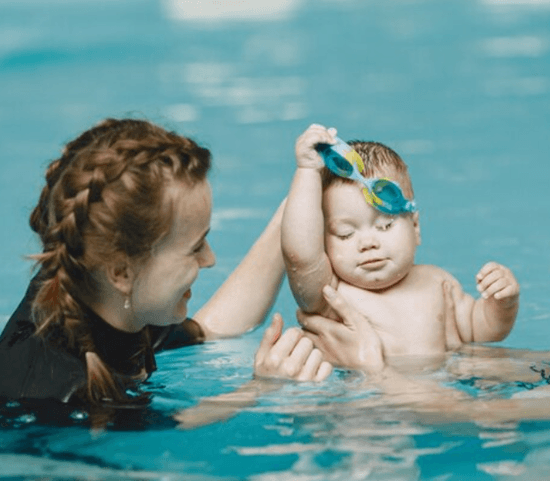
The harsh fluorescent lights, the smell of chlorine that clings to your jacket for hours afterward, the echoes of small voices bouncing off tiled walls. Then, twenty minutes after arriving screaming, a toddler is floating on her back, half-closed and motionless, somewhere in the shallow end. Her mother appears to have seen a minor miracle as she observes from the deck while holding a cold cup of coffee.
Nobody really discusses this portion of swim lessons. This is the part that has very little to do with breathing, kicking, or surviving a pool fall. Parents, teachers, and a few researchers are beginning to feel that there is more going on in those lessons. It has to do with how a two-year-old learns to manage the massive, overpowering weather system that is her own emotions.
| Topic Information | Details |
|---|---|
| Subject | Swimming and Toddler Emotional Regulation |
| Age Group Focus | 6 months to 4 years |
| Recommended Frequency | 2–3 sessions per week |
| Key Benefits | Reduced cortisol, improved focus, social skill development, self-confidence |
| Optimal Starting Age | 6 months (once head control is established) |
| Notable Research | Griffith Institute for Educational Research, Australia (Prof. Robyn Jorgensen) |
| Health Endorsement | Recommended by the UK’s NHS for child anxiety and mental wellbeing |
| Reference Source | American Academy of Pediatrics – Swim Lessons Guidance |
The research itself is still in its early stages of development. Anecdotal evidence, however, has been accumulating for years. Almost without being asked, swim instructors who have worked with toddlers for decades will tell you that kids who stick with lessons typically have fewer tantrums. On days when they have the pool, they sleep better. They bounce back from frustration more quickly. It’s genuinely unclear whether the structure, repetition, human contact, water, or some combination of these factors are responsible.
We do know that water affects the nervous system in quantifiable ways. The buoyancy itself lessens the body’s gravitational load, and the rhythmic sound of tiny splashes appears to resemble the type of background noise that humans have evolved to find calming. Levels of cortisol decrease. The heart rate remains constant. This could resemble a pleasant afternoon at the lake for an adult. It might be more akin to medicine for a toddler whose brain is still developing the fundamental mechanisms of self-regulation.
The Griffith Institute for Educational Research in Australia conducted a study on young swimmers a few years ago that is now widely cited. Even the researchers were taken aback by Professor Robyn Jorgensen’s findings. In addition to surpassing physical milestones, the kids who regularly swam also showed notable improvements in oral expression, story recall, and direction comprehension. The children under study were only 50 months old on average. What appeared to be a cognitive advantage may have been, at least partially, the result of improved emotional regulation. A toddler is capable of learning if they are able to sit still and listen.
Most beginning toddler classes have a moment that teachers covertly search for. It typically occurs during the fourth or fifth lesson. Once clinging to a parent’s leg, the child now walks alone to the edge of the pool. She is still unsure. However, she does it. Somewhere in her growing prefrontal cortex, that hesitation and the tiny victory of conquering it are having a significant impact. She is discovering that strong emotions can be experienced and endured in a way that words cannot.
Another layer that is more difficult to duplicate at home is added by group lessons. Toddlers are not cooperative beings by nature. It’s a lot to ask them to share a kickboard, wait their turn at the wall, or applaud another child’s first underwater bubble. Nevertheless, they eventually do it, for the most part. Some of the heavy lifting is done by the lesson’s structure. Repetition takes care of the rest. Early childhood program investors appear to think that this is where the true long-term value lies. In the freestyle stroke, no. in the endurance.
Usually in bits and pieces, parents are the first to notice the changes. An easier time going to bed. A trip to the grocery store without tears falling. A sibling fight that resolves itself before it escalates. It’s difficult not to wonder how much of this is actually swimming and how much is just the parent watching their child take a risk for forty minutes a week. Most likely, both are important. It simply takes place in the water.
The establishment for mental health has gradually improved. For many years, swimming has been recommended by the British National Health Service (NHS) as a way to help children with their anxiety. American pediatric organizations have been more cautious, primarily concentrating on preventing drowning. However, that discourse appears to be changing. The connection between the safety benefits and the cognitive and emotional benefits is becoming more widely acknowledged. From different perspectives, they are the same thing.
How much of this scales is still unknown. Not every kid enjoys being in the water. It would be completely counterproductive to force someone who is truly afraid into a swimming pool in an attempt to improve their emotional control. Proficient educators are aware of this. Even if it means spending the entire lesson sitting on the edge with their feet in the water, the best ones follow the child’s pace.
You begin to notice the pattern when you watch a class come to an end and parents leave with snacks and towels. The kids who showed up with dysregulation left looser. Shy people tend to leave a little louder. It doesn’t appear to be a side effect, whatever swimming is doing to their growing brains. It appears to be the point more and more.
i) https://easy2swim.com/the-impact-of-swimming-on-emotional-regulation-in-young-children/
ii) https://www.ocaquatics.com/benefits-of-swimming-for-children-brain-development
iii) https://kidscanswimcanada.ca/how-swimming-helps-children-think-smarter-focus-better-and-learn-faster/
iv) https://www.swimtime.org/blog/the-3-biggest-reasons-swimming-is-good-for-your-child-s-wellbeing