

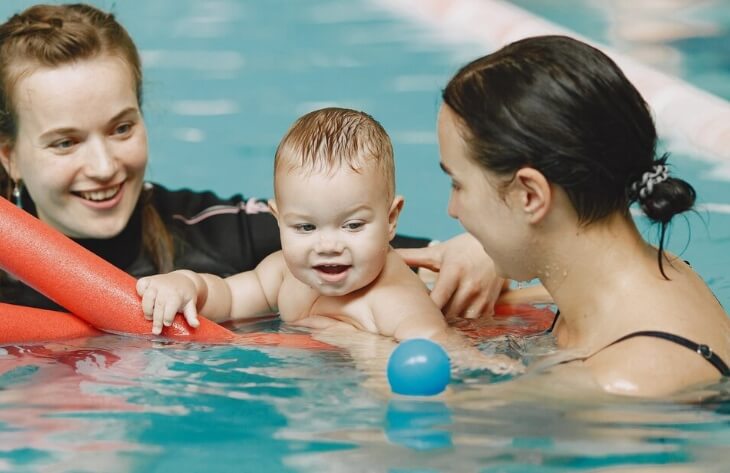
On a weekday afternoon a certain sound can be heard at the shallow end of a public pool. A child arguing briefly with the cold. An instructor counting backwards from three. Or the sound of small feet slapping wet tile. Then there was a splash. Then a head emerged with an expression that was halfway between triumph and surprise. It was difficult to ignore how uncommon that look has become elsewhere when I saw this last month at a Cardiff recreation center.
Today’s kids are shielded from many threats, which is generally beneficial. They are also increasingly shielded from the minor, controllable setbacks that once revealed their true nature. Parents are beginning to discuss swimming as one of the few places where such low-stakes hardship still occurs on a regular basis.
| Topic Snapshot | Details |
|---|---|
| Subject | Childhood resilience through swimming |
| Region of Focus | Cardiff, Wales (with broader UK and global context) |
| Key Statistic | Only 16% of Cardiff children can swim by the time they leave primary school |
| Reported By | Swim England, Cardiff Council, Griffith University (Australia) |
| Risk Highlighted | Drowning — second most common cause of accidental death for under-18s in Wales |
| Notable Research | Griffith University’s four-year study on early-childhood swimmers |
Cardiff’s numbers speak for themselves. By the time they graduate from primary school, only 16% of kids can swim, which is the lowest percentage in Wales. Council officials have referred to this as a “all-time low.” As expected, safety has been the main topic of discussion when it comes to fixing it.
According to a council spokesperson, learning to swim “can be the difference between life and death.” Drowning is still the second most common cause of unintentional death for under-18s in Wales. It’s difficult to dispute that. Second argument that swim lessons are also doing something else has been developing subtly in parent WhatsApp groups and school-gate chatter. Character-related. If you’ve seen a four-year-old attempt to submerge their face in water for the first time, you can easily make this argument. There’s a genuine fear there.
The water doesn’t bargain. Because the child is upset, it does not soften. Almost any modern activity can be used to spoil a child; there’s always a participation ribbon, a softer landing, or an adult to help. One of the few locations where the situation’s physics cannot be compromised is the pool. You either blow the bubbles or you don’t. You either sink a little or kick.
Researchers have been quietly building a strong evidence base for what swimming actually does to a developing child. Even the researchers were surprised by the results of a four-year study conducted at Griffith University in Australia that tracked children who began swim lessons in infancy. By the time the children were four years old. The swimmers were eleven months ahead of their peers in oral expression. Six months ahead in mathematical reasoning. And about thirty months ahead in understanding directions.
The degree to which that is due to swimming itself versus the type of household that prioritizes swimming is still up for debate, but the pattern continues to emerge. It is simpler to quantify the physical advantages. Swimming is particularly beneficial to developing bodies because it uses almost all of the muscles at once, is low-impact on joints, and is taxing on the heart and lungs.
For years, Swim England has observed that kids who regularly swim have better posture and flexibility than their age-group peers. Additionally, researchers believe that swimming’s cross-lateral motion facilitates more effective communication between the brain’s two hemispheres. It is still unclear if that will result in a sustained academic advantage.
The emotional architecture that swim lessons subtly create is something that is rarely discussed but likely matters more. By the time they enter primary school, a child who has been taking regular swim lessons since they were three years old has already completed hundreds of difficult tasks. They’ve shivered as they climbed out of pools. They recovered after ingesting water. They have dealt with a classmate who advanced a level ahead of them. These are not significant traumas.
They are rehearsals, the kind of minor, repairable setbacks that, when added up, appear to create something more resilient than affirmation by itself. Swimming teaches the power of showing up, even when you don’t feel like it, according to one swim instructor. These days, parents say things like that, almost defensively.
Every phone game is made to reward, every classroom is calibrated to prevent distress, and every weekend activity is made for enjoyment rather than effort, giving the impression that childhood has become remarkably frictionless. The pool has resisted this more by accident than by design. The water’s temperature hasn’t changed in forty years.
The lessons continue to require effort, attendance, and the slow, unglamorous progress that no app can replicate. Anyone who has watched these lessons is aware of the moment when a child who was unable to swim the entire length of the pool the previous term can now do so. When they come into contact with the distant wall, it’s not really about swimming.
It’s about realizing that they’ve outgrown the version of themselves from three months ago and are growing into a more resilient person. The expression on a child’s face provides a decent explanation for why the parents are covering the cost of the lessons. The sustainability of the cultural shift back toward swimming is still unknown.
The opposite is pushed by pool closures and growing expenses. For the time being, the lane ropes are back in place, and an ancient and practical structure is being rebuilt, one width at a time.
i) https://www.swimready.co.uk/swimready-blog/how-swimming-supports-child-development-physical-cognitive-emotional-and-social-benefits
ii) https://fitnesschamps.com.sg/how-swimming-supports-kids-growth-and-development/
iii) https://www.swimjim.com/blog/diving-into-development-how-kids-benefit-from-swimming
iv) https://swimworks.co.uk/news/from-brainpower-to-social-skills-how-swimming-helps-your-child