

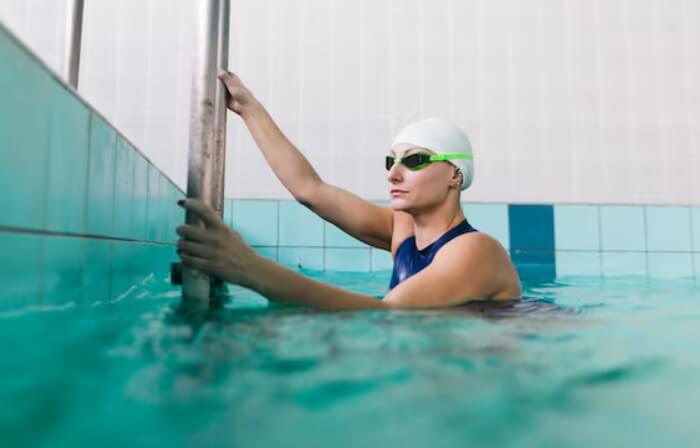
Around six in the morning, there’s a certain silence in an indoor pool. The low hum of the filtration system, the chemical tang of chlorine, and swimmers navigating lanes like familiar commuters. No one is performing for anyone in this type of setting. Nobody is filming themselves. Nobody is looking at a leaderboard. People simply swim, depart, and then, for some reason, return for years. More than anything, that may be the reason why swimming has subtly emerged as the most resilient exercise habit a person can develop.
The majority of exercise regimens eventually come to an end. Runners experience knee problems. Lifters pull or plateau. Spin classes become less appealing. Yoga turns into something you want to do but don’t. Strangely, swimming appears to break free from this cycle. Perhaps the water itself is supporting you as it pushes back. Physiologists believe that the combination of resistance and weightlessness, which is what makes the pool such a forgiving teacher, is more uncommon than people realize.
| Quick Reference | Details |
|---|---|
| Topic | Swimming as a long-term fitness habit |
| Recommended Frequency | 3 sessions per week |
| Suggested Duration | 20–30 minutes per session |
| Primary Benefits | Cardiovascular health, arterial flexibility, cognitive function, joint protection |
| Key Research Source | Prof. Hiro Tanaka, University of Texas at Austin |
| Notable Study | University of South Carolina, 40,000 men tracked over 13 years |
| Best For | All ages, injury recovery, joint issues, weight management |
According to Dr. Michael Mosley, swimming vigorously activates a variety of muscle groups that must contend with the water’s constant pressure. You can’t fake this kind of exercise. You are exposed by the water. It doesn’t penalize you in the same way pavement does, and as the years pass, that distinction becomes increasingly important. This has been witnessed in real time by anyone who has seen a sixty-year-old swimmer glide past a younger person flailing in the adjacent lane.
The effects of swimming on the arteries are almost completely ignored. Despite its name, heart disease is primarily an artery issue. Over decades, arteries lose their elasticity and stiffen, placing pressure on the kidneys and brain long before any symptoms appear. During a three-month swimming program, University of Texas, Austin professor Hiro Tanaka observed a measurable reduction in arterial stiffness. For three months. That’s just one season. It’s difficult not to question why this discovery hasn’t gained more traction outside of academic circles.
It is more difficult to overlook the longevity data. Over 40,000 men, ages 20 to 90, were monitored by a University of South Carolina team for an average of thirteen years. Compared to those who did not exercise, swimmers had significantly lower death rates. Large-scale studies typically don’t yield clear results, but this one did, and it’s worth pondering. Your life appears to bend slightly upward when you have a swimsuit, a pool, and a few mornings each week.
The part that surprises people is cognition. Because you’re horizontal, submerging yourself in water seems to improve blood flow to the brain. Walking and cycling push blood upward by defying gravity. Swimming doesn’t. In a way, the brain receives a more abundant supply. Tanaka has even conducted experiments with Nordic walking poles submerged in water, which may seem absurd until you look at the results. A broader stretch of the motor cortex is activated by hand and arm movement, and the hydrostatic pressure takes care of the rest. Rats’ memory was enhanced after seven days of swim training. Similar patterns were seen in humans. Reaction times were sharpened in just twenty minutes.
The science isn’t really what makes swimming stick. It’s the way it feels. Even if your meniscus is torn, you can still swim. You can swim through the months when running seems impossible, through chemotherapy recovery, and through pregnancy. Kerrie, a swimmer with lung cancer, has talked about how swimming allowed her to continue moving when all other options were exhausted. After years of trying everything else, Ellie, another long-distance swimmer, went back to it. The pattern is repeated. People stray from running clubs and gyms, but they always return to the water.
Additionally, there is the issue of mood. Even if they can’t quite put their finger on it, anyone who has stepped outside into the chilly morning air after finishing a swim is familiar with the feeling. a relaxation of the chest. A silence that had not previously existed. There is something akin to a meditative effect from the repeated strokes, the muffled silence beneath the surface, and the careful timing of your breath. There is a measurable decrease in stress. Sleep usually gets better. This is not dramatic at all. It simply builds up.
Tanaka offers a modest recommendation. Keep moving for twenty to thirty minutes three times a week. That’s all. Its simplicity almost seems suspicious in contrast to the complex programs offered by fitness apps. Simplicity may be the key. Routines that don’t require an entire identity to be constructed around them are the ones that endure.
You get the impression that the swimmers have discovered something that the rest of the fitness industry continues to overlook when you watch them exit the pool with towels wrapped around their shoulders and their hair still damp. The hardest workout isn’t the best one. Twenty years from now, you’ll still be doing it.
i) https://www.bbc.co.uk/programmes/articles/5Y9qZzcKDYdVxSDdM9gxGqY/why-swimming-could-be-the-best-exercise-you-do
ii) https://roycastle.org/6-reasons-why-swimming-is-the-ultimate-exercise-for-overall-health/
iii) https://www.swimming.org/justswim/8-benefits-of-swimming/
iv) https://www.edinburghleisure.co.uk/dive-into-spring-4-reasons-to-include-swimming-in-your-training-plan/
v) https://responsephysio.com/blog/swimming-why-it-should-be-part-of-your-fitness-and-recovery-routine/