

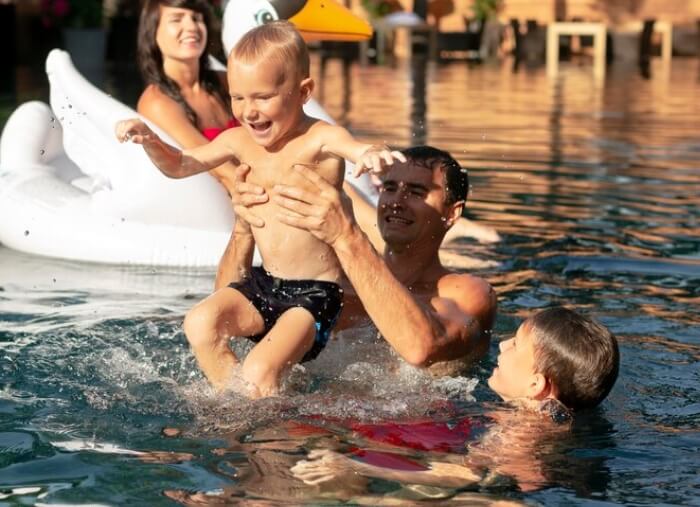
When you arrive at a community pool on a Saturday morning, the noise is the first thing you notice. Though there is a lot of splashing, it’s not exactly that. It’s the subtle bickering between parents and toddlers over goggles and floaties, the layered hum of conversation, and the shallow end’s laughter.
Swimming changed from being a solitary, quiet sport to something more akin to a family ritual at some point. And it’s difficult to ignore how recent that change seems. Swimming had a particular cultural connotation for many years.
The chlorine-soaked seriousness of training, competitive teams, and lap lanes. After dropping off children, parents waited in the car. That image is still there, but it has gradually changed into something more communal. If you walk into a Fitness Champs session in Singapore or a Watermelon Swim class in Tampa today. You’ll see parents in the water with their kids. Sometimes holding them and other times cheering from the sidelines.
| Topic | Details |
|---|---|
| Subject | Swimming as a family-centered social activity |
| Category | Health, lifestyle, community recreation |
| Primary Beneficiaries | Children aged 6 months and up, parents, grandparents |
| Core Benefits | Water safety, social development, low-impact fitness, family bonding |
| Common Settings | Community pools, swim schools, leisure centres, holiday resorts |
| Notable Statistic | Early swim lessons can reduce drowning risk in young children by up to 88% |
| Trending Among | Urban families, multi-generational households, working parents |
The pool is now more of a gathering place than a venue. Speaking with swim instructors, it seems like this shift began to take shape during the pandemic years and never fully reversed. Families that had been deprived of social interaction tended to seek out activities that felt secure, organized, and tangible. Swimming provided the three. It also provided a less evident opportunity for parents and children to be together without screens. That could account for a portion of the appeal.
Group instruction has always been beneficial for kids, of course. Observing a Parent-Tot class in action demonstrates the subtle social mechanics at play, such as sharing a floating noodle without losing it, taking turns, and imitating peers. Instructors discuss how swimming improves early friendships, peer communication, and body language reading. The direct way parents are drawn into that setting is more recent. They are no longer merely bystanders. They are learners with their own kids, albeit sometimes awkward ones.
This has an emotional component that is not sufficiently discussed. A lot of the typical parental hierarchy is eliminated when people swim together. A six-year-old may float in the water with greater assurance than her father.
It’s possible for a grandma to outsmart her teenage grandson. Few other activities have the same leveling effect as the pool. It’s possible that families are drawn to swimming because it provides a momentary reprieve from the rigid roles that each member of the family plays during the rest of the week.
One of the most unexpected aspects of their work, according to coaches in cities like Tampa, is the social spillover. Coffee is still shared by parents who first met in the bleachers years ago. Youngsters who attended beginner classes together wind up in the same school groups and at the same birthday celebrations.
Almost by coincidence, the swim school develops into a small social network. That weekly, in-person, repetitive gathering seems almost archaic in a time when so much of community life has moved online. Perhaps that is the point.
Of course, the fitness benefits are genuine. One of the few full-body, low-impact exercises that works for people as young as six months old, as old as sixty, and nearly everyone in between is swimming. It provides a forgiving entry point for parents who want to start exercising again after years of restless nights and missed workouts.
It helps children develop a foundation of cardiovascular health, posture, and endurance all of which are increasingly difficult to come by in childhoods spent glued to screens. When you ask families why they return, fitness is rarely at the top of the list. They bring up the routine. The community. The little rituals of post-swim snacks and chatter in the changing room. Teachers are quick to remind parents that safety is still important.
Early lessons can significantly reduce the risk of drowning, which is still a major cause of unintentional death for young children. The framing has changed, though. These days, swim schools promote connection over skill.
Instead of just stopwatch-ready competitors, brochures feature families holding hands in the water. It’s unclear if reality is catching up to marketing or marketing is catching up to reality. You can see why this works by observing a young father attempting to teach his daughter how to blow bubbles, and both of them laughing at his exaggerated demonstration. No scoreboard is present. The audience doesn’t matter. Just time, water, and a little chore to do together. Families seem to recognize this type of moment, which is becoming less common. Therefore, swimming has subtly evolved into something beyond leisure. The anchor is a weekly one.
A social custom disguised as physical activity. Additionally, the pool continues to provide a solution that has been there for families searching for a way to stay together as children get older and schedules become more constrained.
i) https://watermelonswim.com/swimming-and-social-skills/
ii) https://felixswimschools.com/how-swimming-boosts-your-childs-confidence-and-social-skills
iii) https://fitnesschamps.com.sg/how-swimming-classes-shape-healthy-family-lifestyles/
iv) https://jccstl.com/blog/why-swimming-is-the-perfect-family-fitness-activity/
v) https://oasischildren.com/how-swimming-benefits-young-children/