

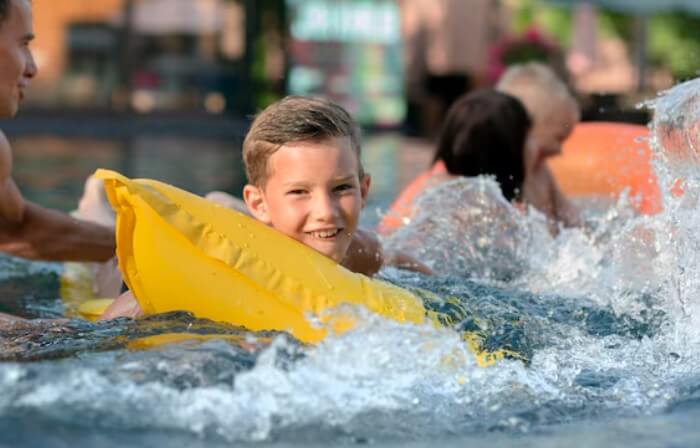
A small procession of parents wearing wet hoodies, holding rolled-up towels, and goggles still dripping from the previous session can now be seen on a Saturday morning in any reasonably sized city. A few of them appear worn out. While their four-year-old splashes through a kickboard drill behind glass, some are scrolling through work-related emails. Ten years ago, weekend swim club kids and the occasional aspiring competitor dominated this scene. Millions of families now plan their weeks around it, and the change as subtle as it has been tells a bigger story about how this generation of parents views risk, childhood, and what is important.
When you look closely, the numbers reveal more information than the conversations on the pool deck. According to a recent survey conducted on behalf of the STA, 99% of parents in the UK who have children under the age of twelve believe that swimming is an essential life skill. Almost everyone is like that. Even though swimming is officially part of the national curriculum, only 2.8% of those parents reported that their kids were currently learning through school-based programs. Approximately one in three British children are still unable to swim 25 meters when they graduate from elementary school. Families have chosen to close the gap between what they think is important and what schools are actually providing, frequently at great expense.
Speaking with parents gives me the impression that there is more to the urgency than just drowning statistics, even though those statistics are sobering enough on their own. It’s about redefining childhood preparation in a more comprehensive way. In a position that would have seemed aggressive a generation ago, the American Academy of Pediatrics now advises swim lessons as a layer of protection that can start for many children at age one. Infants are now enrolled in parent-and-baby classes before they can walk, thanks to parents who took lessons in the shallow end of municipal pools when they were six or seven years old. It’s worthwhile to consider whether this is due to improved science or a culture that is becoming more concerned about safety in general.
It’s interesting to note that most of the parents advocating for these classes aren’t raising competitive swimmers. Merely 18% of respondents expressed a desire for their child to pursue swimming as a sport. Water confidence and basic competence were the overarching themes that were nearly word for word repeated in all of the responses. One parent told the STA researchers, “I just want my child to learn the basics so they are competent and safe around water.” Something about contemporary parenting that is overlooked by more ostentatious statistics is captured by that sentiment, which is modest, pragmatic, and a little defensive. Medals are not what families are pursuing. They are attempting to take one concern off the lengthy list of concerns.
The economics of all this are unsettling and should be stated clearly. The gap left by fewer schools has been filled by private swim schools, which are not inexpensive. A month of after-school care is more expensive in some neighborhoods than a term of weekly half-hour lessons. The STA itself has argued that swimming lessons shouldn’t be a luxury, rejecting the notion that this ability should be based on a family’s pay stub or postcode. As soon as something that is presented as universal water safety leaves the public system, it is difficult to ignore how quickly it becomes stratified.
Then there’s the emotional aspect, which parents usually talk about in hushed tones. Recently, discussions about toddlers who cry during class, the conflict between forced safety training and bodily autonomy, and whether eighteen months is too young to be given to a stranger in a swimming pool have taken over the parenting podcast circuit. Parenting author Janet Lansbury, the creator of the *Unruffled* podcast, has thoughtfully discussed the exact conflict that arises when a mother emails in about her 18-month-old daughter sobbing during every class, attempting to balance her conviction that the lessons could one day save her life with her belief in respecting her child’s body. Parents who act as though there is a simple solution typically haven’t seen their own child experience it.
A more participatory model appears to be slowly taking shape. It is becoming more and more expected of parents to attend classes, pick up cues, practice skills at the recreation center pool on the weekends, and view the teacher as a collaborator rather than an outsourcer. Having a parent present can mean the difference between panic and progress for newcomers and kids with special needs.
For better or sometimes worse, it fits neatly into the broader pattern of intensive parenting that characterizes this era. It’s a more demanding kind of involvement than what the previous generation experienced. It remains to be seen if all of this effort results in a generation of swimmers who are actually safer. According to the STA survey, nearly half of parents expressed concern that their child lacks confidence when swimming. Classes are taking place. The order of importance has been established. One lesson at a time, the final product is still being written.
i) https://www.sta.co.uk/news/2025/05/16/sta-survey-reveals-parents-priorities-and-concerns-around-learning-to-swim/
ii) https://www.janetlansbury.com/2021/04/water-safety-bodily-autonomy-and-emotional-health/
iii) https://www.healthychildren.org/English/safety-prevention/at-play/Pages/Swim-Lessons.aspx
iv) https://www.rlss.org.uk/blog/the-importance-of-baby-and-toddler-swimming