

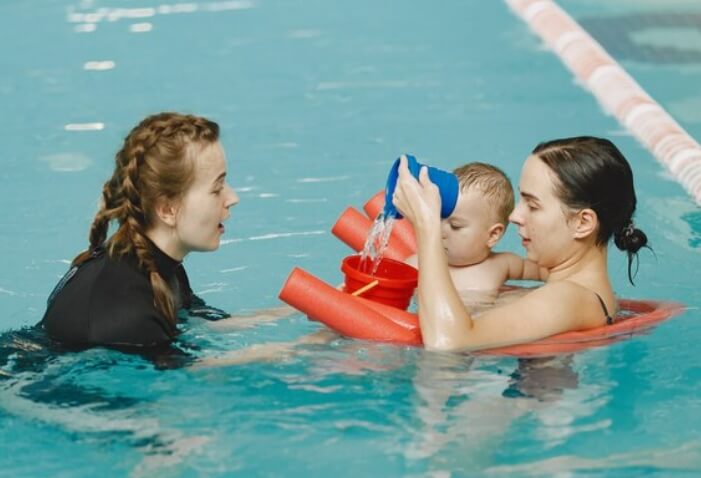
If you stroll by any suburban recreation center on a Saturday morning, you’ll notice something that wasn’t around twenty years ago. Coffee cups in hand, a long line of parents watch their four-year-olds practice back floats in shallow water through fogged-up viewing windows. It now has an almost ceremonial quality. With the same quiet certainty as the dentist appointment or the first day of preschool, swim class has crept into the modern childhood schedule, and most families don’t even stop to consider why.
It used to only happen in the summer. A holiday. Something that children learned at the beach or lake from a cousin or a distracted uncle who had learned the same thing himself. Most of that informal attitude has vanished. It is replaced by a regimented, nearly academic endeavor, complete with waiting lists that extend into the following year and progress charts displayed on lobby walls. Speaking with parents gives me the impression that swimming has subtly transformed from a recreational activity into something completely different. an insurance policy of sorts. a fundamental ability. Something you owe your kid.
| Quick Reference: Swimming & Child Development | |
|---|---|
| Topic | Swimming as a core developmental skill for children |
| Primary Age Group | 3–11 years (pre-school through end of primary school) |
| Key Benefit | Lifesaving skill + Fundamental Movement Skill (FMS) development |
| Curriculum Status (UK) | Only compulsory sport in the national curriculum |
| Competency Target | Swim 25 metres unaided, perform self-rescue |
| Current Achievement Rate | Only 34% of UK Key Stage 2 students meet full swim competency |
| Drowning Risk | Top-five cause of death for ages 1–14 in 48 of 85 countries (WHO, 2021) |
| Assessment Tools | TGMD-2, BOTMP, Aquatic Movement Protocol (AMP) |
The shift is explained by the numbers. In almost half of the nations the World Health Organization surveyed, drowning continues to rank among the top five causes of death for children between the ages of one and fourteen. Repeated in government briefings and pediatric clinics, that number has actually changed behavior something statistics rarely accomplish. Parents who grew up believing that their children would simply figure things out the way they did are no longer making this assumption. Nowadays, it’s too easy to Google the risk at midnight after a summer vacation by a hotel pool because it’s too well documented.
There is more to swimming than just a safety precaution. For years, researchers who study basic movement skills have been subtly advancing the idea that time spent in the water benefits young bodies in ways that no other sport can match. Kicking, throwing, balancing, rotating, jumping, grasping, holding one’s breath, and arranging one’s limbs in opposition to resistance. All of this occurs simultaneously in a setting that penalizes hesitation mildly rather than severely. A child’s knee is scraped when they fall while attempting to skip across a playground. When a child mishandles a stroke, the instructor nods encouragingly and gives them a mouthful of pool water. The learning somehow sticks, and the stakes feel different.
A study that is frequently mentioned in these discussions suggests that children who regularly swim perform better than their peers who do not swim in early literacy, math, memory tasks, and motor coordination. The underlying intuition feels correct whether you accept the results at face value or treat them with the appropriate amount of skepticism. When a four-year-old learns to listen intently, follow a multi-step instruction, hold their body in an unfamiliar way, and then repeat it on command, they are engaging in cognitively significant activities. In that way, the pool is an exceptionally demanding classroom.
The unequal distribution of access is striking. Although swimming is the only required sport in the UK’s national curriculum, only about one-third of students who graduate from primary school truly meet the official competency standard of being able to swim twenty-five meters and perform a basic self-rescue. Pool time is costly, school budgets are tight, and the PE Sports Premium spending guidelines are just that guidelines, not policies. Some schools invest a lot of money in it. Others disregarded the requirement in silence. As a result, a generation of children is growing up with drastically different attitudes toward water, largely based on parental income and postcode.
Private swim schools have filled that void as quickly as one might anticipate. holiday intensives, levels, badge systems, parent-and-child classes, and term-long programs. In a sense, it’s an industry now that it wasn’t a generation ago, and like all such industries, it carries a small amount of unease. Is something that was once joyful and unstructured being overly formalized? Maybe. Most likely, even. The response is consistent if you ask any parent who has witnessed their child being pulled out of the deep end by a vigilant lifeguard if they regret the lessons.
You notice something on a six-year-old’s face that is more difficult to replicate in dry-land sports when you watch them surface following their first proper underwater glide. A tiny, personal delight. the realization that they have successfully negotiated with an element that, to be honest, doesn’t care about them. It’s partly because of this emotion that swimming has become so ingrained in the minds of contemporary parents. It teaches resilience without giving lectures. It instills respect for boundaries without enforcing them. And an hour a week spent moving rhythmically through cool water might be one of the more genuine gifts a parent can give to a child who is growing more indoors, more mediated by screens, and more anxious in ways no one fully understands yet.
Another question is whether schools will catch up to what families appear to already know. There are still gaps in the research, the evaluation instruments are still being improved, and the funding is still unclear. The majority of the work is currently being done by the cultural shift. Unbeknownst to them, the children paddling through their Saturday morning lessons are proof that swimming has subtly evolved from an optional activity to a necessity.
i) https://premierswimacademy.com/dive-into-development-how-swimming-boosts-child-development/
ii) https://wallenswim.com/how-swimming-helps-raise-healthy-smart-kids/
iii) https://aquaticpros.org/swimming_into_success_early_swim_lessons/
iv) https://texasswimacademy.com/how-does-swimming-affect-a-childs-development/