

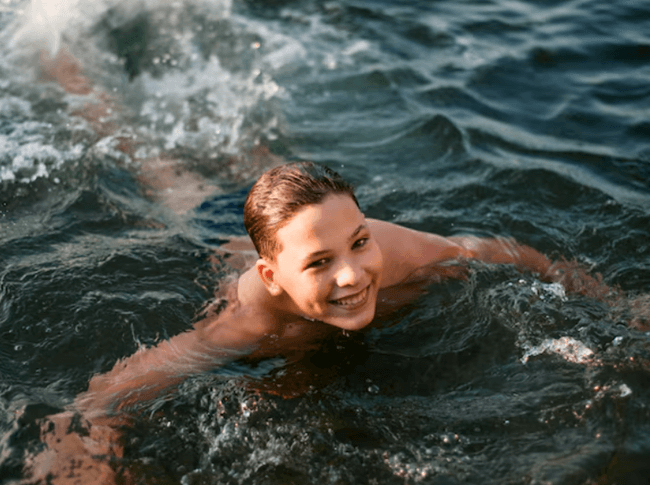
After a lengthy lesson, children get a certain look when they climb out of a pool. Eyes slightly glassy, towel partially wrapped, hair plastered down. They were quieter than they had been an hour before. Before the kids do, parents who are waiting on the deck notice it. No one is quite sure what has changed. The scene is recognizable when you enter practically any community pool on a weekday afternoon.
Instructors in red shirts crouched at the edge of the shallow end, fluorescent lights humming overhead, and the sharp tang of chlorine. Children form a line along the wall, splashing, kicking, and sometimes fighting over who gets to go first. It appears to be typical chaos. There appears to be something more intriguing going on beneath it, and an increasing number of parents and pediatricians are beginning to take notice.
| Topic Snapshot | Details |
|---|---|
| Subject | The calming, regulating effect of swimming on overstimulated children |
| Core Concept | “Blue Mind” — coined by marine biologist Dr. Wallace J. Nichols |
| Backed By | International Journal of Environmental Research and Public Health (2023); Swim England (2018) |
| Common Beneficiaries | Children with anxiety, ADHD, sensory processing differences, or general overstimulation |
| Recommended Frequency | 2–3 sessions per week, roughly 30–45 minutes each |
| Authoritative Reference | American Academy of Pediatrics — Swimming and Child Development |
Today’s kids have an odd sense of exhaustion. They swipe, scroll, and endure schedules that would wear out the majority of adults. Schools are now louder, classrooms are more visually crowded, and weekends are jam-packed with organized events and constant notifications. Many parents will tell you in private that the outcome is a child who finds it difficult to relax, even when nothing is going on. A child who has too much information and nowhere to put it.
Strangely enough, swimming seems to provide a place to store it. Sound is muffled by the water. Light is softened by it. It compresses the body in a way that resembles a long hug to a tiny nervous system. Occupational therapists have been using hydrotherapy for decades with children who are sensory-sensitive for a reason that has nothing to do with strokes. It has to do with how the water affects the sound inside.
It was dubbed the “Blue Mind” by marine biologist Dr. Wallace J. Nichols, who spent years researching how people react to water. He maintained that being in, on, under, or close to water causes the brain to become calmer and more concentrated. Anyone who has been near a pool deck can probably tell you that it tracks, though the research supporting this is still in its early stages. Children who come bouncing off walls depart with the appearance of having just taken a long nap. Children who are quiet and quiet when they first arrive can become talkative and carefree. Something is done by the water. It’s difficult to disagree.
Swimming dramatically decreased symptoms of anxiety and depression in both adults and children, according to a 2023 study published in the International Journal of Environmental Research and Public Health. According to a previous survey conducted by Swim England in 2018, over 1.4 million adults in the UK reported that regular swimming helped them feel less anxious. The figures are helpful, but they don’t fully convey what a parent witnesses on a Tuesday night when their seven-year-old, who lost it twice that morning over a sock, nods off before the car has even left the parking lot.
There is a physiological component to what is occurring. The body’s dependable mood enhancers, endorphins, are released during aerobic exercise. The breathing patterns that therapists teach to calm the nervous system are similar to the rhythmic breathing needed to swim even one slow length. The tenacious stress hormone cortisol decreases. Some of it is more difficult to quantify. It seems as though the water itself serves as a barrier between a child and the outside world. Not a screen. No warnings. No voice from the teacher. Only their own breathing rhythm and the muffled silence of being submerged.
It’s also important to consider the cognitive demands swimming places on kids. While floating in an unfamiliar element, they must watch a demonstration, listen to an instructor, and then translate what they see into their own bodies. In contemporary childhood, that kind of focus is uncommon. The majority of activities simultaneously draw attention in a dozen different directions. It is drawn inward by swimming. Even in the midst of a boisterous lesson, there’s a quiet quality to that.
Naturally, none of this is magical, and overselling it would be foolish. A child who is truly struggling won’t be helped by swimming, and when therapy or medical attention are required, swimming won’t take their place. It can take months for some kids to even feel at ease submerging their faces in the water. Some people adore the pool but object to the lesson plan. Not every child finds the reset in the same way, and it isn’t automatic.
It’s difficult to ignore the pattern, though. Swim nights are discussed by parents in the same way that long walks after dinner were discussed by earlier generations. Mothers sitting in lobby chairs and fathers waiting with car keys in hand share a silent sense that something beneficial is taking place there. something that won’t be available the rest of the week.
Perhaps that is the true story. Not even the safety skills, which are crucial, nor the strokes or medals. Just the simple fact that for forty-five minutes a few times a week, a child gets to be inside a quieter version of the world. They look exhausted, but in a good way. They take a nap. They breathe more slowly. The static appears to go away somewhere in the midst of the splashing, shivering, and ill-fitting goggles.
i) https://pedalheads.com/en/blog/swimming-benefits-for-kids
ii) https://www.rockstaracademy.com/blog/swimming-mental-health
iii) https://blog.swimmingnature.com/water-and-wellbeing/
iv) https://individualityswimmingandfitness.co.uk/the-mental-health-benefits-of-swimming-lessons/
v) https://sealswimming.ca/blog/top-5-benefits-of-swimming-for-your-childs-mental-health