

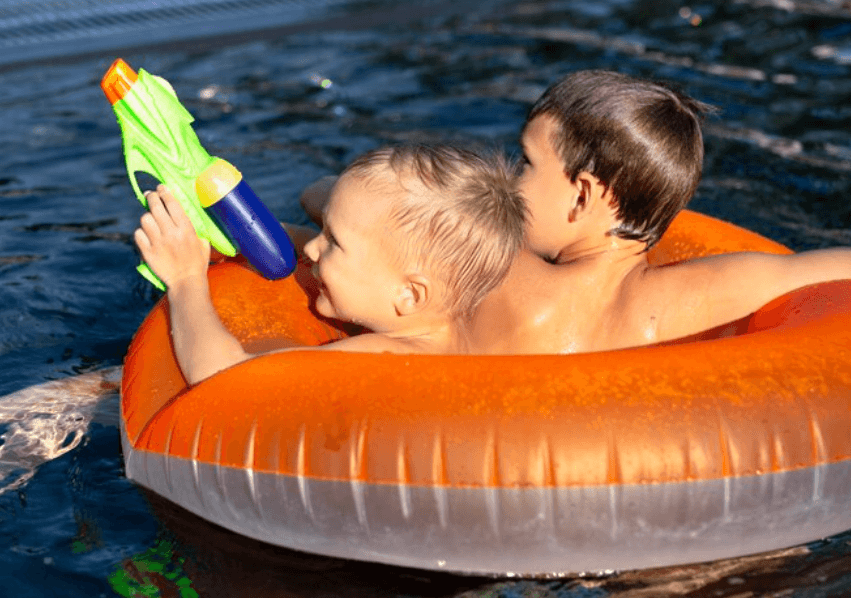
At the edge of a public pool, you notice a certain type of child. Not the one already mid-lap, nor the one cannonballing off the side. The noise, the spray, and the chlorine hitting the back of the throat are all sensed by this child as he stands motionless and watches the water. They may be holding onto a parent’s hand. Perhaps they’re just waiting. reflecting.
Before they commit to taking a single step forward, they take it all in. Perhaps more than any other sport, swimming was subtly created to benefit these children. About 20% of kids have what researchers refer to as sensory processing sensitivity. Dr. Elaine Aron, a psychologist who spent decades mapping the inner world of the highly sensitive child, discovered and thoroughly investigated this trait. She emphasized that it is not a disorder.
| Topic | Details |
|---|---|
| Focus | Swimming as therapeutic and developmental support for sensitive children |
| Key Research Figure | Dr. Elaine Aron — Researcher and author, identified Highly Sensitive Person (HSP) trait |
| Trait Prevalence | Approximately 20% of children show signs of high sensitivity (sensory processing sensitivity) |
| Key Benefits | Anxiety reduction, emotional regulation, improved sleep, sensory calming, confidence building |
| Recommended Session Duration | Up to 30 minutes of swimming shown to lower stress and reduce anxiety symptoms |
| Ideal Environment | Small class sizes, quieter pool times, low-chlorine or saline pools, predictable routines |
Not something that needs to be fixed or medicated. Rather, it is a temperament that is inherited: a more profound understanding of the social, emotional, and physical environment that they live in. These kids take note of everything. Their shirt’s back was scratched by the tag. the change in tone of a teacher. The way a multitude of voices blend together to form a loud, shapeless entity.
They are more acutely aware of everything. This can be both beautiful and draining for parents. A sensitive child’s hesitation at the water’s edge can appear a lot like fear, and occasionally it is. Frequently something more deliberate than that, a child making a silent internal calculation before making a commitment. These kids get more than just exercise from swimming. It resembles a reprieve more.
The world can be made simpler by water. The sound overhead becomes a muffled hum as soon as a child is submerged. Blue replaces the visual chaos of a crowded pool. Suddenly weightless, the body briefly stops defying gravity and simply floats. This is a big deal for a child whose nervous system is operating at maximum capacity for the majority of the day. Even brief swimming sessions, lasting about 30 minutes, have been shown to reduce stress hormones, reduce anxiety, and enhance sleep.
Even a seven-year-old who wouldn’t know the term “meditation” if it fell on them can achieve something close to a meditative state through the simple mechanism of rhythmic, full-body movement combined with controlled breathing. In group settings, shy kids in particular often bear a special burden. Social navigation is a constant on the soccer field: who passes to whom, who applauds, and who disputes a call.
Noise, quick status changes, and a form of extroversion that is clearly rewarded are all part of team sports. In contrast, swimming makes very few social demands. A child navigates the water mostly in their own lane, at their own speed, and in comparison to their former selves. Teachers who work with anxious kids frequently talk about seeing something subtly change over the course of several weeks for example.
A child who previously refused to submerge their face in the water suddenly decides to stay underwater and gaze up at the light peeking through the surface. It’s difficult to ignore the fact that these children typically don’t experience a dramatic moment of confidence. It increases gradually. A foot in. A flutter kick. a width reached without pausing.
The child gathers evidence about themselves from every little thing, demonstrating that the world at least this particular wet corner of it is manageable. Most parents don’t realize how important the learning environment is. A smaller, more intimate session with a knowledgeable instructor who knows what high sensitivity really means in practice is not the same as a busy, noisy public pool during peak hours.
Nowadays, some swim schools make special accommodations for kids with sensory issues. These include providing off-peak hours, maintaining small class sizes, utilizing earplugs when necessary, and incorporating predictable routines so that a child is aware of what is going to happen before they arrive. This predictability is not a minor concession.
Knowing the order rinse, enter slowly, breathe, float removes a layer of fear before it can develop for a child who processes novelty more intensely than most. Additionally, there’s a feeling that swimming connects with these kids in a way that team sports occasionally don’t. The water doesn’t reconsider.
It doesn’t get louder or more complex overnight. When a body passes through it, it reacts consistently. The honesty of water what it asks and what it gives can serve as a kind of anchor for a child who frequently finds human environments unpredictable. It’s easy to undervalue the role parents play. The way a child reads the water, so too does the adult next to them. Even without words, a tense, hovering parent conveys danger.
A composed person conveys safety. Observing a trusted adult at ease in a new setting may be half the battle for a shy or sensitive child; this is proof that the setting has already been tested and is worthwhile. This does not imply that sensitive children can swim with ease. Some will hold out for weeks. Some will weep. Some will grow to love the water in a quiet, fierce way that surprises everyone including themselves.
The conditions that swimming fosters individual pace, rhythmic movement, sensory containment, and a soothing teacher with a steady voice align remarkably well with these kids’ needs. The majority of swim schools may not fully comprehend the demographic they covertly serve. However, the child who stands at the edge and takes their time before stepping in is experiencing something in pool after pool. Water is waiting. Eventually, they leave.
i) https://fitnesschamps.com.sg/common-struggles-kids-face-in-swimming-and-how-to-help/
ii) https://davinasswimhouse.com/how-swimming-supports-children-with-anxiety-and-sensory-processing-challenges/
iii) https://www.swimexpert.co.uk/about-us/news/how-we-help-nervous-children-feel-safe