

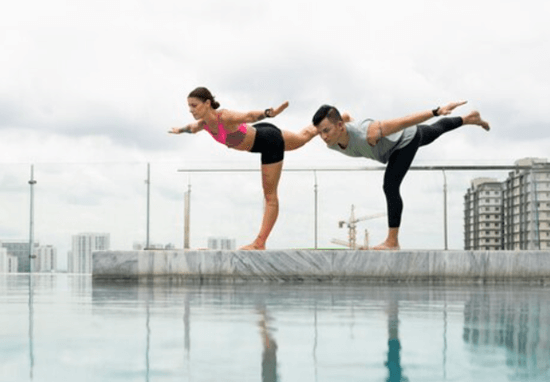
When bodies move slowly, deliberately, and without urgency, water folds back on itself to create a layered sound that is remarkably similar across all pools. This is what people notice first, rather than instruction or music.
Mental fitness has moved away from cushions, apps, and digital reminders in recent years and has reappeared in community swim centers and heated pools where movement, rather than forced stillness, rebuilds attention.
| Context | Details |
|---|---|
| Central shift | Mental fitness practices are increasingly being embedded into aquatic exercise rather than traditional gyms or meditation settings |
| Common formats | Aquatic yoga, Ai Chi, paddleboard yoga, mindful lap swimming, aquatic Pilates |
| Scientific grounding | Studies link swimming and water immersion to significantly reduced anxiety, notably improved focus, and enhanced mood regulation |
| Cultural driver | Fatigue with screen-based wellness and rigid meditation formats |
| Core appeal | Low impact movement combined with breath, rhythm, and sensory immersion |
Fitness pioneers saw something especially novel in water-based exercise, observing how immersion naturally simplifies focus and releases participants from metrics, mirrors, and the continual self-monitoring that permeates most gyms.
Schedules that were previously devoted to aerobics now include programs like aquatic Pilates, paddleboard yoga, Ai Chi, and mindful lap swimming. These programs offer a remarkably effective combination of mental regulation and physical conditioning without making any extravagant claims.
Shirley Archer, a longtime integrative health educator, has carefully crafted the term “mind-body” to describe intention rather than superiority, emphasizing exercises that coordinate breath and alignment to create a meditative state while still conditioning the body.
This distinction is important, especially for those who have attempted traditional meditation and, despite their best efforts, have found it to be inaccessible, frustrating, or subtly discouraging.
Almost instantly, water alters the rules by softening vision, muffles sound, and produces resistance that is incredibly dependable in requiring cooperation rather than force, making attention less voluntary and more automatic.
Anecdotal evidence from swimmers has been progressively corroborated by medical research, which indicates that movement and immersion are linked to markedly better mood regulation, stronger respiratory capacity, and significantly lower blood pressure.
When the water environment eliminates decision fatigue and permits the nervous system to relax while the body is still gently engaged, those advantages become especially advantageous.
Early in a session, breathing shifts are facilitated by hydrostatic pressure, which lengthens exhalations and naturally deepens inhalations. After the first few minutes, verbal breath cues are frequently no longer necessary.
One extreme of this spectrum is paddleboard yoga, which offers emotional instability that is surprisingly inexpensive because falling into the water has no social cost and subtly eliminates perfectionism.
A remarkably effective method of eliminating performance anxiety without the need for discussion or analysis is for participants to laugh, get back on the board, and try again.
Ai Chi and water-based tai chi classes, on the other hand, emphasize acceptance and flow through slow, extremely clear movements that are not physically taxing.
The underlying premise of these sessions is that things work out as they should, which is a different idea when resistance comes from water instead of gravity.
Halfway through a class, I noticed that a number of shoulders suddenly dropped, as if everyone in the group had been given the go-ahead to stop trying to stay together.
Even conventional lap swimming contributes to this movement, especially when viewed as a rhythmic exercise rather than a workout, which enables repetition of strokes to focus attention and progressively devalue intrusive thoughts.
Repetitive aerobic exercise has been linked by neuroscientists to enhanced cognitive function, with notable improvements in memory, processing speed, and emotional regulation.
The sensory-rich pool environment makes a substantial contribution by lowering outside stimuli and offering continuous tactile feedback that keeps the mind grounded in the here and now.
An additional layer of comfort is provided by heated pools, which help to relax muscles and create ideal conditions for evening sessions, when participants frequently report better sleep quality.
Swimming programs have been linked to improved focus and behavioral regulation in children, which is particularly encouraging. These results seem to be consistent across age groups and ability levels.
Adults come for a variety of reasons, such as joint pain, burnout, or curiosity, but many stay because of the setting’s extreme adaptability, which rewards effort without penalizing it.
By substituting shared presence for competition and encouraging connection through coordinated movement rather than dialogue, group classes subtly amplify these effects.
Pool-based mental fitness offers stability, consistency, and a sense of control that feels both achievable and long-lasting, in contrast to trend-driven fitness concepts that steer clear of transformation narratives.
These sessions have been incorporated into training regimens by even competitive athletes, who use water to recalibrate focus and restore attention instead of taxing the body.
The more general change seems hopeful, implying that environments that promote mental-body cooperation rather than seclusion or intensity are necessary for mental fitness.
Long disregarded as merely recreational or therapeutic areas, pools have become incredibly resilient environments for attention restoration, serving as a reminder that focus can be trained subtly, consistently, and without the use of spectacles.