

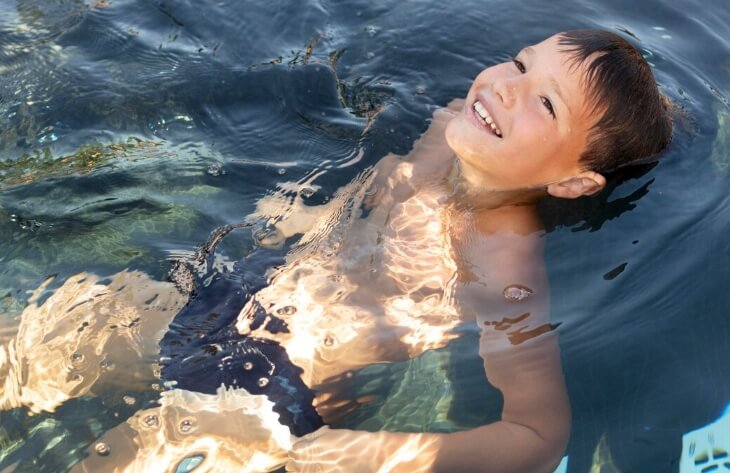
At seven in the morning, there’s a certain silence in an indoor pool. Somewhere in the second lane. A 23 years old in a black one-piece is dragging herself through the water without checking her phone for the first time in perhaps twelve hours. While the fluorescent lights buzz softly and the lifeguard drinks coffee from a paper cup.
It’s a brief scene. It keeps happening in cities everywhere, and it’s beginning to have some significance. Of all things, swimming has emerged as one of Gen Z’s favorite stress relieving activities. Not silent retreats, not cold plunges, not the eight-step morning routines that appear on TikTok with background music. Simply swimming. slow laps.
| Quick Reference | Details |
|---|---|
| Topic | Swimming as a Mental Health Ritual Among Gen Z |
| Demographic Focus | Adults aged roughly 12–27 (Gen Z) |
| Reported UK Impact | 1.4 million adults say swimming has reduced their anxiety or depression |
| Reported Mood Lift | 43% say it makes them happier and more motivated |
| Key Mechanisms | Endorphin release, rhythmic breathing, water buoyancy, “blue mind” effect |
| Cited Concept | “Blue Mind” — coined by marine biologist Wallace J. Nichols |
Fast ones, occasionally. The kind of activity that, until recently, seemed to be exclusive to competitive teenagers and retirees, with very few people in between. Talking to people in their early twenties gives me the impression that they’ve discovered something their parents never told them about, and they have some doubts about how effective it is.
What the pool decks already indicate is supported by the numbers. According to a UK study, 1.4 million adults say swimming has greatly decreased their anxiety or depression, and 43% say it makes them happier and more driven in their day-to-day lives. These are not insignificant numbers. Swim instructors in the UK and North America have been observing the change for some time now. Even though the data doesn’t clearly break down by generation. More young adults are arriving by themselves. Frequently before work.
And frequently with the slightly anxious expression of someone relearning a skill from elementary school. They might be pursuing the same goal that past generations pursued through yoga studios or running clubs. It’s also possible that when your nervous system is elevated during group chats, water simply hits you differently.
Even though the experience seems mysterious, the science isn’t. The mood-enhancing hormones known as endorphins are released during aerobic exercise, and swimming produces them just as consistently as a long run. The water adds something that the gym floor cannot match.
In a way that feels almost mechanical, buoyancy releases physical tension from the body, making you feel as though someone has taken a weight off your shoulders without asking. Anxious brains seldom go to the calmer parasympathetic state on their own, but the rhythmic breathing three strokes, exhale regulates the autonomic nervous system. Aquatic exercise significantly reduces the symptoms of anxiety and mood disorders, according to a 2022 systematic review of eighteen trials.
Due to buoyancy and the meditative coordination required, a different study on college students discovered that swimming resulted in deeper relaxation than land-based exercise. Exactly, none of this is new science. The people who are reading it and acting upon it are new. Gen Z experienced the most well-documented anxiety crisis of any generation that has been the subject of formal research. Waitlists for therapy are lengthy. SSRIs are widely used.
I’m having a hard week” doesn’t need to be followed up with an explanation because the discourse surrounding mental health has developed to such an extent. In spite of all that fluency, the available treatment options frequently seem either unattainable or inadequate on their own. The gap has been filled by swimming.
It requires no spiritual commitment at all, is less expensive than therapy, and requires less than meditation. You simply show up and get soaked. The frequency with which the appeal returns to the phone is difficult to ignore. You cannot doomscroll in water. A podcast cannot be partially listened to while responding to Slack messages. Your ears are submerged, your hands are occupied, and your eyes are clouded.
The forced disconnection isn’t a side effect; rather, it’s the main goal for a generation whose stress is primarily mediated through screens. One swimmer referred to her morning lane time as “the only forty minutes a day where nobody can reach me”. Using language similar to how someone might describe discovering a secret room in their apartment.
Additionally, there is the cultural appeal of “blue mind”, a term made popular by marine biologist Wallace J. Nichols to characterize the somewhat contemplative state that water seems to induce in people. The underlying idea that being near water changes something in us has undoubtedly struck a chord with younger swimmers, regardless of whether the phrase holds up scientifically across all claims made about it.
A few of them have never read Nichols. They simply understand the emotion. They characterize it as “quieter”, “slower”, and “the panic gets diluted.” The language sounds remarkably consistent between strangers, regardless of the exact mechanism. Within this broader trend. Cold open-water swimming has its own subculture. In part because of a widely circulated BMJ case study about a young woman whose severe anxiety and depression improved to the point where. Under medical supervision. She was eventually able to stop taking her medication.
The majority of therapists take care to note that this case isn’t a model for everyone. Enough people have read it, taken screenshots of it, and shared it that it has influenced people’s perceptions of what swimming could accomplish, even those who would never wade into a January lake. The whole thing feels remarkably unbranded.
There isn’t yet a startup attempting to gamify lap counts into a streak-based app that ruins it, nor is there a Gen Z swimming influencer empire. The ritual is primarily carried out by people who aren’t very photogenic when wearing goggles in regular municipal pools with slightly chlorinated water. Of all the details, that one may be the most telling.
A generation appears to have quietly concluded that the thing that is truly working is the one that no one has figured out how to monetize after ten years of wellness being sold back to them in ever-more-polished packaging. At least for the time being. As you watch it happen, you get the impression that the pool deck is one of the few locations left where a twenty-three-year-old can be unproductive, unreachable, and perfectly content with both.
i) https://www.swimdesignspace.com/blog/swimming-for-anxiety-stress-mental-health
ii) https://instacare.pk/blog/physical-and-mental-benefits-of-swimming
iii) https://plungesandiego.com/why-swimming-release-stress//
iv) https://www.sciencedirect.com/science/article/pii/S0272494423001214