

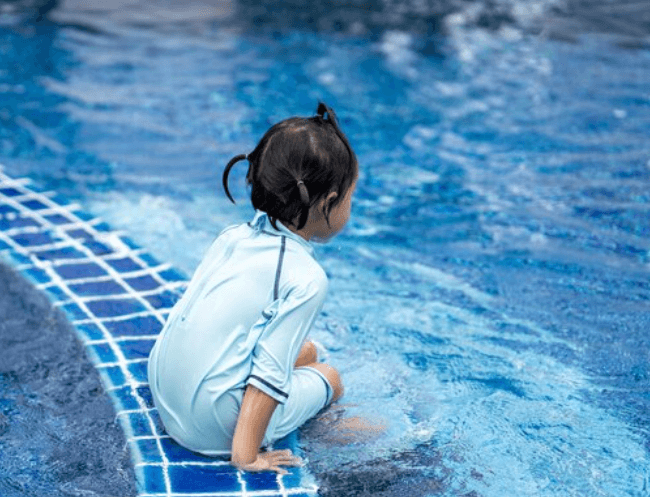
On a weekday afternoon, a certain sound can be heard inside a public swimming pool: the muffled echo of an instructor counting strokes, the slap of tiny feet on wet tile, and a whistle somewhere. If you spend enough time standing close to the shallow end, you begin to notice something that the new research is just now beginning to catch up with. The children who emerge from the water have a different appearance than the children who entered. calmer at times. quieter in a practical sense. A bit more in the moment.
For many years, British families were persuaded to enroll their children in swimming lessons with the sole assurance that they would not drown. Councils maintained funding pools despite shrinking budgets because that was the headline, the moral argument. The most recent round of #LoveSwimming research from Swim England is taking the discussion in a surprising direction.
| Reference | Details |
|---|---|
| Subject | Swim England #LoveSwimming Campaign (Wave 16 Research) |
| Lead Organisation | Swim England, in partnership with regional councils including Wiltshire Council |
| Notable Voice | Leon Taylor — Olympic silver medallist (Athens 2004), parent advocate |
| Technical Lead | Alex Barrett, Senior Technical Aquatics Manager, Swim England |
| Headline Finding | 84% of parents report mood improvement after a swimming lesson; nearly 8 in 10 report better concentration |
| Programme Example | Aqualetes lessons offered through Wiltshire Council leisure centres |
Based on thousands of parent responses, the results indicate that something occurs in the water that extends to the dinner table, the classroom, and the bedtime ritual. After a lesson, 84% of parents report that their child’s mood improves. Almost 80% report increased focus. The figures are impressive, but it’s important to consider their true significance.
Neuroscientists are not parents. Instead of being measured in a lab, what they are reporting is felt. When so many caregivers independently report the same pattern the child arrives restless and leaves calm something is most likely going on that needs to be addressed. Swimming causes a number of physiological reactions that are not triggered by most land-based activities, according to research. The most often mentioned is the Mammalian Dive Reflex, an ancient evolutionary trick that causes the heart rate to nearly instantly slow down when the face is submerged. It’s the pause button integrated into the body. That pause might be more important than anyone realized for a child who is wired with school-day adrenaline.
When announcing the council’s renewed push for its Aqualetes program, Cllr Mel Jacob, who is in charge of community services at Wiltshire Council, put it simply. In addition to helping kids succeed both in and out of the water, she claimed that swimming is a life skill. It sounds, and in part, like council-speak. The press release wrapping belies the intriguing nature of the underlying claim. In England, councils are secretly wagering that pool time improves children’s wellbeing in quantifiable ways. Until recently, this wager would have sounded flimsy and unverifiable.
Because he doesn’t overpromote it, Leon Taylor, the silver medallist from Athens in 2004, has emerged as one of the more reliable voices in this discussion. When discussing his five-year-old son Ziggy, he uses everyday language to describe the transformation: the boy has become more self-assured and composed, traits that he applies to everything. The modesty comes from someone who has spent his entire life participating in competitive aquatic sports. He is not saying that kids who can swim are gifted. He claims that it provides them with an internal stability that is difficult to impart in any other way.
Observing this research gives us the impression that we are rediscovering something that earlier cultures took for granted. The human nervous system has always reacted strangely to water. Even reluctant swimmers may eventually relax once they gain confidence in the water because floating creates a nearly weightless feeling that some experts speculatively link to early development in the womb. It’s difficult to ignore how infrequently kids experience anxiety for extended periods of time after they begin to overcome it. Although no instructor would refer to it as such, the repetitive motion kick, breathe, reach, breathe looks almost like a moving meditation.
Policymakers are likely to pay attention to the classroom data. According to a Swim England survey, about 75% of parents think lessons have increased their child’s level of engagement at school. Lessons, according to eight out of ten working parents, have lessened their child’s anxiety or stress. These are significant numbers, and they come at a time when the UK’s child mental health services are overburdened, waiting lists are expanding, and parents are looking for any kind of assistance. Weekly swimming lessons are hardly a remedy. It is structured, approachable, and results in a child who can sit still, listen, and try again something the research consistently points to.
Swimming instructors often describe it as something they witness on a daily basis, according to Alex Barrett of Swim England. Kids come out of the pool happier, more concentrated, and prepared to tackle the next challenge. He suggests that the research is finally catching up to what educators have been quietly noticing for years. It remains to be seen if parents, schools, and councils take action. In some areas of the nation, pool closures are still ongoing. The cost of lessons is increasing. It appears that the science is more transparent than the policy.
There’s a sense that families’ perceptions of the pool are changing. It serves as a place for kids to unwind for thirty minutes, in addition to being a place to learn a stroke. That may be the true discovery; it’s more subtle than a statistic, more difficult to quantify, but the kind of thing parents have been talking about all along.
i) https://www.ocaquatics.com/benefits-of-swimming-for-children-brain-development
ii) https://www.wiltshire.gov.uk/article/14822/New-research-highlights-the-powerful-benefits-of-swimming-for-children-s-wellbeing
iii) https://american-pools.com/swimming-brain-boost-back-to-school-2025/
iv) https://www.swimscoil.ie/post/the-magic-of-swimming-how-it-helps-kids-grow