

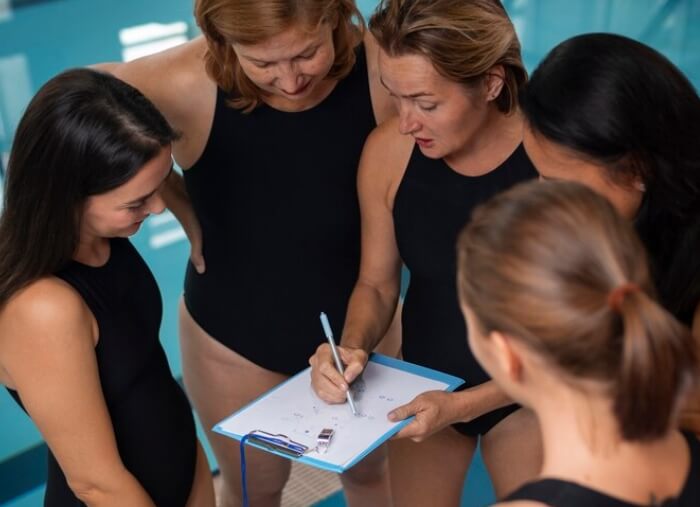
At first, it was simple to miss the shift. A few years ago. A Saturday morning at most community pools looked pretty much the same everywhere. Eight or nine kids clinging to the wall. A teacher pacing the deck. And one or two parents observing through fogged-up glass with a cold cup of coffee.
That image hasn’t exactly vanished. Something has changed underneath it. And anyone who has recently enrolled a child in classes has undoubtedly noticed that the schedules are becoming more bizarre. The questionnaires are becoming longer. And the teachers are asking questions they never asked before. *Does she enjoy getting splashed? Has he ever had a negative encounter with water? On which side does she breathe?
The group was the foundation of swim instruction for the majority of the previous century. It was widely effective, economical, and efficient. As a result of the slowest child in the lane holding everyone back, the fastest child became disinterested and stopped participating.
| Field | Detail |
|---|---|
| Topic | Personalisation in Swim Instruction |
| Featured School (Reference) | Patti’s Swim School |
| Location | California, United States |
| Specialisation | One-on-one and small-group personalised swim lessons |
| Age Range Served | Toddlers to adults |
| Core Focus Areas | Confidence building, water safety, technique refinement, fear management |
| Tools Increasingly Used Industry-Wide | Video analysis, wearables, AI-powered stroke feedback platforms |
| Average Cost (US, Private Lessons) | Roughly $40–$80 per session, varying by region |
| Key Industry Insight | 84% of parents report mood improvement after swim lessons (recent UK research) |
| Reference | https://www.pattisswimschool.com |
Coaches were aware of this. Parents were also aware of it. The alternative paying for one-on-one time seemed ostentatious and was only appropriate for serious club swimmers or nervous six-year-olds who just wouldn’t put their faces in.
That’s the presumption that has quietly crumbled. Supply is one aspect of what has changed. Compared to ten years ago, there are now more independent swim schools, many of which were founded with the personalized model in mind.
Among them is California’s Patti’s Swim School. An instructor working with a single anxious four-year-old in waist-deep water. A teenager practicing a flip turn under the supervision of a coach holding what appears to be a phone tripod. And a retiree relearning freestyle in the adjacent lane are all things that don’t resemble the old YMCA setup when you walk into the facility on a weekday afternoon.
Three distinct individuals with three distinct lesson plans in the same pool at the same time. That arrangement would have been regarded as a scheduling failure ten years ago. It’s the product today.
Families are drawn to this model for more complex reasons than the marketing copy makes clear. It is a well-established fact that children learn more quickly when given one-on-one attention. Early swim instruction has been linked to improved problem-solving abilities, according to research, and teachers have long maintained that confidence gained in the water carries over into other domains.
The fact that contemporary parents are just more aware of their child’s unique anxieties than parents were two generations ago is another, less talked-about factor. Toughening up is no longer advised for a child who recoils when water is poured over the back of their head. Someone is given them, and it will take them three weeks to become accustomed to that one feeling. It moves more slowly. By most accounts, it’s also much more effective. A few years ago, the ways in which technology has permeated society would have seemed a little absurd.
These days, coaches show swimmers exactly what their hand entry looks like at the catch using slow-motion playback and underwater cameras. Stroke rate and stroke distance are monitored by wearable sensors. A few platforms are testing AI-driven feedback that identifies asymmetries that the human eye might overlook.
It’s still unclear if all of this is truly transformative or merely theatrical, but it seems from speaking with seasoned coaches that the best coaches were already picking up on these things instinctively. The information is undoubtedly helpful in explaining a correction to a parent who is trying to figure out why their child keeps veering to the left. The economics are also fascinating, though not always in the way you might anticipate.
Although private lessons are much more expensive per session, families frequently need fewer of them to achieve the same goal. A child may learn to swim a distance without assistance for three months in private lessons after a year in a group class. When parents actually do the math, the results have been subtly influencing choices.
Swim schools have taken notice. Many now provide hybrid structures: a small-group setting for endurance and stroke variety, followed by a few private sessions to lay the groundwork. Even though it makes billing more difficult, it’s a reasonable compromise.
The cultural component is more difficult to quantify. The first dive off the dock. The summer vacation. And the relief a parent feels when their child can finally be trusted near a pool are all examples of how swimming has always carried a certain weight in family life.
Instruction that is tailored to each student seems to enhance that. Checking a box on a generic skill chart is not the same as a child truly conquering something they were afraid of that morning at the end of a lesson. Instructors talk about it. Parents discuss it. When a child leaves the building, it’s difficult to ignore how their posture has changed. All of this does not imply that group lessons will disappear.
They continue to be the most economical entry point, and they frequently function perfectly for a self-assured, inquisitive child. But the centre of gravity in swim instruction has moved. The question parents now ask isn’t *should we put her in lessons* it’s *what kind of lessons, with whom, and how tailored*.
That’s a different conversation entirely, and it’s the one swim schools across the country are increasingly built around. Whether the trend continues to deepen, or settles into a steady middle ground between group and private, is something the next few years will sort out. For now, the pools are quieter, the lanes less crowded, and the instructors, for once, are paying attention to one swimmer at a time.
i) https://www.pattisswimschool.com/blogs/blog/1322193-the-benefits-of-private-swim-lessons–why-personalized-instruction-makes-a-difference
ii) https://www.villagegym.co.uk/blog/swimming-for-beginners/
iii) https://teachme.to/blog/how-much-do-swimming-lessons-cost
iv) https://nationalcareers.service.gov.uk/job-profiles/swimming-teacher