

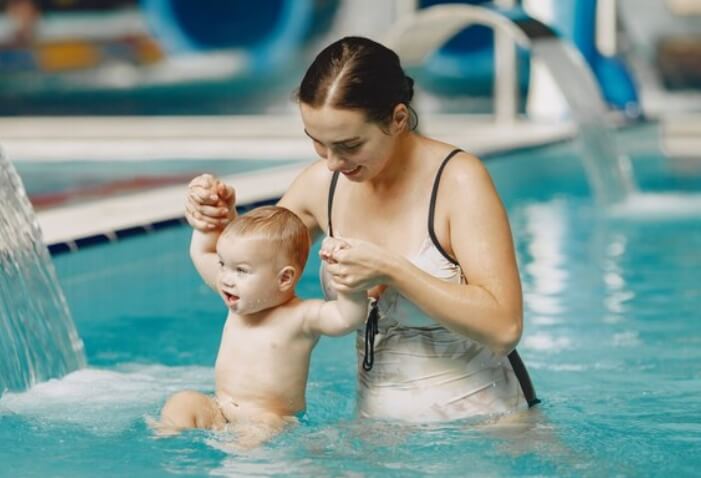
A parent watches a four-year-old wearing oversized goggles inch toward the instructor’s extended arms while kneeling by the edge with their phone tucked into a moist towel. The youngster pauses. The parent’s smile is a bit too forced. The parent lets out a sigh akin to that of someone who has just witnessed a stock they own rise in value as the kick occurs and the splash hits the ground. Although it’s a brief incident, it conveys a lot about swimming’s place in today’s family budget.
Swim lessons were treated like piano or soccer for many years. A pleasant bonus. Something to enroll in if funds and time were available. There is a change in that perception. Parents in places as diverse as Houston, Singapore, or Faisalabad will tell you the same thing: swimming is no longer optional. It is fundamental. There is a perception that the pool provides something that other activities can’t quite match, particularly among younger parents.
| Topic | Details |
|---|---|
| Subject | Children’s swim lessons as a modern parenting investment |
| Industry Voice Cited | Association of Aquatic Professionals (AOAP) |
| Contributing Writer (referenced) | Duncan McNally, in partnership with Nemo Swim School |
| Notable Program Cited | SPEEDISWIM, Singapore — over 25,000 students taught in two decades |
| Core Themes | Water safety, child development, confidence-building, family time |
| Demographic Trend | Rising parental spending on early-childhood swim programs |
| Reference Source | Association of Aquatic Professionals |
First, the reasons are pragmatic. The majority of enrollments are still motivated by water safety. Parents are aware that drowning is still one of the most common unintentional causes of death for young children. Seldom do swim schools need to explain that aspect. Everything is now stacked on top of safety. For the past ten years, aquatics organizations, coaches, and pediatricians have quietly argued that early swim exposure benefits a child’s nervous system, attention span, and sense of self in ways that are difficult to duplicate on a soccer field.
Research supports some of this, while parental folklore supports others, and it’s harder to distinguish between the two than most people realize. Young swimmers may reach some developmental milestones earlier than non-swimmers, according to a 2012 Griffith Institute study. Educators at programs like SPEEDISWIM in Singapore, which has trained more than 25,000 students, describe similar patterns. The results appear consistent enough to be taken seriously, regardless of whether the cause is the water itself, the ritual of structured lessons, or just the fact that involved parents tend to enroll their children in things.
The way the industry surrounding all of this has developed is fascinating. The foundation of Nemo Swim School’s business model is one-on-one instruction given to customers in their own pools. A generation ago, the prices charged by boutique programs in American suburbs would have seemed ridiculous. The willingness of parents to pay it often without much complaint tells you something about how the perceived value has changed. In the same way that families used to justify tutoring, swimming has subtly evolved into an investment.
It’s difficult to ignore the cultural context. For many children, childhood has become more sedentary, pixelated, and anxious. Pediatricians frequently report problems with posture, focus, and self-control. In light of this, the pool begins to resemble a sort of remedy rather than a recreational activity. Breath control, full-body exercise, cardiovascular conditioning, and just being away from a screen for 45 minutes all add up. Parents may not express it that way, but they sense it.
Additionally, there is an emotional component that is underreported. When a child crosses the shallow end by themselves for the first time, the parent watching experiences something. It’s not precisely pride. It’s more akin to relief combined with a sort of realization the tiny, somewhat shocking insight that the child is growing into an independent individual who can navigate the world without assistance. This look is something coaches see all the time. They have mastered the art of not interfering.
In ways that would have shocked a teacher in the 1980s, the lessons themselves have become increasingly complex, incorporating elements from child psychology and sports science. Programs discuss autonomy thresholds, resilience cycles, and progress markers. A portion of the language is overdone. Not all of it is. Aquatics expert Kristin Stitt, who entered the sport through her own daughter’s competitive swimming, has written about how the sport develops character in ways that go beyond medals. When parents read something like that, they nod. After that, they enroll for an additional semester.
Skeptics still exist. Some parents question whether an industry with a financial stake in starting children early has oversold the early-start gospel. It’s a legitimate query. By the age of two, not all toddlers require structured lessons. For ten years, not every family can afford weekly classes. The truth is probably that the floor is more important than the ceiling; most kids will benefit more from basic water skills and a good relationship with the pool than from pricey extras.
Even so, it’s difficult to dispute the direction of the cultural momentum as this trend develops. Swimming has evolved from a summertime skill to a year-round investment, from optional to expected, and from recreational to developmental. It’s unclear if that change will continue into the upcoming economic cycle. As of right now, the waiting lists are lengthy, the pools are full, and parents continue to arrive on Saturday mornings with their phones wrapped in wet towels in anticipation of the kick.
i) https://aquaticpros.org/swimming_into_success_early_swim_lessons/
ii) https://www.speediswim.org/15-science-backed-benefits-of-swimming-for-childrens-development/
iii) https://www.backyardoasis.com/6-reasons-for-swimming-lessons/
iv) https://texasswimacademy.com/how-does-swimming-affect-a-childs-development/