

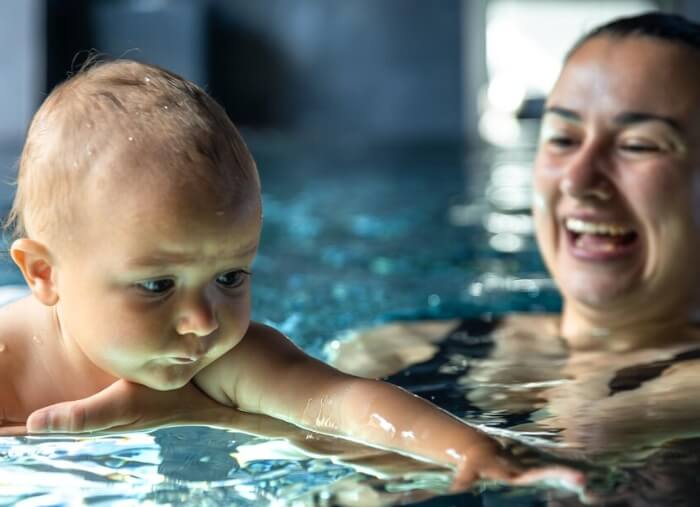
A Manchester recreation center on a Saturday morning in late September has the typical scent of a recreation center: damp tile, chlorine, and a hint of someone’s coconut shampoo. Something has changed within the structure. There’s more to the parents pressed up against the viewing window than just watching their kids float. They are quietly observing their transformation. These days, that word keeps coming up in discussions with families.
Not merely acquire knowledge. Additionally, it’s difficult to ignore how swimming lessons are discussed differently now than they were even ten years ago. The pitch was simple for the majority of the previous century. A child who can swim does not drown. That was sufficient, and that was the deal. Lessons were scheduled by parents in the same manner as dental examinations: they were essential, sometimes inconvenient, and seldom sentimental.
The discussion is messier, more expansive, and, in some respects, more fascinating today. Parents themselves are gradually repositioning swimming lessons as something more akin to a developmental investment, rather than marketing departments. The sixteenth wave of Swim England’s most recent #LoveSwimming study captures that change in numbers that even the campaign’s organizers were taken aback by.
| Information | Details |
|---|---|
| Topic | Modern Swimming Lessons & Family Wellbeing |
| Featured Organisation | Swim England (#LoveSwimming Campaign, Wave 16) |
| Notable Voice | Leon Taylor, Olympic Silver Medallist (Athens 2004), Parent |
| Spokesperson | Alex Barrett, Senior Technical Aquatics Manager, Swim England |
| Key Finding | 84% of parents report mood improvement in children after lessons |
| Framework Referenced | Learn to Swim Framework (LTSF) |
| Year of Latest Research | 2024–2025 wave of #LoveSwimming data |
After a lesson, 84% of parents report that their child’s mood has improved. Lessons have lessened their child’s stress or anxiety, according to nearly 80% of working parents. Nearly the same percentage claim that their ability to focus in class has improved.
These are not the measurements of a 1995 swimming lesson. To be honest, they sound more like therapy metrics. In a recent statement. Leon Taylor. Who won silver in synchronized diving at the Olympics in Athens and now spends most of his time by the pool with his five-year-old son Ziggy. Stated clearly that lessons are about more than just learning to swim. They are about learning to thrive.
It’s the kind of statement you would typically be wary of coming from a campaign, but thousands of parents seem to be saying the same thing in their own words. The value that families place on their children spending time in chlorinated water is evolving. The lessons themselves are also changing, frequently in a subtle way.
Instead of throwing kids into a beginner pool and hoping for the best, swim schools are increasingly focusing on structured progression frameworks like Swim England’s Learn to Swim Framework, which moves kids through stages. It seems like parents now demand the same level of clarity from a swim instructor as they would from a school report. What my child is working on. What comes next. And why it matters.
Families are increasingly drawn to programs that explain the journey, but informal lessons are still available. Who’s in the water is another issue. Once a niche embarrassment for adults who never learned, adult beginner classes are becoming more and more popular. Parents are registering alongside their children. In part because they don’t want to be the only family member anxiously standing at the shallow end of vacation. And in part because. To put it politely.
Modern parenting is exhausting and 45 minutes of weightlessness is a small mercy. One of the more subdued contemporary scenes you’ll see in a community pool is a mother and her seven-year-old practicing the same back-float side by side. Additionally, the accessibility argument continues to hold up.
One of the few activities that doesn’t penalize bodies for being older, heavier, recuperating from an injury, or simply exhausted is swimming. Joints are given a rest. The cardiovascular systems do not.
That’s uncommon for families navigating drastically disparate fitness levels across generations, and it’s evident in the frequency with which grandparents now attend Sunday afternoon recreational sessions. The most notable thing, though, is that swim schools are beginning to discuss the social aspects of instruction without hesitation. The unseen mechanics of a lesson used to be children waiting for their turn, paying attention to instructions, and supporting the child next to them.
They are now, in part, being used as the lesson. According to Alex Barrett of Swim England, parents frequently link their kids’ time in the pool to broader improvements in their lives, such as increased focus and resilience. It’s still unclear if all of that holds up in more rigorous academic research.
Parents appear to be persuaded, and parents who are persuaded often continue to attend. We still have a long way to go. Waiting lists for popular schools can last for months, lesson costs are not insignificant for many families, and pool closures in some parts of England continue to be a concern.
The enthusiasm for culture has outpaced the infrastructure. As you watch it happen, you get the impression that swimming lessons are taking on a new identity that is more about not shrinking than it is about not drowning. From the security of a life skill to the gradual development of an individual. Not much has changed in the pools. It’s obvious that the families surrounding them have.
i) https://www.swimming.org/justswim/swimming-lessons-benefit-children-beyond-pool/
ii) https://fitnesschamps.com.sg/how-swimming-classes-shape-healthy-family-lifestyles/
iii) https://www.wiltshire.gov.uk/article/14822/New-research-highlights-the-powerful-benefits-of-swimming-for-children-s-wellbeing