

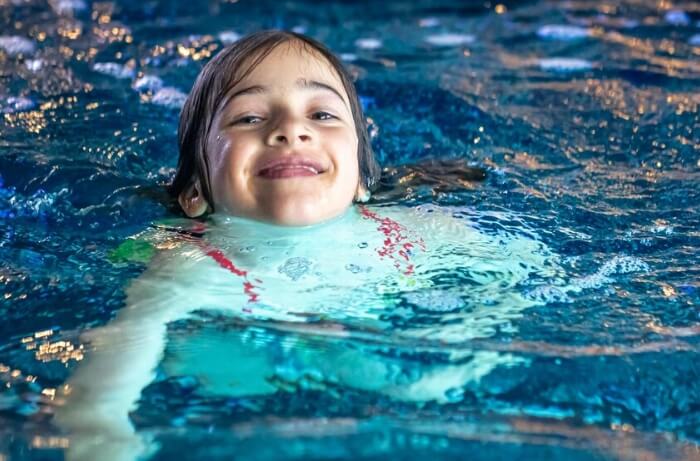
On a weekday afternoon, there’s a certain kind of silence at a swimming pool. It’s not quite silence, but rather a low hum of splashes, teachers yelling names, and parents sitting on the side benches, half watching their kids, half watching their phones. Occasionally, a tiny voice would emerge above everything and say, “I did it.” A parent’s somewhat relieved smile usually follows three words that are typically shouted.
You begin to understand why swim instructors continue to say the same things about the children in their classes as you watch it happen week after week. This isn’t merely a sentimental observation, according to new research from Swim England’s #LoveSwimming campaign. According to the most recent wave of their data, which was gathered from parents nationwide, swimming lessons do much more than just teach kids how to avoid drowning.
| Information | Details |
|---|---|
| Topic | Childhood development through swimming lessons |
| Source Organisation | Swim England (#LoveSwimming campaign, Wave 16) |
| Key Voice Featured | Leon Taylor, Olympic silver medallist (Athens 2004), parent |
| Supporting Institution | Brightwater Swim School (Harrogate, York, Cundall) |
| Reported Findings | 84% of parents say child’s mood improves after a lesson; 8 in 10 working parents say lessons reduce stress or anxiety |
| Recommended Starting Age | As young as four months |
After a lesson, 84% of parents say their child’s mood improves.Lessons, according to nearly eight out of ten working parents, have helped their kids feel less stressed or anxious. Additionally, almost 75% of parents attribute their child’s academic success to swimming. These kinds of numbers can seem abstract.
After an hour in a beginner’s class, they start to make sense. Leon Taylor, who won silver in diving at the Olympics in Athens, has been observing this change at home. On weekends, he goes swimming with his five-year-old son Ziggy, who regularly attends lessons.
Taylor has talked candidly about it, describing Ziggy’s poise and self-assurance outside of the pool and in all other situations, including playdates and school mornings. It’s the type of testimony that has a slightly different impact when it comes from a parent rather than a champion. Listening to him gives the impression that he has observed what many other parents have as well.
Lessons are carrying out a subtly significant task. The structure is undoubtedly a part of it. Young children learn to listen, follow directions, repeat skills, fail at them, and try again when they swim.
The pool doesn’t give a damn if you’re grumpy or exhausted. The water reacts to your body’s actual actions rather than your desires. That feedback loop has an honesty to it that is uncommon in early childhood. When a child learns to float on their back, they have truly discovered something on their own. The teacher is able to provide guidance. The parent can applaud.
The child’s body is where the floating takes place. Children as young as four months old can attend Brightwater Swim School, which offers small classes in Harrogate, York, and Cundall. The school believes that the objective is not to encourage kids to swim independently as quickly as possible. Teachers all over the nation share this viewpoint. The reverse is true. The idea is to allow independence to develop gradually on a basis of security and confidence.
Reduced class sizes are beneficial. Patience is also important. Allowing a four-year-old to independently determine that today is the day she will cover her face also goes hand in hand. Nowadays, it’s difficult to ignore how much childhood is mediated. apps that monitor screen time. play areas with rubberized flooring.
scheduled enrichment, pickups, and drops. Strangely. The pool is one of the few places where a young child can be truly alone for extended periods of time while engaging in physically demanding activities. With an adult nearby but not holding their hand. Much of the development appears to occur in that gap, the area between self-direction and supervision. Little decisions are made by children. Which stroke? How profound. When to take a breather. These don’t feel particularly significant.
They add up to something when combined. The senior technical aquatics manager for Swim England, Alex Barrett, has stated it clearly. Teachers of swimming observe children emerging from the pool with greater focus, happiness, and preparedness for whatever lies ahead. According to him, it’s remarkable how frequently parents link the pool to academic advancements. focus. inspiration.
the readiness to make an effort. The data doesn’t fully address whether all of this can be directly linked to swimming or whether kids who take lessons typically come from homes that are already committed to their development. Both could be true at the same time.
The argument for getting started early and sticking with it long enough to reap the rewards appears to be strengthening. Swim England’s pool finder is available at swimming.org/poolfinder for parents looking for local classes. If Taylor, the teachers, and the parents in the survey are correct, they will discover something more than a life-saving ability. They will locate the moment when their child realized they could accomplish a difficult task on their own, without much fuss. and discreetly took that with them when they returned home.
i) https://www.swimming.org/justswim/swimming-lessons-benefit-children-beyond-pool/
ii) https://brightwaterswimschool.co.uk/2025/03/06/the-role-of-swimming-lessons-in-building-confidence-and-independence/
iii) https://www.everyoneactive.com/content-hub/swimminglessons/how-learning-to-swim-improves-your-childs-confidence/
iv) https://newcastlepools.com.au/how-swimming-builds-resilience-and-independence/