

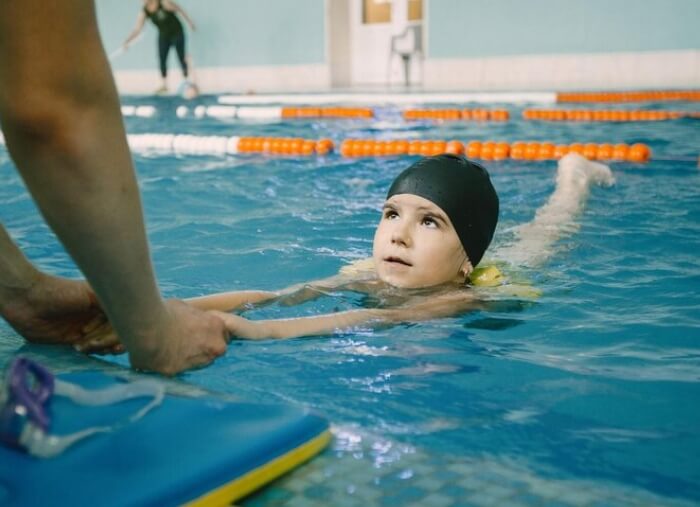
Swim lessons have existed in that uncomfortable limbo between necessity and luxury for a long time. Parents are aware of the risks. Even though drowning is one of the top causes of death for young children in the US, eight private lessons can cost more than $400 before anyone has even purchased goggles. It has never been easy to do the math. Slowly at first, then all of a sudden, the people in charge of setting policies and prices have begun to take notice.
The scene tells you most of what you need to know when you walk into a community pool on a Saturday morning. A teacher with a whistle, parents moving on bleachers, children wearing mismatched swim caps, and the patience of someone who has taught kicking technique a thousand times. The actual lessons haven’t changed all that much. The surrounding economy has. Speaking with program directors and instructors, it seems like affordability is now a major concern rather than a minor one.
| Topic | Cost trends in U.S. swim instruction |
| Typical private lesson range | $50–$200 per session |
| Most affordable format | Group classes at community rec centers |
| Major federal proposal | SWIM Act (HSA/FSA eligibility for lessons) |
| Notable city investment | NYC: $5.5M expansion, ~18,000 students served |
| Estimated family savings (NYC alone) | $1.3 million |
| Reference | American Red Cross — Swim Lessons |
Consider New York City. Mayor Eric Adams announced earlier this year that the city’s free swim program would be expanded by $5.5 million, specifically targeting underprivileged neighborhoods. Working-class families will save an estimated $1.3 million on lessons they would otherwise have to pay for out of pocket thanks to the initiative, which is expected to reach an additional 4,800 second graders, bringing the total number of students served close to 18,000. For the families who actually use these pools, the difference between free and even moderately priced is the difference between learning to swim and not, even though numbers like that don’t usually make a difference in a city of millions.
The federal angle, on the other hand, has been more subdued but may have a wider reach. Families could use pre-tax money from Health Savings Accounts and Flexible Spending Accounts to pay for swim lessons under the proposed SWIM Act. It’s the kind of policy detail that, until you look at the numbers, seems boring. That amounts to a 22 percent annual discount on all lessons and packages for a household in the 22 percent tax bracket. It remains to be seen if the bill will be passed. The framing alone treating swim instruction as a health expense rather than a recreational one is a significant change, though it’s still unclear how much traction it has in the current Congress.
Though more randomly, the private market is also evolving. platforms such as TeachMe and independent teachers.to have placed more emphasis on package pricing, where purchasing eight or twelve sessions in advance results in a twenty or thirty percent reduction in the cost of each lesson. Eight lessons for $360 equals $45 per session, which is still not inexpensive, but it’s not the same as paying $80 for a single session. Quietly, semi-private lessons in which two or three swimmers share an instructor have also grown in popularity. They are less expensive than going one-on-one and offer more individual attention than a packed group class, making them a helpful middle ground. Sibling families discovered this long ago. The market as a whole is catching up.
It’s difficult to ignore how much of this change is taking place against a somber backdrop. In recent years, drowning rates have increased, especially among children and teenagers living in lower-income areas. In response to that data, Boston University’s FitRec program, among others, has increased the number of year-round classes. The safety story and the cost story are one and the same. The narrative has always been the same, but it has been presented from various perspectives based on the audience.
Gaps still exist. A 30-minute class with six children at a busy suburban recreation center is not the same as a 45-minute class with four students at a specialized aquatics facility, and group lesson prices vary greatly by region with no true national benchmark. The sticker price can be subtly increased by pool access fees, cancellation policies, and the frequently concealed cost of facility surcharges. When comparing prices, one soon learns to inquire about what is included in a lesson as well as its price.
As you watch this happen, you get the impression that there is a genuine but uneven shift toward affordability. Suddenly, a Bronx family may have access to free city-run classes that their cousin in a smaller town can only imagine. If the SWIM Act is passed, a self-employed parent might gain a great deal, while a salaried parent without an FSA might not see any changes at all. Lumpy progress, but still progress.
For the first time in a long time, it appears that the fundamental premise that swim lessons are an inevitable, unavoidable expense parents just absorb is being put to the test. In areas where it once felt fixed, the price tag is decreasing due to federal tax policy, municipal investment, or a more competitive private market. That is long overdue for a service that, to put it simply, has the potential to save a child’s life. And most likely still insufficient.
i) https://usswimschools.org/swim-act-allowing-pre-tax-dollars-for-lessons/
ii) https://bigblueswimschool.com/blog/comparing-the-value-group-vs-private-swim-lessons/
iii) https://teachme.to/blog/how-much-do-swimming-lessons-cost
iv) https://www.nyc.gov/mayors-office/news/2025/03/mayor-adams-5-5-million-investment-expand-free-swim-lessons-nearly-18-000