


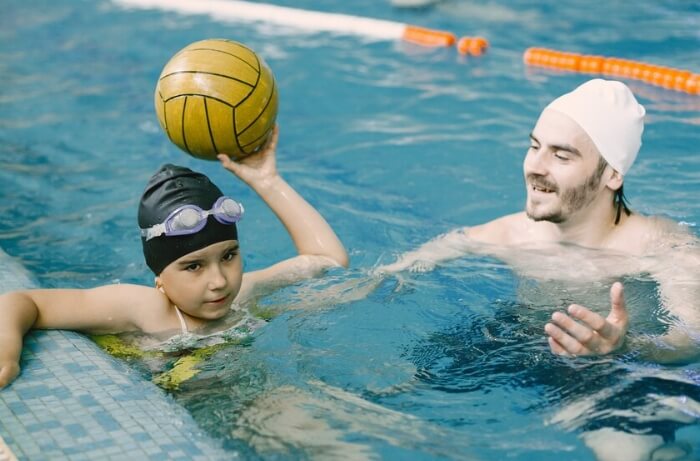
After the final practice whistle, there’s a certain type of silence on the swim club deck. With half-wrapped towels and hair dripping onto the tile, children climb out of the lane lines with that loose, slightly exhausted gait. Before their hair is even dry, some of them take out their homework. This little scene. Which is repeated in pools from suburban Texas to public recreation centers in England. Suggests what coaches have long suspected. Kids who arrive early Put in a lot of effort in the water and learn to lose gracefully also tend to perform oddly well in the classroom. This was considered folklore for a very long time.
At registration, coaches shared a charming tale with parents. A report by Karl New of the University of South Wales and Ian Cumming, CEO of Health Education England at the time, gave that story some unexpected weight. According to their review. The cognitive boost from a rigorous practice can last up to three hours. And competitive swimming. More than most childhood sports. Provides something near the ideal balance of aerobic effort and mental focus.
It turns out to be long enough to finish an exam in the morning or even an evening’s worth of homework. What’s actually happening here might be a quiet kind of training that the brain doesn’t typically receive on a basketball court or a soccer field. Swimming requires a child to count strokes, maintain pace, think while out of breath, and translate a coach’s correction into a small adjustment in the subsequent length.
| Information | Details |
|---|---|
| Organization | MARS Swimming |
| Type | Year-round competitive swim club |
| Location | Arlington, HEB, Grapevine, Colleyville, Fort Worth (Texas) |
| Ages Served | Children 5 and up |
| Mission | Build well-rounded swimmers who succeed in the pool and in life |
| Key Values | Diversity, accountability, respect, leadership, water safety |
| Reference Report | Swimming and Academic Achievement by Ian Cumming (CEO, Health Education England) and Karl New (University of South Wales) |
Observing a young swimmer tighten their streamline following a brief lesson gives the impression that the discipline being practiced is more than just physical. It’s the discipline of focusing while uncomfortable, just as it’s the discipline of enduring a challenging math exam. According to Cumming, a Level 3 swimming coach and swim parent, the project started when a teacher at his school mentioned almost casually that the swimmers there were exceptionally diligent and academically gifted.
Such a casual observation may be a coincidence. It might also be the beginning of something. According to Cumming’s own admission, the data that suggested children should continue training during exam season not less, but in a measured manner surprised him the most. This is in contrast to what many worried parents naturally advocate. It’s not hard to figure out how this could work. Swimming is a bilateral activity that activates both hemispheres of the brain by using both sides of the body.
The brain happily absorbs the increased blood flow and oxygen. It activates proteins involved in memory formation. While none of this science is particularly novel, children who consistently engage in it tend to accumulate. Without knowing the studies. Parents at MARS Swimming. A year-round club that serves Arlington. Grapevine. Colleyville. And the surrounding Fort Worth suburbs. Frequently describe the same thing. Their child swims for an hour. Returns home. Eats.
And then settles down to read with a level of focused attention that wasn’t there before. Anyone who has spent time with a swim team eventually notices a softer, more difficult-to-quantify benefit. Waiting is a skill swimmers acquire.
Every week, they are taught to follow a black line on the bottom of a pool for thousands of yards by themselves while thinking. They discover that until the meeting, the work is invisible. Long study sessions require slow, repetitive effort, which children raised on that diet appear to develop a tolerance for.
There aren’t many Tesla-style overnight makeovers in the pool. Just as grades change by half a letter, improvement happens by tenths of a second. Saying swimming is a panacea for academic success would be overly simplistic. Many intelligent students never come into contact with a swimming pool. Many competitive swimmers have academic difficulties. The pattern continues to appear in coaches’ notes. Teachers’ observations.
The brief report Cumming and New put together and the testimonies of parents at clubs like MARS who see their kids become more organized. Focused. And capable of overcoming setbacks and trying again. In his foreword Duncan Selbie the Chief Executive of Public Health England at the time put it broadly clubs like these. Whether they are swimming or not. Give young people a place to learn goal-setting. Stress management. And how to be around other people who are trying just as hard.
It’s difficult not to believe that the academic advantage is partially a byproduct of something more straightforward when you watch all of this develop over the course of a season. Children who learn to swim are being repeatedly and gently taught how to deal with challenges. They arrive exhausted. Before a meeting, they arrive anxious. The morning after a poor race, they arrive. Nevertheless, they enter the water after that. They might bring that habit into the exam room more than any blood flow chart or protein.
i) https://www.swim-inzone.com/2020/08/swimming-improves-academic-ability
ii) https://www.hamptonswimschool.com.au/the-life-long-benefits-of-childhood-swimming
iii) https://www.babyotterswimschool.com/swimming-lessons-boosting-brainpower-in-kids-and-teens/
iv) https://www.aqua-tots.com/why-swimming-is-more-than-a-sport/