

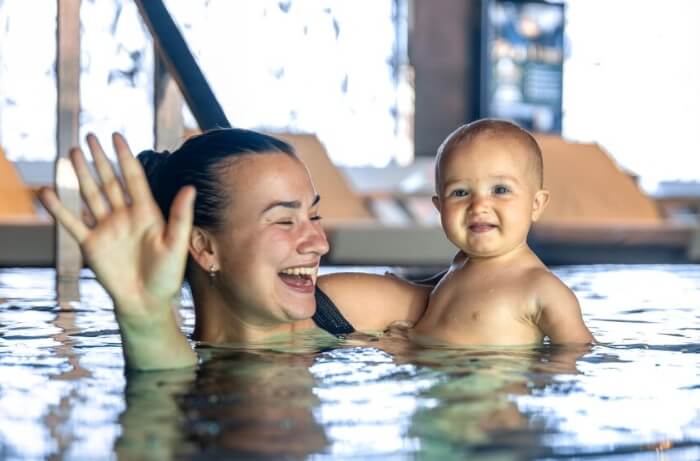
Almost everything you need to know about contemporary parenting can be found in the lobby of a community recreation center on any given Saturday morning. Wet towels draped over shoulders, a group of parents juggling coffee and car keys, children wearing vibrant swim caps pulling at goggles that don’t fit properly. It has a certain quiet chaos to it.
It appears ordinary, even unremarkable. If you watch long enough, you begin to see a pattern that indicates these lessons are helping families much more than what the curriculum on the wall would indicate. Swimming lessons were placed somewhere between learning to ride a bike and music class on the parenting checklist for many years. A pleasant possession. A matter of safety. Something you managed to do.
| Topic | Details |
|---|---|
| Subject | Swimming Lessons in Modern Parenting |
| Featured Organisation | Swim England (#LoveSwimming Campaign) |
| Campaign Wave | Wave 16, 2024–25 |
| Notable Voice | Leon Taylor, Olympic Silver Medallist (Athens 2004), Father of Ziggy (5) |
| Key Statistic | 84% of parents say their child’s mood improves after a lesson |
| Working Parents Insight | 8 in 10 say lessons reduced their child’s stress or anxiety |
| Cognitive Impact | Nearly 8 in 10 report improved concentration and attention span |
| Recommended Starting Age | As early as possible (infancy, with parental supervision) |
| Core Skills Built | Water safety, confidence, focus, resilience, social cooperation |
This framing is changing, and not in a subtle way. According to recent data from Swim England’s #LoveSwimming campaign. Eight out of ten working parents say the lessons have helped their child feel less stressed or anxious. And 84% of parents say their child’s mood improves after a lesson.
Such numbers are uncommon. Even if no one refers to it as such, they imply something more akin to therapy than recreation. It’s possible that the swimming itself isn’t what parents are reacting to. Packed schedules. School anxiety. The constant buzz of electronics. And the strange new pressure of raising kids who are expected to be both emotionally stable and academically astute before they’ve lost their second tooth have all contributed to the unusually dense modern family life. In contrast, swimming eliminates the majority of that. No screen is present. No homework is required.
A teacher, a whistle, and forty-five minutes of disciplined, physical, somewhat chilly concentration are present. This enforced simplicity appears to be working, according to parents. Former Olympic diver Leon Taylor, who won silver in Athens in 2004, has talked about watching this unfold with his five-year-old daughter Ziggy.
He has explained how his son’s regular lessons have helped him feel at ease throughout the rest of the week. Many parents nod silently at this kind of observation. There’s a sense, anecdotal but persistent, that kids who swim handle the school day differently.
It’s difficult to say for sure whether that’s the exercise, the discipline of adhering to an instructor’s instructions, or simply the peculiar neurological effect of being submerged in water. The pattern persists. It is now more difficult to ignore the cognitive component.
In the same study, nearly eight out of ten parents reported that their child’s focus and attention span were enhanced by swimming lessons. Teachers are usually the first to notice it. A child who has practiced the same stroke for thirty minutes. Listened to corrections. And held their breath for three more tries will arrive at a Monday morning classroom with a slightly different relationship to effort. In the pool, progress is rarely noticeable. It comes in annoying little steps. which, when you consider it, is precisely the beat of everything else that is worthwhile learning.
The social connotations of swimming are another issue. For younger kids, group lessons are still one of the few unstructured but supervised social settings. They alternate.
On the pool’s edge, they wait. When someone finally swims a width without stopping, they support one another in a disorderly, somewhat tribal manner. The friendships made there are different from those made at school; they are more casual, less structured, and frequently stem from just spending six months in the same lane on the same Tuesday.
Even if they don’t always express it, parents are also aware of this. Of course, the financial calculation is accurate. Pool access varies greatly based on a family’s residence, and lessons are not inexpensive.
Some parents absorb the expense in the same way that they absorb the cost of school shoes: they are necessary, unavoidable, and a little uncomfortable. Others must make more difficult choices. Swim England has been arguing that early enrollment is important. In part because the window of opportunity for a child to gain confidence in the water is smaller than most people realize. And in part because the longer a child attends lessons. The more these secondary benefits actually compound.
The trial term doesn’t do the work; the continuation does. As this develops, it’s difficult to ignore how much contemporary parenting has evolved into a hunt for activities that covertly accomplish multiple tasks at once. Something tangible. Something communal. Something that develops character without being called character-building, since kids can detect that label from a distance. Almost by coincidence, swimming has evolved into just that.
It’s not the most glamorous way to raise a resilient child. It’s difficult to dispute the outcome on a Saturday morning in a lobby with a faint chlorine odor, when a child emerges from the water with a proud and pink face.
i) https://www.swimexpert.co.uk/about-us/news/building-champions-how-swim-lessons-benefit-your-childs-development
ii) https://fitnesschamps.com.sg/how-swimming-classes-shape-healthy-family-lifestyles/
iii) https://www.parent.com/blogs/conversations/2017-use-philosophy-life-pick-swim-lessons
iv) https://www.abbeycroft.org.uk/from-splash-to-success-why-swimming-is-a-vital-skill/