

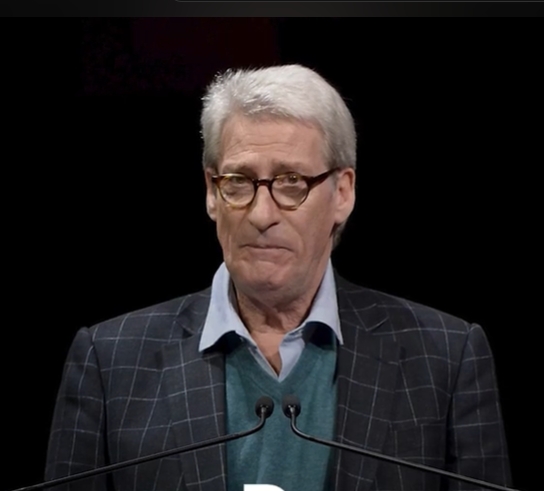
When a man like Jeremy Paxman stops being the one posing the questions, it’s an odd thing. He was the unimpressed face across the desk on Newsnight, the quizmaster on University Challenge, and the interviewer that politicians dreaded for decades. His raised eyebrow could simultaneously end undergraduate dreams and careers. A London neurologist then noticed something in Paxman’s face while watching the show at home sometime in 2020. Not even a flicker. not having one.
A doctor diagnosing a national broadcaster on television seems almost too tidy to be true; it’s the kind of anecdote you’d think a memoirist would have polished for impact. However, Paxman has recounted the tale in a straightforward manner on multiple occasions, and the version doesn’t really change. He had been having trouble buttoning his shirts. He appeared to have lost some of his physical exuberance on air, as his wife had gently pointed out. Then there was the fall while walking the dog with the lead still in his hand on a patch of ice in a London square. The physician who had been observing extended his hand. Tests came next. The long, strange reign of one of the most recognizable faces on British television came to an end in 2021 with the diagnosis.
| Field | Detail |
|---|---|
| Full Name | Jeremy Dickson Paxman |
| Born | 11 May 1950, Leeds, Yorkshire, England |
| Nationality | British |
| Education | Malvern College; St Catharine’s College, Cambridge |
| Profession | Former broadcaster, journalist, author |
| Known For | Newsnight (1989–2014), University Challenge (1994–2023) |
| Career Start | BBC Radio Brighton, 1972 |
| Diagnosis | Parkinson’s disease, announced May 2021 |
| Stepped Down From University Challenge | 2023 |
| Notable Project (Post-Diagnosis) | Movers and Shakers podcast; Putting Up with Parkinson’s documentary |
| Reference | BBC News — Jeremy Paxman |
Watching old videos of him now gives me the impression that the warning signs had been present for a while. One of the symptoms of Parkinson’s disease that a stranger might overlook but a clinician can quickly identify is the flattening of facial expression. In Paxman’s case, the act had always included his expressiveness. The smirk, the frown, the theatrical sigh directed at a competitor who was struggling with Pythagoras. The loss becomes apparent when that vocabulary of tiny movements begins to fade, something that most of us wouldn’t notice.
After hosting the revived program for almost thirty years, he left University Challenge in 2023. Even though the decision wasn’t shocking at the time, it still felt like the end of an era one of those slow, low-key British endings. According to Parkinson’s UK, there are about 153,000 Parkinson’s patients in the UK, and two more are diagnosed every hour. According to the charity’s literature, it is the neurological condition with the fastest global growth. The cure is still unattainable.
What Paxman has done since has been even more unexpected. Instead of running away, he and a few other victims, including former BBC technology correspondent Rory Cellan-Jones and former Princess Diana’s divorce attorney Sir Nicholas Mostyn, co-founded a podcast called Movers and Shakers. The program, which focuses on a disease that most of its viewers would prefer not to consider, is both a support group and a current affairs program. There are moments when it’s humorous, which feels significant. According to Paxman, Parkinson’s disease is not a tragedy that should be bravely endured. It is a daily annoyance that can be worse at times and darker at others.
When he and the podcast team gave Downing Street a document they dubbed the “Parky Charter” in April of last year, that darker register became apparent. Tens of thousands of signatures, five recommendations, and one quote that went farther than all of them. Parkinson’s disease “may not kill you but will make you wish you hadn’t been born”, according to Paxman.” The prime minister at the time, Rishi Sunak, pledged to give the charter the consideration it merited. As usual, Paxman told reporters that he anticipated “no effect whatsoever” from the entire situation.
Some in the Parkinson’s community took offense at the statement that you wish you hadn’t been born. In a letter published in The Guardian, a fellow patient in the Scottish Borders gently countered that, for the majority of people, the illness isn’t quite that dire a gradual decline, yes, but one that many can manage with the aid of medicine, physical therapy, neurotherapists, and even Zoom Pilates. Individual differences in pace are significant. It’s a valid point, and most likely the more representative one. However, Paxman has never been in the business of softening edges for the benefit of the general public.
His former Newsnight coworker Jeremy Vine, whose own father passed away from Parkinson’s in 2018, told The Times that he had been meaning to get in touch and expressed his sadness at Paxman’s suffering. He remembered what a coworker had once said about Paxman’s working style: sometimes he would think up a single question for an entire day, then deliver it like a striker who had been silent for eighty minutes before scoring the season’s biggest goal. “Well, it’s not been a very good century, has it?” said the German ambassador in 1989. such a query.
It’s difficult to ignore the fact that his own condition is now the target of the same instinct, the slow accumulation, and the well-aimed sentence. Not in a memoir, but on the steps of Downing Street, he has said things that most people with Parkinson’s disease don’t say aloud. As Paxman himself suspected, it is still unclear whether the government will take any action regarding the charter. Meanwhile, the illness continues to do what it does. Slowly, erratically, and with little consideration for the audience.
i) https://neuroclin.com/jeremy-paxman-gets-parkinsons-diagnosis-after-doctor-saw-him-on-tv/
ii) https://www.theguardian.com/society/2024/apr/17/jeremy-paxman-take-on-parkinsons-disease-is-far-too-bleak
iii) https://parkinsonseurope.org/parkinsonslife/jeremy-paxman-i-refuse-to-be-beaten-by-parkinsons-disease/