

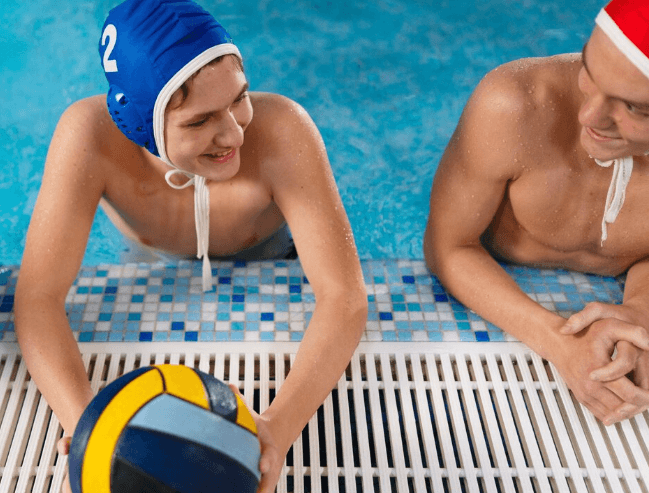
Early in the morning, before the lanes fill up, a certain kind of silence descends upon a swimming pool. A swim instructor uses a kickboard to tap the side. With arms still unsteady and legs kicking too quickly, a child, perhaps six years old, descends the ladder and pushes off. It’s difficult to ignore how different this scene feels from a basketball court or football field as you watch it play out. There is no scoreboard and no yelling. Only the sound of breathing and the flow of water.
In the realm of youth sports, swimming has always had a somewhat underappreciated reputation. Parents frequently discuss tennis lessons, gymnastics, and football academies. Swimming is viewed less as a developmental skill and more as a safety one. The evidence continues to point in a more intriguing direction.
| Field | Detail |
|---|---|
| Topic | Swimming and physical development |
| Primary Source | Swim England Health & Wellbeing Report |
| Commissioning Body | Swim England (national governing body for swimming in England) |
| Report Chair | Professor Ian Cumming, former CEO, Health Education England |
| Key Finding | Swimmers show reduced all-cause mortality risk by roughly 28% |
| Population Benefit | Children, older adults, people with joint conditions, mental health concerns |
Children who take swimming lessons seem to develop social, cognitive, and physical skills more quickly than those who don’t, according to a Swim England report chaired by Professor Ian Cumming. That is a compelling assertion that merits careful consideration. When you look at the pool, it’s almost clear what makes it different from the pitch. The body is resisted by water in all directions. Muscles are not drawn into the same repetitive groove by gravity.
Some muscles are heavily trained by a football player, while others receive very little training. In contrast, a swimmer uses their shoulders, back, hips, legs, and core in a manner that resembles balance. Swimming is sometimes referred to by coaches as the only sport that develops long, lean muscle without causing joint damage.
This seems to be the reason why so many cyclists and runners end up in the pool when their knees start to hurt. Swimming has an even greater advantage on the cardiovascular side. Young swimmers’ lung capacity typically develops earlier and remains higher than that of their peers who participate in land-based sports.
It’s possible that swimming’s breath control requirements holding air, exhaling rhythmically, and surfacing on a count train the lungs in ways that running on a track does not. Researchers have found that regular swimmers have better blood vessel elasticity and a longevity link that is difficult to match in other sports. According to research by Swim England, swimming may lower the chance of dying young by about 28% a figure that makes you read the sentence twice. Injuries are another issue. Over time, sports like football, rugby, gymnastics, and even tennis have significant physical costs. knees, ankles, shoulders, minor stress fractures, and persistent tendon issues.
Most of this is avoided when swimming. About 90% of the body weight is carried by the water, allowing joints to move freely without grinding. This is more important than most people realize for a developing skeleton.
Bones do not withstand the force of a hard tackle or an improper dismount, but they still benefit from the muscular pull. Robert, a swimmer highlighted in the Swim England report, has both Korsakoff’s syndrome and bipolar disorder. He discusses the pool in a manner similar to how some people discuss therapy.
It’s just a simple swim” , he replied, “but it has changed my life.” This type of testimony makes the discussion more difficult because mental and physical development are inextricably linked. When a child learns to breathe rhythmically, feels safe in the water, and advances through small, noticeable milestones, they develop something that other sports don’t always provide. quiet assurance.
the perseverance to try again when a stroke doesn’t work. Another unique feature of swimming is that it is practically accessible to everyone. To begin, you don’t have to be tall, quick, or powerful. Elderly people can swim. Women who are pregnant swim. Arthritis sufferers swim.
The water is unconcerned. Swimming has the potential to be a true game-changer in public health, according to Mike Farrar, former CEO of the NHS Confederation, especially as long-term care budgets continue to shrink. There is a component to that. Few sports are as effective over the course of a lifetime. This is not meant to minimize other sports. Football improves decision-making and agility.
Gymnastics develops proprioception and raw strength. Team sports impart knowledge that is difficult to duplicate in the pool. Swimming is unique when it comes to physical development the kind that creates a body that can perform a variety of tasks over an extended period of time.
It’s still unclear why most parents still view swim lessons as a checkbox rather than a foundation, and why this hasn’t translated into a more pervasive cultural emphasis. Perhaps that will change. You get the impression that it probably should when you watch a child complete their first continuous front crawl, breathing steadily and turning their head at the appropriate time.
i) https://www.sportengland.org/news/study-reveals-huge-health-benefits-of-swimming-regularly
ii) https://www.abbeycroft.org.uk/from-splash-to-success-why-swimming-is-a-vital-skill/
iii) https://swimoc.com/blog/the-benefits-of-incorporating-swim-training-for-young-athletes/