

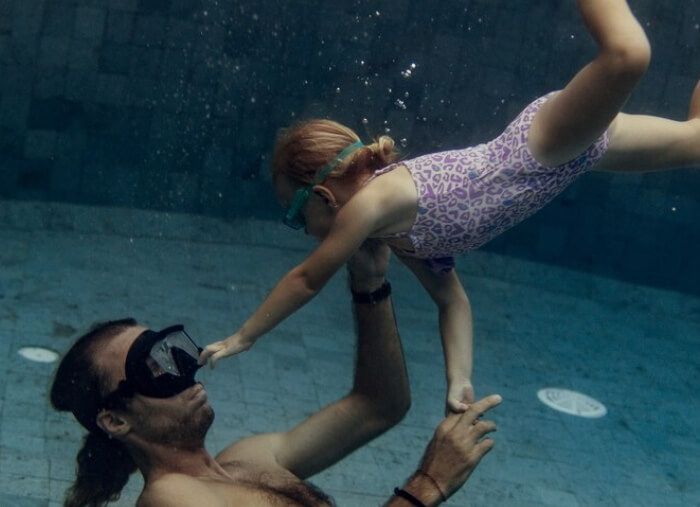
A Saturday morning at any community pool is the best time to witness the subtle change in parents’ perspectives on keeping their children active. By eight, the parking lot is completely occupied. Inside, parents balance coffee cups and wave from the bleachers as children wearing goggles drag their towels across wet tiles.
That same group was most likely at a soccer field ten years ago. They’re here now, and the shift isn’t coincidental. Pediatricians, school counselors, and even physiotherapists have gradually begun to recommend swimming, and most parents appear to have noticed without quite understanding why.
| Reference | Details |
|---|---|
| Topic | Swimming as the leading fitness recommendation for children |
| Recommended By | Pediatricians, CDC, child development researchers |
| Recommended Age to Start | Infants (with parent) onward; structured lessons around age 4 |
| CDC Activity Guideline | At least 60 minutes of physical activity daily for children |
| Key Physical Benefits | Full-body strength, cardiovascular health, joint protection, coordination |
| Key Cognitive Benefits | Memory, language, math skills, focus, bilateral brain engagement |
| Notable Research | Griffith University (Australia) study on early swim learners |
It used to be just one choice. These days, it’s frequently mentioned first. Families seem to be quietly coming together from various angles; some are pursuing fitness, some are pursuing safety, and some are merely attempting to get their children away from screens for an hour. The physical appearance of childhood has changed over the past ten years, which is part of the reason. Children spend more time sitting. They take fewer walks.
Children should still engage in at least sixty minutes of physical activity each day, according to the CDC, but most do not. Pediatricians have been raising concerns about children’s weight, posture, and cardiovascular health at younger ages than anyone would anticipate. Strangely, swimming seems to address the majority of those issues simultaneously, which likely accounts for its popularity.
Swimming is more accommodating to a developing body than, say, basketball or gymnastics. Childhood joints and bones are still pliable and negotiating with one another. Sports with a strong impact leave scars.
Water doesn’t. Since the buoyancy carries the majority of the body’s weight, a child can exert a lot of effort, become truly exhausted, and still leave without experiencing knee pain the following morning. Swimming is the only activity that coaches who work with kids recovering from injuries say they fully trust.
Additionally, there is the issue of muscles. Almost no other childhood sport can match swimming’s ability to pull in the back, shoulders, core, hips, and legs in a single, continuous motion. It’s difficult to ignore how much more of the body is used when a seven-year-old completes a lap and emerges from the water. Gasping but smiling. Compared to a brief sprint across a soccer field.
The child uses every muscle in response to the water’s resistance in every direction. It’s play masquerading as strength training. The recommendations have changed the most dramatically in recent years in the cognitive section, which is also where things get really interesting. Children who began swimming early demonstrated quantifiable advantages in language. Literacy. And basic math when compared to their peers who did not swim. According to a Griffith University study from Australia that is now frequently cited in parenting columns.
In contrast to most other activities, researchers believe that the bilateral, cross-pattern movements associated with strokes activate both hemispheres of the brain. The direction of the evidence is consistent enough to be difficult to ignore, though it is still up for debate whether that fully holds up under additional research. Swimming teaches children to follow multi-step instructions in a way that few sports require, according to Steve Wallen, who has operated a swim school in El Dorado Hills for decades.
Breathe, kick, turn, stroke, and repeat. The body instantly detects when one step is missed. Regular swimmers have been observed by coaches to listen better, complete tasks more carefully, and be more patient with minor annoyances.
It’s more difficult to determine whether that’s the discipline that comes with attending lessons twice a week or the swimming itself. Then there’s the safety argument, which most parents eventually come to. For children aged one to fourteen, drowning continues to be one of the most common unintentional causes of death.
A skill that could literally save a child’s life is taught in no other sport. Perhaps more than any cardiovascular benefit, this one fact could account for the recommendation’s widespread acceptance among pediatricians, child psychologists, and government health organizations. It is an uncommon form of exercise that also serves as a fundamental survival skill. People are also surprised by the social aspect. Pools are strangely egalitarian. There are no positions, no benchwarmers, and no child who will spend the entire season in right field.
The person in the lane next to you doesn’t really care how fast you are; everyone gets in the water and moves. The pool usually feels safer to shy kids or kids who get nervous when playing team sports. They are not alone at all, but they are alone with the water.
It would be a mistake to treat swimming as a magic solution to anything. Children still have to learn how to run, climb, fall, and handle a ball. It’s difficult to argue with what the pool offers as a starting point and the first activity a parent schedules.
It’s easy to understand why the advice has endured when you watch the morning crowd emerge from the changing rooms, their hair still damp, with parents following behind with snack bags. Children seem to benefit from the water in a way that the rest of contemporary childhood consistently fails to.
i) https://piranhast.com/why-swimming-is-the-best-sport-for-kids-physical-development/
ii) https://wallenswim.com/how-swimming-helps-raise-healthy-smart-kids/
iii) https://plungesandiego.com/what-happens-body-when-you-swim/
iv) https://ymcawhittier.org/why-swimming-great-activity-kids/