

When a professional golfer is absent from the leaderboard for months at a time, a certain silence falls around him. It is well known to Brandt Snedeker. His name vanished from Sunday afternoon conversations, broadcast graphics, and weekly rotation for almost eight months. When the full explanation was finally revealed, it sounded more like something taken from a medical journal that no one ever reads than a sports injury.
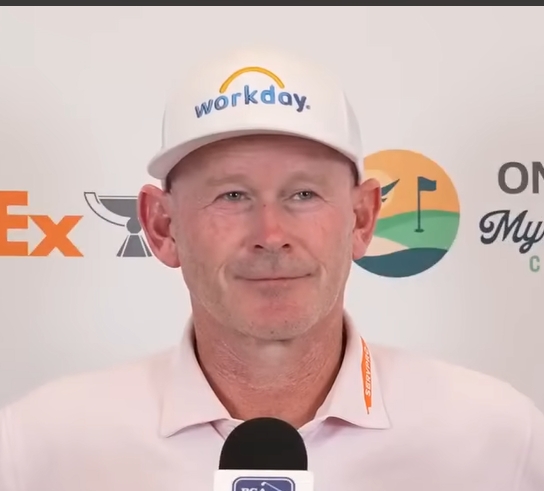
Last June, he was sitting in the Muirfield Village press tent, sporting that well-known Tennessee drawl and the faint half-smile he usually wears even when the topic is serious. To be honest, it was a little difficult to visualize the story he told. He was completely trusted by a Nashville surgeon who had purposefully broken his sternum, opened it, removed a thumb-sized chunk of hip bone, and replaced it putty made of bones Copy and paste. The entire structure remained intact and requested healing. You have to read it twice before you can believe it.
| Bio Data | Details |
|---|---|
| Full Name | Brandt Newell Snedeker |
| Nationality | American |
| Profession | Professional Golfer (PGA Tour) |
| Age (at time of surgery) | 42 |
| PGA Tour Wins | 9 |
| Most Recent Win | 2018 Wyndham Championship |
| Major Career Honor | 2012 FedEx Cup Champion |
| Career Money Rank (at the time) | No. 21 all-time |
| Diagnosis | Manubrium Joint Instability |
| Surgery Date | December 1, 2022 |
| Surgeon | Dr. Burton Elrod, Nashville, TN |
| Return Event | The Memorial Tournament, June 2023 (Muirfield Village, Dublin, OH) |
Before Snedeker said the name aloud, the majority of golfers were unaware of the condition because it is so uncommon. instability of the manubrium joint. He almost casually mentioned that over the previous fifteen years, there may have been twelve cases reported worldwide. Twelve. Snedeker had no car crash to point to for something that is typically linked to trauma from auto accidents. Only years of fluctuations. Thousands of them. It appears that the body maintains a ledger.
Hints of it were evident as early as the 2017 British Open, when he pulled out, believing he had broken something. After returning home, he ran the scans and discovered nothing clean. Although they were aware of the issue, doctors were unsure of how to address it. Thus, he succeeded. When athletes discuss pain, the word *managed* frequently appears. Usually, it refers to something more akin to *endured*. He played a sport that required torque and rotation for seven years despite having a chest joint that wouldn’t stay in place.
The surgeon, however, is the peculiar aspect of the tale. Dr. Burton Elrod was reluctant to perform the surgery. He wasn’t eager to do it again because he had already done it once in his career. Snedeker didn’t want the alternatives steel plates, screws, rods, and the hardware store method. He had a suspicion that they would simply move the pain, and he was probably correct. So he continued to inquire. Elrod finally consented. That conversation between an athlete and his physician has a profoundly human quality: one of them is certain that this is the only course of action, while the other secretly wishes he wouldn’t have to find out.
Snedeker accomplished what golfers consider nearly impossible following the surgery on December 1. He came to a halt. After essentially remaining motionless for sixteen weeks, bone was able to reattach itself to bone. It wasn’t until April that he picked up a club. It wasn’t until April 21 that he completed eighteen holes. By the beginning of May, he was returning to the level of practice he once took for granted four hundred balls in a session, four hours at a time. It was only in hindsight that it became evident that this had been unattainable for years and that the suffering had subtly changed the definition of his career.
Observing this, it seems as though Snedeker deliberately chose the Memorial as his return. There is no soft landing in Muirfield Village. The field is among the best outside of the majors every June, it’s Jack’s place, and it can be brutal at times. He could have chosen a simpler stage. He didn’t. You had the impression that he had been waiting a long time to say, “At some point you have to jump into the deep end.”
Now, the medical math is a different story. In order to earn 144 FedEx Cup points, he must compete in four events under a minor medical extension. If he succeeds, a major extension will allow him to play for the remainder of the season. He has opportunities he wouldn’t otherwise have, such as a one-time top-25 exemption, sponsor invites, and the typical benefits of a lengthy career, because he is ranked No. 21 on the all-time money list. But if the sternum doesn’t hold, it doesn’t really matter.
It’s difficult to ignore how effortlessly Snedeker now recounts the tale, sounding almost joyful about something that ought to have ended his career. Perhaps that’s the relief speaking. Perhaps it’s the peculiar clarity that follows a protracted period of agony. It remains to be seen if the smooth tempo and world-class putting that characterized his prime will return to the golf course. But for the first time in a long time, golf itself rather than the body beneath it is the question. And that in and of itself is a victory for a forty-two-year-old who had secretly believed the suffering would never end.
i) https://www.si.com/golf/news/brandt-snedeker-back-following-bizarre-experimental-surgery
ii) https://www.nationalclubgolfer.com/tour/19th-hole/brandt-snedeker-reveals-rare-surgery-pga-tour-absence/
iii) https://www.golfdigest.com/story/brandt-snedeker-experimental-surgery-sounds-like-the-most-painful-thing-ever-pga-tour
iv) https://www.golfmonthly.com/news/they-snapped-it-back-into-place-snedeker-details-gruesome-surgery-that-saved-his-career