

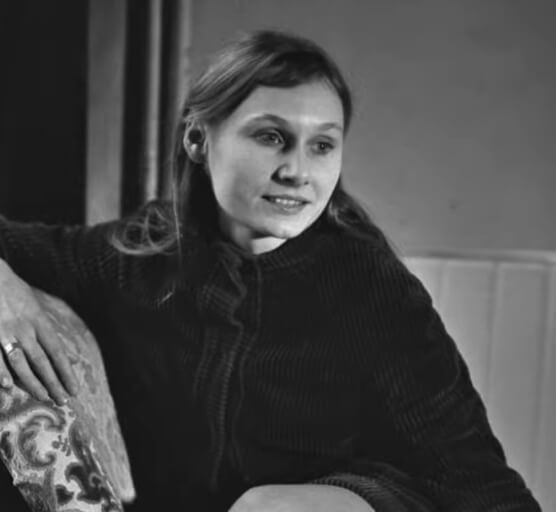
As was often the case with news about Angela Pleasence, it came quietly. There was no well-planned press release, no statement from a Hollywood publicist. The actress passed away on April 6, 2026, at the age of 84, according to a brief notice that was picked up by British outlets in early April. As of this writing, the family has yet to reveal the cause of death. Somehow, that silence seems right. Pleasence’s departure has mirrored her temperament, as she spent more than 60 years on stage and screen without ever quite pursuing the attention her father demanded.
She was eighty-four. As far as the public record shows, she hadn’t worked in front of the camera since her 2016 role as Winnie in the second season of “Happy Valley”, where she portrayed a sharp-tongued Yugoslav immigrant with that signature trembling voice. There were no final project records, no farewell interviews, and no recent reports of illness. The lack of information about her death is startling for an actress whose career spanned entire television formats, but it’s not totally shocking considering how private her life was.
| Information | Details |
|---|---|
| Full Name | Angela Daphne Anne Pleasence |
| Born | 17 September 1941, Chapeltown, Yorkshire, England |
| Died | 6 April 2026 (aged 84) |
| Cause of Death | Undisclosed by family |
| Nationality | British |
| Profession | Actress (stage, film, television) |
| Father | Donald Pleasence (actor) |
| Mother | Miriam Raymond (actress) |
| Training | Royal Academy of Dramatic Art (RADA) |
| Notable Roles | Monica Sutton (Coronation Street), Elizabeth I (Doctor Who), Winnie (Happy Valley), Catherine Howard (The Six Wives of Henry VIII) |
| Spouse | Michael Cadman (m. 1964; div. 1970) |
| Children | One son, Pascoe |
| Reference | The Guardian Obituary |
When the news broke, the British media heavily relied on her ancestry. After all, she was the daughter of the Pinter regular, Donald Pleasence, the Halloween villain, and Blofeld from “You Only Live Twice”. Throughout her life, that comparison followed her nonstop, and it continues to do so in the obituaries as well. In its tribute, The Guardian described how father and daughter sat in “identically sunken sockets” and shared “intent eyes.” The Daily Record once joked that the only roles they could play together were father and daughter. In “From Beyond the Grave” (1974) and a BBC adaptation of Trollope’s “The Barchester Chronicles” (1982), they accomplished precisely that twice.
Reading the coverage makes it difficult to ignore how few concrete medical details have emerged. British entertainment writers believe that the family wants to keep things under control, and the media have generally respected that. It is genuinely unknown if the cause was age-related, a chronic illness, or something else entirely. The lack of hospital statements and thorough timelines for celebrity deaths in this day and age is noticeable. Perhaps it’s a generational issue. Perhaps it’s just a matter of taste. Fans hoping for a definitive answer on the details will probably have to make do without it.
Instead, memory has filled the void. Social media fans of “Coronation Street” have paid special tribute to her for a four-episode run in January 1968, when she portrayed Monica Sutton, a hippie who wandered into Elsie Tanner’s home, peeled off a black wig, and asked for a tomato. Really, it was nothing. A workweekend. People recalled. That provides some insight into the type of impression she made.
Her true stronghold was television, where she consistently worked on crime dramas, horror films, and literary adaptations. She portrayed Elizabeth I in a 2007 “Doctor Who” episode, Lady Bertram in the BBC’s 1983 “Mansfield Park”, and Catherine Howard in “The Six Wives of Henry VIII”. She was once described as “beautifully gaunt, heroically dolorous” by The Guardian, a description that actors either love or secretly detest. By all accounts, Pleasence just carried on.
The obituaries don’t fully convey the intriguing tension in her career. Although she received training at RADA, she claimed that during her last term, she hardly spoke at all and instead mumbled through old-lady roles. She had a son named Pascoe, got married to actor Michael Cadman in 1964, divorced in 1970, and hardly ever talked about it in interviews. Before gradually rebuilding through stage and television, she once stated bluntly that “no one wanted me” and that she had been unemployed for years. It was not a glamorous trajectory. It was the life of a working actor, complete with dry spells and little triumphs.
American viewers may vaguely remember Martin Scorsese’s brief but impactful cameo in “Gangs of New York” in 2002, where she is shot in the chest after pulling a knife on Cameron Diaz’s character. In 2011, she played a witch in the medieval comedy “Your Highness” and had smaller parts in “The Search for John Gissing” and “The Gigolos”. Even though she won’t be remembered for any of these, her name continued to appear in credits long after many of her peers had retired.
As the reaction to her passing has developed over the past few days, it has become apparent that British acting has lost one of its true character actors the kind who anchored numerous productions but never starred in a major motion picture. Now, it seems almost irrelevant whether we ever find out the precise reason behind her demise. She left on her own terms, delivered the work, and kept her personal life private. That is a statement in and of itself.
i) https://en.wikipedia.org/wiki/Angela_Pleasence
ii) https://www.thetimes.com/uk/obituaries/article/angela-pleasence-obituary-death-mr95vvwgd
iii) https://www.theguardian.com/tv-and-radio/2026/apr/15/angela-pleasence-obituaryr