

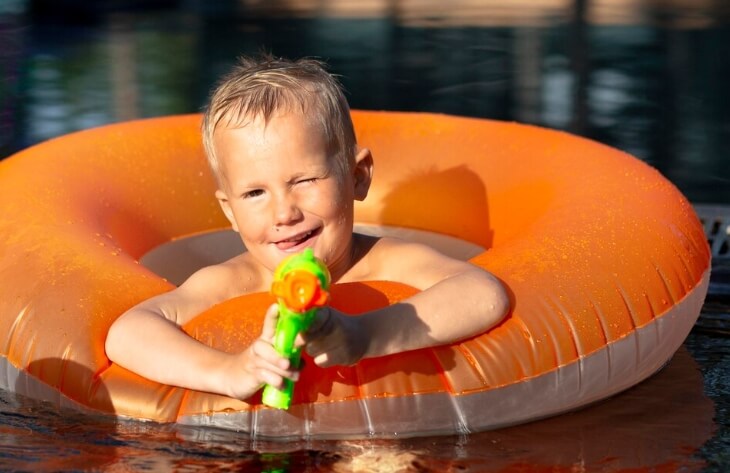
After a swim lesson, children receive a certain look. If you’ve ever waited in one of those slightly humid lobbies with a subtle chlorine and damp towel odor, you’ve undoubtedly noticed it. Hair plastered down, red-cheeked, and frequently quieter than when they entered, they emerge. Not tired-quiet. Something different. Perhaps settled.
It’s as if something has been returned to its proper place within them. Parents dismissed this as physical exhaustion for a long time. After 45 minutes of running around in the water, children naturally become calmer.
Educators, child psychologists, and an increasing number of swim instructors have begun to observe that the tranquility persists in ways that are not typically produced by exercise alone. It appears at school the following morning. It appears when it’s time for homework.
| Information | Details |
|---|---|
| Topic Focus | Children’s emotional regulation through swimming |
| Featured Organisation | Swim Design Space |
| Locations Covered | Cheltenham, Gloucester, Blakeney, Cardiff |
| Programs Offered | Swimming lessons for children, beginners, and adults |
| Key Benefit Areas | Anxiety reduction, confidence-building, emotional regulation, social connection |
| Supporting Research | UK study: 1.4 million adults report swimming reduced anxiety/depression |
| Approach | Community-led, inclusive, intergenerational swim instruction |
Sometimes it manifests when a younger sibling does something truly upsetting and the older sibling doesn’t lose it. The tired-equals-calm theory doesn’t fully capture what’s actually going on here. It turns out that swimming provides children with a structured, sensory-rich space where their nervous systems can reset, something that most contemporary environments do not.
They are carried by water. The rhythm of breathing in and out, which includes turning the face, filling the lungs, and gliding the body, resembles the breathing exercises that therapists teach anxious adults for entire sessions. Children pick it up without even realizing they are learning anything about emotion.
Teachers feel that this is more important now than it was ten years ago. Children are growing up with phones in their hands, classrooms that are more and more focused on screens, and a never-ending, low-pitched buzz of stimulation. The prevalence of anxiety in elementary-aged children has increased in the UK and other countries. And the standard recommendations more outdoor play. More sleep. And less screen time continue to clash with the realities of family life.
Instead of asking parents to break up the chaos, swimming is one of the few interventions that works. Aquatic exercise significantly improves mental health, with quantifiable reductions in anxiety and mood-disorder symptoms across populations, according to a 2022 systematic review of 18 trials. The parents who observe changes in their children are not reading journals, despite the intriguing clinical findings. They’ve noticed that swim days make bedtime easier. Meltdowns at the grocery store are less common during weeks when classes are not cancelled. Little things, but they add up.
Swimming forces a child’s attention into a single, narrow channel, which is part of what makes it unique. Underwater scrolling is not possible. A parent’s instructions cannot be partially followed while you are preoccupied with something else.
In any other situation, an adult would have to gently persuade a distracted seven-year-old to exhibit the kind of presence required by the water. It just happens here. Additionally, the mind tends to follow the body’s focus.
Teachers at locations such as Swim Design Space, which offers classes in Cheltenham, Gloucester, Blakeney, and Cardiff, discuss this without using medical terminology. They talk about children who come wound up and go loose-limbed. Six weeks later, kids who were afraid to submerge their faces in the water are bobbing under as if it were nothing.
In swimming, the fear-to-mastery arc occurs more quickly than in the majority of other physical activities, and this compression appears to affect a child’s perception of their own abilities. Observing a beginners’ class makes it difficult to ignore how much of the work is emotional rather than physical. Eventually, the arm motions and kicking start.
Persuading a child that the water won’t deceive them is more difficult. You can practically see the recalibration when that conviction lands, which is typically between weeks three and five. With their shoulders back, the same child who was unable to handle a change at school without crying exits the changing area.
Additionally, the social component is overlooked. Silently, swimming lessons teach kids to share a lane, wait their turn, and support the child who finally crosses. In writing, that sounds twee, but if you watch a class for ten minutes, you can see that the social lessons are having a significant impact.
In the pool, where the rules are less complicated and the playing field is truly level, children who have trouble making friends at school may find their first easy peer connections. Smaller than that are some of the most remarkable moments. A child who has just learned to float on their back. Lying there with their ears submerged and the world reduced to muffled echoes. Is experiencing what meditation instructors spend years explaining for forty seconds. Most likely, they were unable to express their emotions. However, the body retains memories. And that memory is there, waiting for the next time tension arises at school.
All of this does not imply that swimming is a remedy. Any parent dealing with genuine mental health issues should view the pool as a useful component of a much bigger picture, and children with severe anxiety still require professional assistance. Nonetheless, it’s remarkable how frequently families say that swim lessons were the turning point.
Not the sole thing. It was the first thing that stuck. As this change takes place in communities like the ones Swim Design Space serves, there’s a sense that something truly beneficial is taking place quietly and without much fanfare. Children are learning how to swim. Additionally, they are learning how to return to themselves, almost as a side effect.
i) https://www.swimdesignspace.com/blog/swimming-for-anxiety-stress-mental-health
ii) https://www.mother.ly/health-wellness/how-water-works-to-relax-kids-and-turn-their-moods-around/
iii) https://www.swimready.co.uk/swimready-blog/how-swimming-supports-child-development-physical-cognitive-emotional-and-social-benefits
iv) https://www.swimschoolaustin.com/can-swimming-relieve-my-childs-stress-level
v) https://www.bearpaddle.com/swimming-blog/the-mental-benefits-of-swimming-7-ways-swim-lessons-support-your-childs-emotional-wellbeing/