

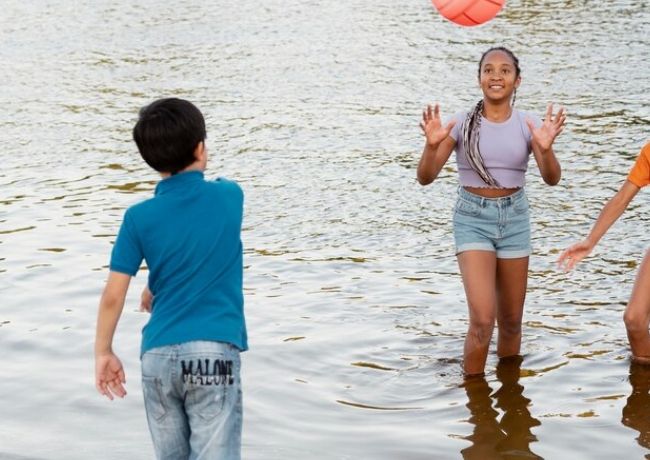
When the wind subsides and the water takes on the hue of pewter in the late afternoon, a certain silence descends upon a lake. It appears secure. More than anything, it appears “boring,” which is precisely the issue, according to those who research teen drowning. The water doesn’t appear to be dangerous. The water appears to be completely insignificant.
For years, toddlers and backyard pools, unlatched fences, and a few unsupervised minutes that resulted in tragedy were the main topics of discussion when it came to child drowning. That narrative is still relevant and true today. However, a second pattern that receives less attention has been emerging somewhere in the data. The number of teenagers drowning in open water, especially boys between the ages of 15 and 19, should worry more people than it does. Boys make up at least 80% of children who drown in open water, and teenagers between the ages of 15 and 19 account for half of all open water fatalities. It’s a peculiar kind of risk, based more on misplaced confidence than on incapacity.
| Category | Details |
|---|---|
| Topic | Teen open water safety and drowning risk |
| Most affected age group | 15–19 years old |
| Gender disparity | Roughly 80% of open water drowning deaths involve boys |
| Most common locations | Lakes, rivers, ponds, and the ocean |
| Leading cause of teen injury death | Drowning ranks third among teens 15–24, after motor vehicle crashes and falls |
| Primary risk factors | Overestimated swimming ability, lack of supervision, alcohol use, currents and depth changes |
When you speak with lifeguards who work in rivers and lakes instead of swimming pools, a common theme quickly emerges: children who get into trouble are frequently good swimmers. Not necessarily powerful ones, but competent ones. Somewhere, at some point, they’ve passed a swim test in a flat-bottomed, chlorinated rectangle with lifeguards every fifty feet. They haven’t stepped off a sandbar into water that suddenly drops six feet or felt a current pull sideways against their legs.
Instead of drowning in pools, the majority of teen and adult drownings take place in natural or open water lakes, rivers, ponds, and oceans, and the drowning rate for males increases dramatically around age 15. The skill set doesn’t seem to transfer the way everyone believes it will.
Speaking with parents who have experienced a near-miss, it seems that the fear manifests itself after the trip, after the pictures, and occasionally after a hospital stay. At a Great Lakes beach, a mother in Michigan reported seeing her son and his friends wade out past a sandbar. She was sure they were okay, but it wasn’t until someone started yelling that she realized the undertow had dragged them thirty yards down the shore. That day, no one drowned. However, she later said something that stuck: she didn’t know rip currents occurred in lakes, so she hadn’t considered asking if the beach had a rip current warning. Most people don’t.
It’s difficult to ignore how much of the risk here is behavioral rather than technical: drinking alcohol at a lake party, daring to swim to and from a buoy, and assuming that having four friends nearby serves as supervision. This is often referred to by public health researchers as “risk compensation”—the notion that skill breeds a certain reckless arrogance. Teenagers are particularly vulnerable to this trap because their brains are still developing the ability to weigh rewards and consequences.
When you add water that conceals its dangers—cold pockets, drop-offs, and currents that are invisible from shore—you get a pattern that appears in beach town news reports every summer, usually in July, and typically involves a group of friends rather than a lone swimmer.
The way families are reacting has changed, or at least appears to be changing. Advocates for water safety are moving away from the outdated toddler-centric framing and toward messaging specifically targeted at teenagers and their parents, who have begun to trust them around open water without fully understanding that the rules are different there.
The recommendations for older kids and teenagers in particular place more emphasis on being able to swim in open water, abstaining from alcohol when engaging in aquatic activities, and adhering to a buddy system rather than assuming that a crowd equals safety. Nowadays, some families view “open water orientation”—a single, supervised swim lesson in a lake or the ocean—as a distinct accomplishment from swim lessons in pools. It’s a minor change. It’s unclear if it’s sufficient.
Another, more subdued cultural undercurrent is worth mentioning. Unlike the majority of adolescent fatalities, drowning rarely makes the news unless several people perish at once. It doesn’t lead to legislation in the same way that vaping led to flavor bans or auto accidents led to seatbelt laws. However, drowning continues to be the third most common cause of injury death for individuals between the ages of 15 and 24, only surpassed by falls and auto accidents. The parents I spoke with were taken aback by that ranking, as most of them believed that drowning primarily affected young children.
It’s genuinely unclear if this moment will result in a long-lasting change in how families view lakes, rivers, and beaches, or if it will just be another summer of renewed interest that fades by Labor Day. It appears that the difference between “can swim” and “can swim “here”, in this water, under these conditions” is now something to be concerned about. Nothing has changed with the water. the assurance surrounding it.
i) https://pmc.ncbi.nlm.nih.gov/articles/PMC11861109/
ii) https://www.injuryresearch.bc.ca/news/rethinking-risky-play-lebanon
iii) https://inverellaquaticcentre.com.au/100-kickstart-towards-teen-goswim-lessons/
iv) https://www.mdpi.com/2227-7102/15/6/760
v) https://www.researchgate.net/publication/392740685_Fear_of_the_Aquatic_Environment_in_Learning_Swimming_Causes_Effects_and_Learning_Methodologies