
Why Swimming Is Becoming the First Choice for Parents of Anxious Teens Seeking Calm
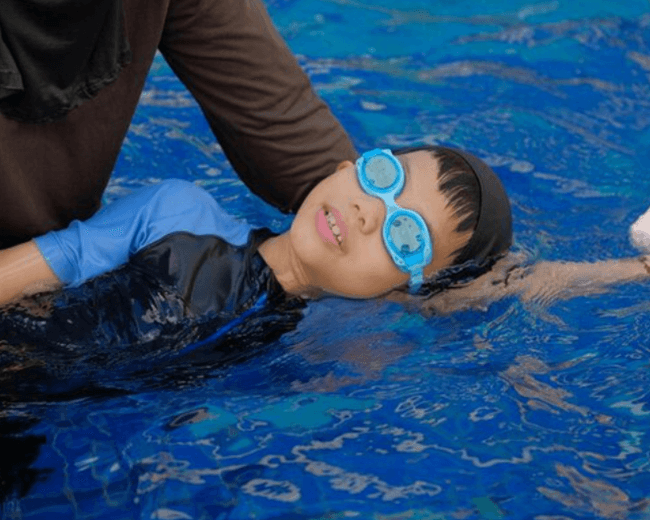
The parking lots outside the community pools are more crowded on weeknights than they were in the past. Not with birthday parties or competitive teams, but with teenagers shuffling out in hoodies while parents wait silently in cars with windows cracked, scrolling through phones, and watching steam rise from wet hair.
These are not the children who are vying for medals. Many people arrive late, avoid making eye contact, and replace their earbuds as soon as they are dry. The shoulders drop on the walk back to the car, which is a minor but telling observation made by their parents.
| Context | Key Facts |
|---|---|
| Rising teen anxiety | Anxiety and stress symptoms among adolescents have increased steadily over the past decade |
| Physical activity | Regular aerobic exercise is linked to reduced anxiety and improved mood |
| Swimming-specific effects | Rhythmic breathing, sensory immersion, and buoyancy support nervous system regulation |
| Duration matters | Around 20 – 30 minutes of swimming is associated with measurable stress reduction |
| Appeal to parents | Non-contact, screen-free, skill-based, and safety-oriented |
Sports used to be a source of conflict for families dealing with teenage anxiety. Too many people watching, too loud, and too fast. The very characteristics that anxious teens struggle with self-consciousness, fear of failure, and sensory overload can be exacerbated by team dynamics that reward aggression or continuous performance.
You don’t need a personality to swim.
There are no shouted instructions from the sidelines, no crowd noise, and no real-time comparisons while in the water. Sound is absorbed by the pool. The motions are predictable and repetitive. Where they start, laps end.
Parents use hesitant language when discussing the first few weeks. “He didn’t despise it”, “She consented to return”. Willingness is a better indicator of progress than skill. Some teenagers initially never fully submerge their heads. Coaches take note. They take their time.
Anticipation frequently fosters anxiety. What if I make a mistake? What if I’m being observed? What happens if I am unable to keep up? Swimming focuses attention on movement and breathing. Breathe in and out. Pull, turn, and reach.
It’s remarkable how frequently swimming is chosen for other types of safety rather than fitness. Parents who have endured school accommodations, medication changes, and therapy waitlists are not seeking miracles. They are searching for a solution that doesn’t exacerbate the situation.
Many claim that compared to other activities, swimming feels neutral. It isn’t theatrical. Unless you want it to be, it’s not social. You don’t have to talk to share a lane.
Parents anecdotal observations are supported by research. Swimming’s emphasis on controlled breathing helps regulate the autonomic nervous system, and rhythmic aerobic exercise has been demonstrated to lessen anxiety symptoms. Spending half an hour in the pool can reduce stress hormones and enhance the quality of your sleep the next night.
For many parents, the first shift occurs during sleep. After evening swims, teens who pace at midnight or lie awake thinking about the next day return home physically exhausted but not exhausted. According to one mother, it’s “a clean tired,” the kind that doesn’t accompany irritability.
Compared to traditional youth sports, swimming lessons for nervous teenagers typically look different. smaller groups. Not as many whistles. Teachers are trained to identify withdrawal instead of disobedience. Comfort is prioritized over competence.
The physical reality of water itself is another. Bodies sensations are altered by buoyancy. Weightless is more than a metaphor. The pool provides a rare reset for teenagers who suffer from anxiety as a persistent physical tension, such as tense chests, clenched jaws, and restless limbs.
I recall thinking about how uncommon it is to witness an environment wait patiently for a young person to enter it as I watched a teen pause at the pool’s edge for longer than I had anticipated.
Swimming is frequently referred to by parents as a “yes” activity. In a calendar full of rejections, this is a rare yes. Sure, I’ll go. Yes, I will remain the entire time. Yes, I will return the following week.
The fact that swimming is contact-free matters. No collisions. No unexpected touches. This in and of itself can make the difference between being bearable and overwhelming for teenagers with increased sensory sensitivity.
The fact that improvement is private is also important. Teens are capable of feeling progress without expressing it. swimming one more lap. floating calmly. Without pausing, turn the head to breathe.
Quietly, confidence grows.
Parents relive certain moments. “The water was warm today”, was the first uninvited remark made by a teenager. the request to purchase leak-proof goggles. the choice to go swimming rather than staying at home during school breaks.
Not all stories follow a straight line. Teenagers can stall. Some give up and come back months later. Learning a backstroke does not make anxiety go away.
However, parents mention swimming as a stabilizing activity. Something that remains constant while other supports change.
Swimming doesn’t encourage teens to discuss their emotions, in contrast to many other interventions. Resistance can be reduced just by that. Indirect processing of emotions occurs through breathing, movement, and even the simple act of completing a lap.
Swimming also has an unspoken dignity. In the pool, teenagers are not viewed as weak or damaged. They can swim. Perhaps beginners. but competent.
This is more important than it may seem.
Swimming provides an identity that is neither clinical nor competitive in a society that frequently portrays anxious teenagers as issues that need to be handled. It simply is.
Even if it works as therapy, parents don’t present it that way. For example, they say, “It helps.” The alternative is “It doesn’t make things worse.”
Many people are unaware of how low that bar is.
Families are becoming more picky about where they direct their kids’ limited energy as anxiety rates among teenagers continue to rise. Swimming consistently makes that short list because it respects boundaries without making them more rigid.
At the wall, you can pause. You are able to float. You are free to go at your own speed. Ultimately, the pool becomes more about predictability than exercise. Every time, the water feels the same. The lane lines remain unchanged. There is consistency in the rules.
That consistency can be comforting for nervous teenagers navigating an increasingly unstable world. And from behind foggy glass, parents often perceive relief as something as minor as a towel wrapped loosely rather than tightly, a longer exhale than an inhale, or a teenager who returns the following week without being asked.