

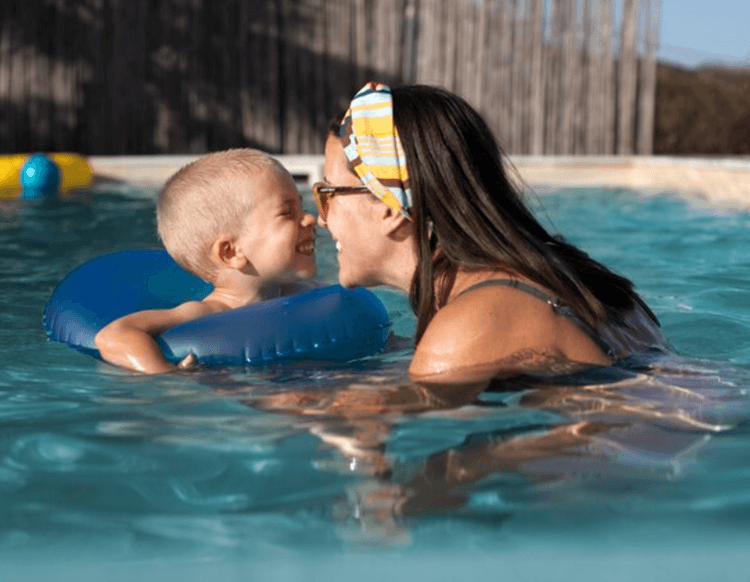
The sound of splashing water and half-heard instructions fills leisure centres throughout the UK on weekday evenings. Parents stand along the walls, holding coats and reusable cups, and watch as the lesson progresses and the tense children who arrived start to relax.
For many families, swimming lessons are now more than just a safety measure or a rite of passage; they are also a particularly helpful way to help kids deal with emotions that seem heavier, louder, and more difficult to identify than they used to.
| Key context | Details |
|---|---|
| Reported mood changes | 84% of UK parents say their child’s mood improves after a swimming lesson |
| Emotional impact | Parents report increases in calm, confidence, and emotional resilience |
| School related effects | Nearly 8 in 10 parents notice better concentration and attention |
| Stress and anxiety | Around 8 in 10 working parents say lessons reduce stress or anxiety |
| Safety dimension | 92% of parents agree swimming is an essential life saving skill |
In the last ten years, parents have become more perceptive of subtle emotional changes, observing how children can become wound tight, like springs waiting to be released, due to school pressures, hectic schedules, and continual stimulation.
In that regard, the pool provides something remarkably straightforward and incredibly powerful: a confined area where focus narrows, breathing stabilizes, and movement takes the place of explanation, enabling emotions to be processed rather than discussed.
According to recent research from Swim England, the vast majority of parents report that their child’s mood improves after lessons, which frequently carries over into more peaceful evenings and noticeably better bedtimes.
Parents describe small, consistent changes that quietly foster trust, like fewer tears over small annoyances or an unexpected willingness to talk in the car on the way home, rather than a dramatic transformation.
Children must coordinate their limbs, follow brief instructions, and time their breathing while swimming, which requires an almost archaic level of focus. The water subtly demands presence rather than distraction.
This structured physicality can be very adaptable for kids who have trouble staying still in class, providing a kind of discipline that feels effortful without being confrontational and physical rather than imposed.
Almost 80% of parents report that these benefits carry over into school life, with kids showing up to class more focused and eager to participate, as though the pool had subtly reset something inside of them.
Here, confidence is crucial and develops gradually as kids gain real world skills like floating on their own or finishing a first length achievements that feel much more tangible than academic accolades.
When a child lets go of the pool edge for the first time, trusting the water and themselves, parents tend to talk more affectionately about it, even though badges and certificates still have value.
Additionally, the sensory element is frequently brought up with caution, as if it were a luxury, but many parents say that the water’s rhythm and pressure are incredibly dependable at soothing kids who are overstimulated elsewhere.
Children who attend classes at the same time every week establish safe routines, and the predictability serves as a stabilizing factor during otherwise disjointed days.
Given that many parents report much less stress on swimming days than on other days, this consistency seems to be especially beneficial for kids who struggle with school-related anxiety.
Crucially, families are realistic about what swimming can and cannot accomplish, realizing that while it provides a useful outlet that complements other forms of support, it cannot eliminate anxiety or stop bad days.
Safety is still a constant concern that is subtly persuasive and rarely overstated, particularly as parents become more conscious of the fact that many children still do not have strong swimming skills when they graduate from elementary school.
The framing has changed, with swimming now being viewed as a means of preparation and protection that gives kids the physical tools they need while also fostering emotional resilience in a way that feels natural.
Parents report that teachers also observe these effects, noting children who appear more at ease and involved, with benefits arising from repetition rather than intensity.
This is a subtly hopeful reminder that solutions don’t always have to be novel or technologically advanced to have a significant impact.
Swimming lessons have not changed much over the years; they still involve cold water, patient teachers, and gradual progress, but they seem more and more appropriate for the demands of contemporary childhood.
Parents now spend more time by the pool, observing not only for technical advancements but also for subtle indications of relief, such as relaxed shoulders, unplanned laughter, or a desire to come back the following week.
Swimming stands out as a highly effective option, modest in promise but consistently delivering calm, confidence, and a sense of forward motion in a time when families are looking for accessible, grounded ways to support wellbeing.