

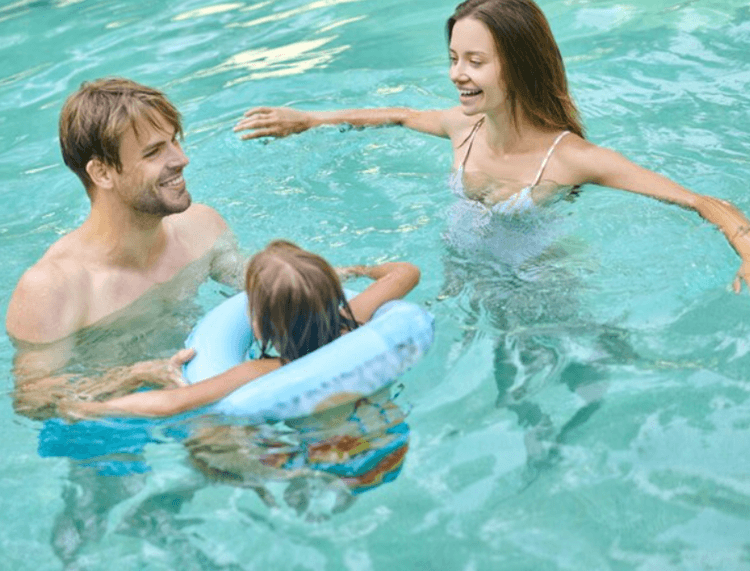
Something changes within a family at some point, usually around the third or fourth lesson. The youngest child lets go of the pool’s edge. Suddenly, a parent who hasn’t been in the water properly since their own school days remembers how to float. Nobody directly discusses it. On the way home, though, you can see it. For years, I have observed families coming and going from local swimming pools, and the pattern keeps coming up.
On paper, swimming appears to be a physical activity. In reality, it’s doing something else in silence. It’s providing a structured justification for people to converse without their phones, without the TV humming in the background, and without the typical barriers of family life getting in the way. The majority of parents I’ve talked to are unaware of it until much later. One Singaporean swim school owner told me that children learning a new stroke rarely gave her the best feedback.
| Information | Details |
|---|---|
| Topic Focus | Family bonding through swimming lessons and aquatic activities |
| Authority Reference | Swim England (national governing body for swimming in England) |
| Reference Website | https://www.swimming.org |
| Key Research Source | Griffith University, Australia (4-year early childhood swim study) |
| Health Body Cited | International Journal of Environmental Research and Public Health |
| Recommended Frequency | Weekly family sessions, 30–45 minutes |
| Suitable Age Range | Infants (6 months and up) through adults |
Mothers reported that since lessons began, dinner conversations had changed. The child had a small fear that they had named aloud and then beaten in chlorinated water, so they had something specific to describe and something to be proud of. There’s a feeling that this type of shared development, witnessed in real time from the poolside by a parent, creates a vocabulary that families don’t typically develop together.
According to data from Swim England, kids who regularly swim typically have stronger coordination and better focus than their age-appropriate peers. The more intriguing discovery which no one is quite sure how to interpret is that families who take part together later describe their relationships using different terminology. Words like “teammate” are used. Partner and coach. At the breakfast table, most parents don’t say these things about their seven-year-old.
There is a biological component to the reason for that. The bilateral coordination instructors discuss how swimming simultaneously activates both sides of the brain. Early swim instruction seemed to push kids months ahead in language and literacy benchmarks, according to researchers at Griffith University in Australia who tracked young swimmers over a four-year period.
Enhancing the rhythm in the water appears to reflect the rhythm required for listening, speaking, and reacting. It is truly unclear whether the relationship is causal or merely correlated. Primary school teachers I’ve spoken to insist they can identify swimmers in a classroom.
They look each other in different ways. Swim class mechanics compel communication in ways that are uncommon in everyday life. A child must listen to an instructor, apply what they have learned to their body, and then explain what they have learned to a parent.
The family piece takes place in that final stage. Unlike at a football practice, a father who is waiting in the gallery is unable to peruse his emails. His child is aware that he is observing, frequently just inches away from the glass.
When local statistics revealed that only sixteen percent of children in Cardiff could swim by the end of primary school the lowest rate in Wales they made headlines. The discussion that ensued had nothing to do with swimming prowess. It focused on what children were losing outside of safety and what families were losing out on.
One winter morning, while observing the Johnson family at a pool, you were able to witness the kind of family communication that is lost in the majority of contemporary homes. To keep active during the winter, they had begun taking classes together. They created their own relay race by the third month, with rules that no one else could figure out.
The father was being guided where to stand by the youngest, who might be five years old. He paid attention. At home, where everyone has a script and the hierarchy is set, that kind of role reversal hardly ever occurs. Another benefit is more subdued. People become honest when they drink water. A child cannot act as though they are not afraid.
A weary parent cannot pretend to be enthusiastic. In the US, Davina’s swim House has based a large portion of its philosophy on this concept, viewing swim lessons as opportunities for shared vulnerability rather than merely teaching new skills. The teachers there advise parents to commemorate what they refer to as “micro-wins”, which are the little things like a face submerging for the first time, since those are the moments that are worth discussing later.
After doing something courageous, a youngster wants to tell someone. The conversation would have written itself if the parent had been present. Additionally, family swim lessons foster something uncommon in contemporary parenting: a common objective that no one competes for.
Swimming is primarily evaluated against your past self, in contrast to school, where parents discreetly compare grades, or sports, where kids are ranked. In a significant way, a forty-year-old father learning to breathe sideways and a four-year-old learning to submerge her face in water are practicing the same skill. Families don’t often have the opportunity to experience that equality, even if it’s only for an hour a week.
Following a near-miss during a beach vacation, the Ramirez family began taking lessons. Safety was what drove them. According to their own description, what they received was a radical change in the way they collaborated to make decisions.
On family outings, the children now conduct safety briefings. Parents pay attention. Their conversations started at the shallow end of a community pool and now have a structure that wasn’t there before.
It’s difficult to ignore the fact that the families who consistently attend aren’t always the ones with the best swimmers. They are the ones who use the classroom as a gathering spot. Somewhere to discuss advancement.
Somewhere to rejoice. Somewhere to make mistakes in front of one another, bounce back, and try again the next Saturday. In the long run, it probably doesn’t matter if the kids start swimming competitively or never swim in another pool after they are teenagers. The habit is what endures. the common tongue. The Saturday morning ritual of showing up together, a little worn out, and heading out with something to discuss.
i) https://www.swimjim.com/blog/the-power-of-swimming-lessons-for-parent-child-bonding-and-social-interaction
ii) https://www.penguinswimschool.sg/blog/communicating-swim-goals-with-parents
iii) https://kjaquatics.com/7-reasons-swimming-lessons-should-be-your-familys-new-tradition/
iv) https://advantagesportsservices.com/blog/f/swimming-as-a-family