

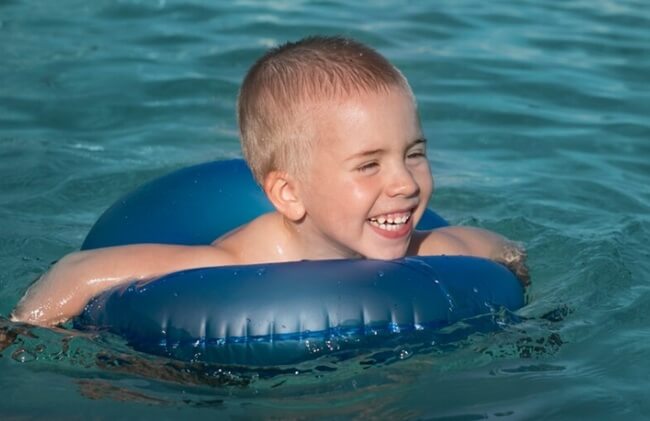
When a quiet child lets go of the wall and floats on her own for the first time, you realize something that no parenting book can adequately describe. With her phone halfway up, her mother is standing close to the bleachers, unsure whether to record or merely observe. The teacher takes a two-foot step back. The girl’s arms shake briefly before settling. She lets out a breath, opens her eyes, and smiles as if she’s just learned about electricity. It’s a brief moment and the kind of experience that rewires a child.
For years, parents have been told that praise, affirmations, and gold-star charts affixed to the refrigerator are the best ways to boost confidence. Speaking with swim instructors who have been in the business for decades, it seems that nothing compares to the pool’s effectiveness. Children are more nervous than ever when they arrive at school, and the statistics support this: over the past 25 years, children’s rates of anxiety and depression have increased by about 70%. Clearly, something is wrong. Swimming continues to come up in discussions with pediatricians and child therapists as one of the more consistently effective interventions, even though there isn’t a single solution for what’s happening to a generation raised on screens and carefully curated comparison.
Simply put, a portion of it is hormonal. Instructors frequently emerge from the pool smiling at nothing in particular because a thirty-minute swim floods the body with endorphins. That chemical reset is more important than adults sometimes realize for a child whose nervous system has been on low-grade alert all day at school. When a child returns to the changing room after class, you can see that they are sometimes hungry for the first time in hours, have looser shoulders, and are a little more talkative.
| Topic | Details |
|---|---|
| Subject | Swimming as a confidence-building activity for children with low self-esteem |
| Primary Audience | Parents, caregivers, educators of children aged 3–14 |
| Reported Rise in Childhood Anxiety/Depression | Roughly 70% over the last 25 years |
| Recommended Frequency | 2–3 sessions per week, 30 minutes each |
| Core Psychological Benefits | Self-belief, resilience, independence, reduced anxiety |
| Core Physical Benefits | Endurance, full-body strength, improved coordination, endorphin release |
| Best Starting Age | As young as 6 months for water comfort; 4+ for structured lessons |
The deeper benefit might not even be physical. It’s the encounter with a setting that isn’t totally safe by nature. Water is indifferent to your emotions. Because you’re anxious, it doesn’t soften. Additionally, a child’s internal development changes when they learn to control something that could potentially harm them. Gaining proficiency in a skill is one thing. Another is to become proficient in that skill. It’s almost spiritual, according to swim instructors at programs like Pedalheads, when a child understands that she’s the one keeping herself afloat, not the teacher’s hand under her belly.
The way swim lessons are structured also does a lot of quiet work. Swimming provides a child with quantifiable victories nearly every week, in contrast to sports like basketball or soccer, where progress is messy and dependent on teammates. Lay flat on your back. Next, glide. Next, paddle. Next, a complete lap. Every little graduation serves as a podium of its own. And those little triumphs add up to something that begins to feel like an identity for a child who has been told, whether gently or not, that she is the shy one, the slow one, or the one who stays back at birthday parties.
And there’s the issue of loneliness. Even in a group class, swimming is an oddly personal activity. The world’s noise disappears underwater. There are no siblings interjecting, no teacher waiting for a response, and no peers staring. Just movement, breath, and the gradual rhythm of recovery. That’s a unique and helpful form of quiet for a nervous child. Adults frequently overlook the fact that kids hardly ever have time to think for themselves. That is returned by the pool.
You begin to see spillover as you watch this unfold over several months. Children taking swim lessons raise their hands more frequently, according to teachers. The child who used to cry before birthday celebrations now enters without turning around, according to the parents. It’s not dramatic at all. Hollywood is not changing. It’s slower than that, more akin to the approaching tide. The rocks that were dry an hour ago are now submerged, but you can’t see it move.
To suggest that swimming is a universal remedy for childhood self-esteem issues would be naive. It isn’t. No matter how patient the instructor is or how warm the water is, some children will detest the pool. Some people just need more time, therapy, or a different sport. The pool turns into a sort of weekly testing ground for the kids who do connect with it, and there are more of them than you might imagine. A place where they are clearly and unquestionably growing more courageous than they were on Tuesday.
The story goes that before the cars began to show up in driveways, Tesla appeared to be a doomed venture. A child’s confidence functions similarly. Someone cannot be persuaded to believe in themselves by argument. Splash by splash, you have to let them earn it before taking a step back and letting them feel the consequences of their actions. It’s difficult not to think that we’ve been overcomplicating this whole thing for years when you watch a child haul herself out of the pool, dripping and proud.
i) https://blog.swimmingnature.com/why-swimmers-have-a-higher-self-esteem/
ii) https://www.carlile.com.au/five-reasons-why-swimming-builds-confident-children/
iii) https://pedalheads.com/en/blog/how-swimming-helps-kids-build-confidence-and-overcome-fear
iv) https://www.swimnow.co.uk/health-and-wellbeing/9-benefits-of-swimming-for-kids/