

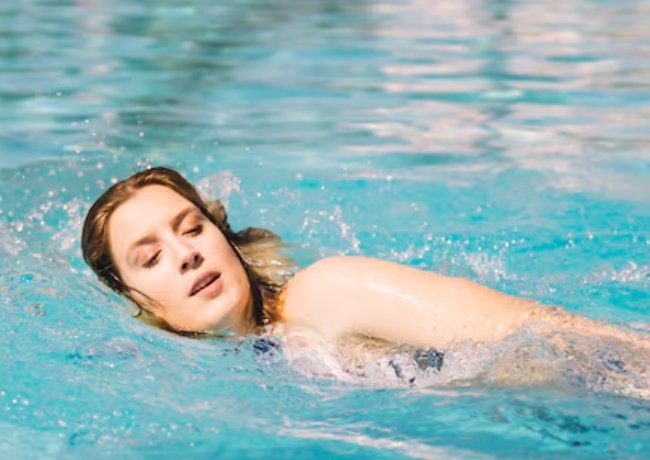
On the hottest day of the year, a certain silence descends upon a reservoir. The silence of warning signs that no one reads, not the silence of stillness by that point, the water is usually crowded with people. Half-swallowed by nettles, faded lettering on a rusted post warns you not to swim here. That silence was not intended to be disregarded. In any case, it occurs.
Like most recent summers, this one has seen its fair share of heat advisories and, predictably, drowning reports. There are sometimes subtle connections between the two. Something in the human brain changes when the temperature rises into the thirties. Water, any kind of water, begins to appear as relief. An otherwise unremarkable canal suddenly takes on a welcoming appearance. In the logic of a long afternoon in the heat, a quarry lake with “no swimming” signs becomes just a lake.
| Category | Details |
|---|---|
| Topic | Swimming during heatwave conditions |
| Primary risk | Cold water shock |
| Recommended locations | Lifeguarded beaches, pools, designated open water venues |
| Vulnerable groups | Children, teenagers, inexperienced swimmers, those with heart conditions |
| UK/Ireland annual coastal deaths | Approximately 140 people |
| Free youth safety program | Swim Safe sessions, ages 7–14 |
| Leading safety authority | RoSPA – water safety guidance |
| Key behavioral risk factor | Alcohol consumption near water |
The fact that water doesn’t heat up like air is something that is easy to forget and frequently comes up in discussions with lifeguards and water safety instructors. It is heavier, slower, and more resistant to change. In the midst of a heatwave that is approaching thirty-four degrees Celsius, a reservoir may be at twelve or thirteen degrees. The danger resides in that gap. Clinically known as “cold water shock”, jumping into extremely cold water can cause a sharp, involuntary gasp, a spike in heart rate, and occasionally panic that even proficient swimmers find difficult to overcome. This is especially true after your body has spent hours acclimating to intense heat.
People seem to be caught off guard by the involuntary part. It’s a common misconception that people who are unable to swim drown, but that’s not entirely accurate, or at least not the whole story. Your swimming certificate is not checked before cold water shock. Teenagers, triathletes, and people who have swum the same river every summer for ten years all experience it. Because the body reacts automatically, years of confidence in the water may not always matter in those first ninety seconds.
This is one of the reasons why safety organizations use language that can become monotonous as they repeat themselves season after season. Only swimming in lifeguarded areas is recommended by RoSPA. The RNLI reminds people to call 999 and request the Coast Guard if they are in trouble. Children between the ages of seven and fourteen, who are statistically overrepresented in water-related incidents during hot weather, are the target audience for Swim England’s free Swim Safe sessions, which are offered at almost thirty coastal and inland locations. This advice is not new. Every July and August, the simple physical reality of being hot and close to clean, cold water competes with this advice.
This also has a generational component that isn’t given enough attention. Swimming outside was the norm rather than the daring option prior to the widespread use of public pools. Through repetition, small mistakes, and inherited caution passed down from an older person who had witnessed something go wrong, people learned the moods of their local river in the same way they learned a neighbor’s temperament. That was altered by pools.
A sort of practical literacy about open water began to fade as they introduced a controlled, chlorinated, lifeguarded version of swimming to several generations. The crowds at practically every good swimming hole on a warm weekend indicate that wild swimming’s recent and genuine surge has brought people back to rivers and lakes, though it hasn’t always brought back that older, harder-won knowledge.
This does not imply that people should stay away from open water. Since people have been cooling off in lakes and rivers for longer than there have been swimming pools, that would be an overcorrection of its own and, to be honest, unrealistic. There is something truly restorative about it that no amount of safety messaging will discourage people from doing. The more sensible objective appears to be more specific: swimming parallel to shore rather than straight out, entering slowly rather than jumping, checking depth before committing to it, never swimming alone if possible, and interpreting a “no swimming” sign as information rather than a recommendation.
The after-effect, known as “after-drop”, which occurs after swimming and causes a person’s core body temperature to drop for several minutes as cold blood from their extremities circulates inward, is more difficult to regulate. Ten minutes later, people start shivering uncontrollably after towel-off, sometimes thinking it’s just a chill. It’s not dramatic advice getting dressed right away, starting with the torso, and having something warm to drink afterwards but it’s the kind that is seldom discussed until someone is already trembling on a riverbank, wondering what happened.
It’s difficult to ignore the pattern in how these stories are reported: every summer, a heatwave strikes, headlines alert people, no one reads them, and by September, a more subdued set of headlines about what transpired next appears. Whether or not that cycle breaks this year, or any year, is likely to depend more on whether or not people begin to approach open water with the same level of curiosity as they would any other unfamiliar terrain that is, with the kind of respect that assumes it might not be on your side.
i) https://www.swimming.org/swimengland/7-tips-stay-safe-water-summer/
ii) https://www.bbc.co.uk/newsround/articles/c202yzglk1po
iii) https://www.itv.com/news/2026-05-27/how-to-stay-safe-in-the-water-during-warm-weather
iv) https://www.theguardian.com/lifeandstyle/2022/aug/12/keep-your-cool-how-to-stay-safe-when-wild-swimming-in-a-heatwave
v) https://lifeleisure.net/blog/staying-safe-around-open-water/